

The Rural Health Transformation Program is putting billions of dollars into rural healthcare — and with it comes an expectation that things will actually change. Not just that technology will be purchased. Not just that services will be launched. But that care delivery in rural communities will be fundamentally, sustainably different.
That’s a change management challenge as much as it is a clinical, operational, or technical one. And most organization’s implementation approaches aren’t built for it.
After 25 years of helping healthcare organizations adopt innovation, the pattern is very familiar to me: a well-funded initiative with an innovative technology component launches with energy and optimism, encounters friction, and gradually loses momentum until it exists on paper but not in practice. The technology is in place. Training was delivered. But the results are not there.
The reason almost always comes down to the same thing: the approach was designed to change systems, change processes, change technology. It wasn’t designed to change the people.
A Tale of Two Minds
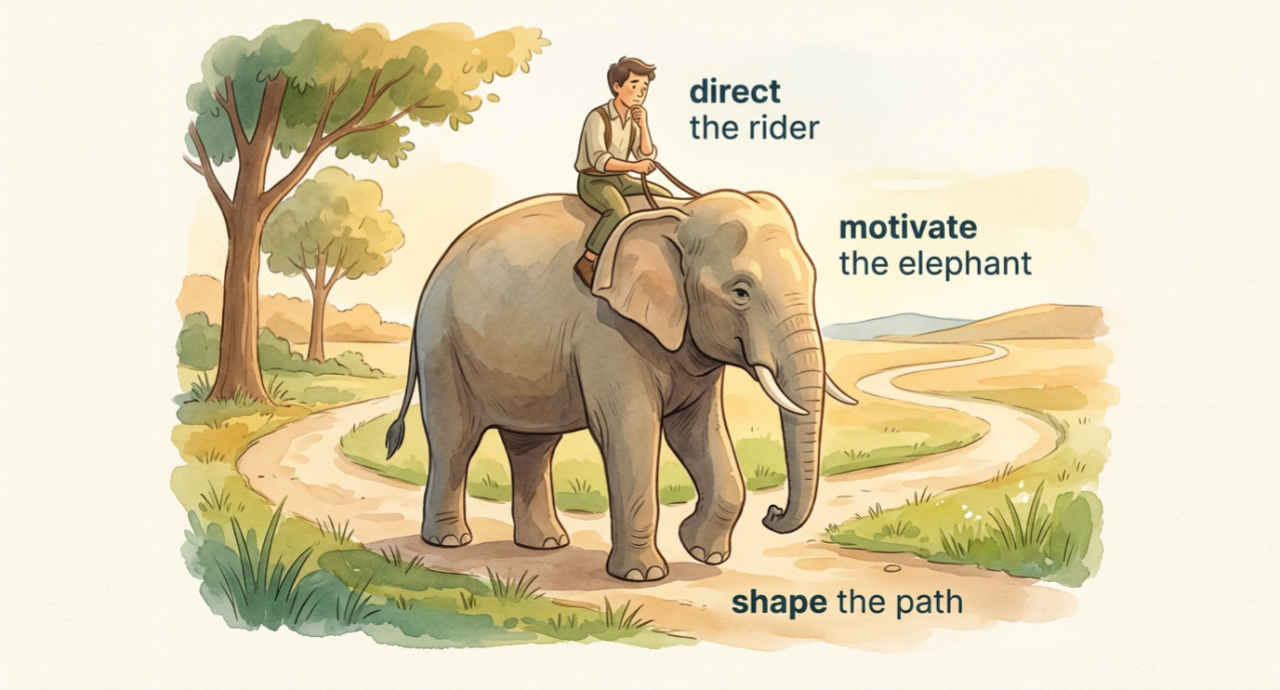
In their 2010 book Switch: How to Change Things When Change Is Hard, brothers Chip and Dan Heath offer a profound and pragmatically simple model for understanding why change is hard — and what to do about it. They describe every person as having two sides that must both be engaged for change to take hold.
The Rider is the rational mind. The Rider analyzes, plans, and decides. Give the Rider clear direction and a logical case, and it will follow: “Direct the Rider”.
The Elephant is the emotional, instinctive side. The Elephant is where motivation, fear, habit, and identity live. The Elephant is enormously powerful — and without its engagement, the Rider can pull on the reins all it wants and go nowhere: “Motivate the Elephant”.
And then there’s the Path — the environment and circumstances that make a given behavior easy or hard, natural or unnatural: “Shape the Path”.
Here’s the key insight for healthcare leaders: most implementation approaches only focus on the Rider. They include logic, rationale, timelines, and checklists. They are thorough and well-reasoned.
And then implementation stalls, even fails — because the Elephants were never considered.
Directing the Rider
The Rider’s weakness isn’t stubbornness — it’s analysis paralysis. When the path forward isn’t crystal clear, the Rider will overthink, second-guess, and spin.
When clinicians are uncertain about the clinical efficacy or validity of a new solution, they want more data. When users are inadequately trained or if the new solution is not intuitive to use, they will stall — and go back to doing it the trusted, the old way.
Based on the authors’ framework, three tactics help to direct the Rider, using video visits as an example.
Follow the Bright Spots. Before designing a new video visit service from scratch, look for what’s already working. Which clinicians are already comfortable on camera? Which workflows have already adapted? Which patient populations are already engaged? Bright spots are proof that the change is possible — and they’re a blueprint for what to scale. At Ingenium, we call this “diagnosis before prescription”: understanding what’s working before recommending what to build.
Script the Critical Moves. Ambiguity is the enemy of adoption. “We’re going to do more video visits” is not a direction — it’s a wish without a rationale. The Rider needs to know exactly what is expected: which visit types will be conducted virtually, what clinical circumstances are suitable, what the workflow looks like step by step, who does what and when. The more specific the critical moves are, the less room there is for hesitation. This is why clinical process development — defining policies, protocols, workflows, and exception scenarios before launch — is one of the six expertise areas we consider essential to any successful RHTP implementation.
Point to the Destination. People commit to change more readily when they can see where they’re going. Not just “improved access” as an abstraction, but a vivid, specific picture: “Within 12 months, every patient in our region who needs a behavioral health consultation will be able to get one within a week — without driving two hours.” A compelling destination gives the Rider something to navigate toward, and gives the Elephant something to want.
Motivating the Elephant
This is where most healthcare implementations quietly fail. The Rider gets a detailed briefing. The Elephant gets a memo.
Find the Feeling. Logic doesn’t move people to change — emotion does. What does it feel like when a rural patient can’t get to a specialist in time? What does it feel like when a clinician watches a patient deteriorate because the right support wasn’t available? Those feelings, made vivid and specific, are what move Elephants. In clinician engagement, this is why we start with stories (think: Medical Grand Rounds), not statistics. The data matters, but the story of one patient who got the care they needed because telehealth was available — that’s what creates desire to change. At one of our clients, a rural FQHC, one of the NPs was able to “diagnose” colon cancer in a 42-year old patient, and a stroke in an 87-year old woman — via video.
Shrink the Change. One of the most common mistakes in telehealth implementation is asking people to change too much, too fast. A clinician who has practiced a certain way for 20 years is not going to reinvent their entire patient interaction model in a training session. Shrinking the change means starting smaller than feels necessary: one visit type, one patient population, one afternoon a week. This is precisely the logic behind our “proof of concept” approach — a bounded, low-stakes test that builds confidence and competence before broader rollout. Small wins build the Elephant’s momentum.
Grow Your People. People change when they see themselves as capable of changing — when the identity shift has already begun. For clinicians, this is particularly powerful framing: they’re not reluctant adopters of technology, they’re innovators finding new ways to deliver excellent care. They’re not learning to do video calls, they’re pioneering the future of rural health. When clinician engagement starts with “we need you to do telehealth”, it positions change as a mandate. When it starts with “we want to design this with you”, it positions clinicians as architects of the change — and Elephants that helped build something will defend it.
Shaping the Path
Even a motivated Rider and a willing Elephant will struggle if the environment works against the change. Path-shaping is about making the right behaviors easier and the wrong behaviors harder.
Tweak the Environment. If telehealth requires a clinician to navigate to a separate system, log in with different credentials, and follow a different workflow than every other patient encounter, it will feel like extra work — because it is. The single most powerful thing an organization can do to sustain telehealth adoption is to integrate it seamlessly into existing workflows. Telehealth shouldn’t feel like an add-on. It should feel like care.
Build Habits. Change that relies on ongoing conscious effort will fade. Change that becomes habitual is sustainable. This is why we advocate for structured, repeatable routines — whether that’s a “Telehealth TechCheck” for patients doing a video visit for the first time, or a 30-minute peer-to-peer training on conducting and documenting virtual exams. The specific habit matters less than the discipline of building one. Make the new behavior routine, and it stops feeling like change.
Rally the Herd. Behavior is contagious. When clinicians see respected peers engaging enthusiastically with telehealth — not grudgingly complying with a mandate, but genuinely seeing its value — they’re far more likely to follow. This is why identifying and cultivating clinical champions is not a nice-to-have. It’s a core implementation strategy. The Herd moves together. Design with that in mind.
Why This Matters for RHTP
The Rural Health Transformation Program is an extraordinary opportunity — but only for organizations that understand what they’re actually being asked to do. The program doesn’t fund the purchase of technology. It funds the transformation of care delivery. That’s a people challenge dressed in a technology budget.
Have you looked up the definition of transformation? Oxford Languages defines it as “a thorough or dramatic change [in form or appearance]”. So, to achieve true rural health transformation, we need to employ the best tools to manage the “thorough change”, the “dramatic change”.
Every RHTP initiative will involve clinicians who need to learn new skills, staff who need to redesign workflows, patients who need to change how they access care, and leaders who need to sustain momentum through the inevitable friction of change. None of that happens through procurement. All of it requires deliberate, conscious attention to the Rider, the Elephant, and the Path.
The organizations that will deliver on RHTP’s promise are not the ones with the best technology. They’re the ones that understand how people change — and plan accordingly.
Next in the series: The ADKAR Model — why the sequence of change matters as much as the change itself, and what goes wrong when you skip a step.

To receive articles like these in your Inbox every week, you can subscribe to Christian’s Telehealth Tuesday Newsletter.
Christian Milaster and his team optimize Telehealth Services for health systems and physician practices. Christian is the Founder and President of Ingenium Digital Health Advisors where he and his expert consortium partner with healthcare leaders to enable the delivery of extraordinary care.
Contact Christian by phone or text at 657-464-3648, via email, or video chat.