

Hands-On Guidance for rural hospital and health center CEOs navigating their state’s $1 billion transformation opportunity.
The Rural Health Transformation Program represents the largest federal investment in rural healthcare transformation in decades. With $50 billion flowing to states over the next several years, rural hospitals and health centers have an unprecedented opportunity to fundamentally strengthen their care delivery capabilities.
But here’s what we know from 15 years of rural health implementation: technology and vendor funding alone doesn’t create transformation. Sustainability — the kind that delivers measurable, lasting value that CMS will be looking for — stems from building a culture of innovation integration and performance management that drives continuous optimization long after the grant period ends.
The challenge? Most RHTP funding will be used to launch entirely new care delivery services. The examples are endless across primary care, behavioral health, maternal health, EMS services, and chronic care management.
While rural leaders (mostly) excel at running existing operations and perhaps optimizing them, very few rural healthcare organizations have staff experienced in successfully launching new initiatives.
⚡This gap between operational excellence and launch expertise is where most transformation efforts stumble.⚡
The Hidden Complexity of “New”
When we talk about launching new telehealth services, remote patient monitoring programs, or AI-enabled clinical tools through RHTP funding, we’re not just talking about buying technology and flipping a switch. We’re talking about orchestrating six distinct areas of expertise:
(1) Change Management Mastery: Successfully appealing to the hearts and minds of clinicians, staff, and patients to engage them in making fundamental changes to how care is delivered and received. This goes far beyond sending an email announcement or holding a staff meeting. It requires systematic approaches to communication, training, and reinforcement.
(2) Project Management Excellence: Planning and executing all necessary steps to verify need, design solutions, develop workflows, validate approaches, launch services, market to patients, and sustain operations. This isn’t the same as managing your daily operations—it’s a completely different skill set requiring structured methodologies and proven frameworks.
(3) Clinical Process Development: Designing the actual processes, policies, and workflows for new services — including planning for alternative and exception scenarios when things don’t go as expected. Your emergency protocols won’t help when your RPM system goes down or your telehealth platform experiences connectivity issues during a critical consultation.
(4) Clinical Protocol Development: New technology and services require new clinical protocols and guidance. How do clinicians effectively conduct virtual exams? What are the decision trees for escalating RPM alerts? How do we maintain quality standards across hybrid care delivery models?
(5) Technology Integration Expertise: Effective vendor selection, seamless integration with existing systems, and ongoing performance monitoring. This requires understanding not just what technology can do, but how it fits into your specific clinical and operational environment.
(6) Mindful Rollout to Position for Sustainable Scalability: Building a performance measurement and optimization culture from day one, rather than treating launch as the finish line. Launching mindfully through a proof of concept that validates assumptions on a small scale and fine tunes the solution. Scaling deployment and ensuring sustainability through the active management of key performance metrics such as utilization, satisfaction, outcomes, and savings or revenue.
Most rural healthcare organizations have deep expertise in clinical care and operational management. But launching new services? That’s a different game entirely.
The Four Paths Rural CEOs Will Take
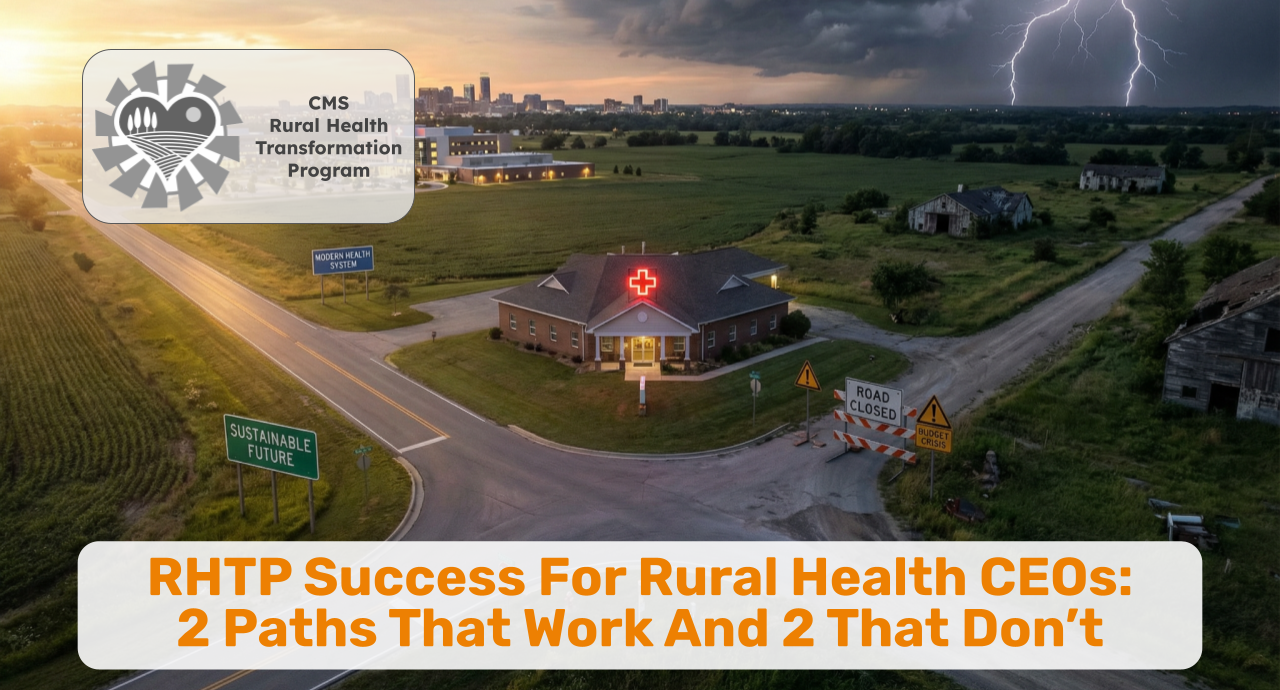
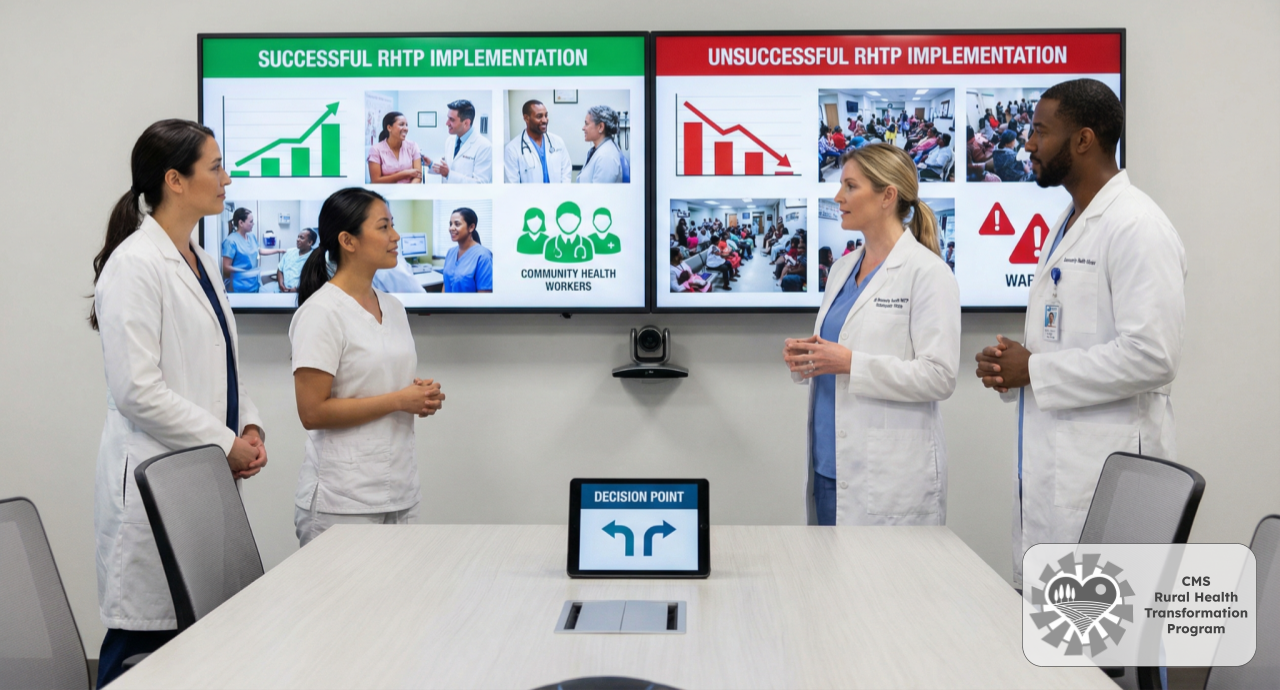
To launch new services or integrate digital health innovation as part of the Rural Health Transformation Program, rural healthcare organizations will go about it in one of four distinct ways. But here’s what we’ve learned from observing dozens of implementations: only two of these approaches reliably deliver sustainable results.
Path One: Leveraging Proven Internal Capacity (✅ WORKS)
The path that is most likely to succeed is one for organizations that have the expertise and bandwidth in-house with a demonstrated track record of successfully rolling out new initiatives and launching new services. If your team has managed complex implementations before, if your staff readily embraces change, and you have dedicated project management resources, then this is the path to proceed with
This path works when:
-
You’ve successfully launched major clinical or operational initiatives in the past 3-5 years
-
Your leadership team includes individuals with formal project management training
-
Your organizational culture actively supports innovation and change
-
You have sufficient bandwidth to manage implementation without compromising existing operations or other initiatives already underway.
Key success factors: Establish dedicated project teams, implement structured project management methodologies, create robust change management communications, and build in continuous performance monitoring from day one.
Path Two: The Vendor Reliance Approach (⚠️ PRONE TO FAIL)
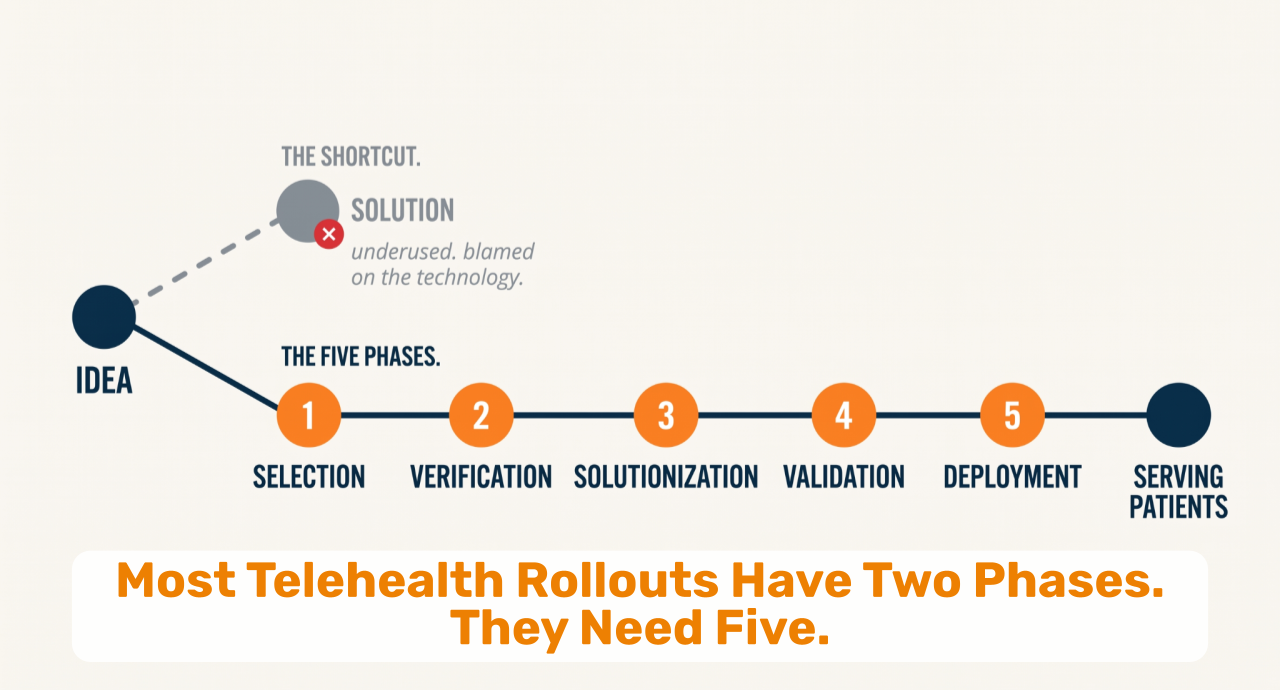
This path is the one that most in rural health will try to take. With little experience in digital health technologies paired with very limited staff capacity for managing the launch, many leadership teams will optimistically rely on the telehealth, digital health, AI vendor to integrate their solution not only technically, but also clinically, operationally, and culturally. As I explained before — in most cases that is not the role a vendor can play. That’s a trap.
Why this typically fails: Vendors excel at demonstrating technology capabilities, but they lack deep understanding of your specific clinical environment, staff dynamics, and patient needs. Their implementation playbooks are generic, not tailored to rural healthcare realities and not tailored to each clinic’s or hospital’s unique culture. Most importantly, they’re incentivized to focus on technology adoption rather than sustainable practice transformation.
The critical missing element: Clinician and staff engagement. Vendors can install systems and provide basic training, but they can’t create the cultural buy-in necessary for long-term success. When implementations feel imposed rather than collaborative, adoption suffers and sustainability becomes nearly impossible.
Path Three: Hope-Based Implementation (❌ DOESN’T WORK)
In this also quite common path, organizations take the funding, assign responsibility to individuals with seemingly sufficient bandwidth and propensity, secretly hope vendors will handle the complex parts, and cross their fingers for success.
Why this fails consistently: Initial enthusiasm gives way to mounting complexity, vendor solutions don’t integrate as smoothly as promised, staff resistance emerges, patient adoption lags, and measurable outcomes fall short of program requirements.
The financial reality: CMS requires states to demonstrate measurable outcomes from RHTP investments. When implementations fail to deliver, there’s increasing scrutiny around fund utilization. States may face clawback requirements, which they’ll pass down to participating organizations. But by then, the money has been spent filling operational budget gaps rather than building sustainable capabilities.
Path Four: Strategic Technical Assistance Partnership (✅ WORKS)
In the absence of the in-house skillsets (as in the first path), the organization secures temporary Technical Assistance from experienced professionals who specialize in healthcare transformation and have proven track records with rural implementations of new services. This creates a bridge between your internal capabilities and the specialized expertise required for successful launches.
This path works when Leadership
-
acknowledges the expertise gap without trying to fill it permanently
-
is committed to building internal capability during the implementation process
-
selects partners based on rural healthcare experience, not just technical credentials
-
maintains ownership of strategic decisions while leveraging external implementation expertise
Key advantages: Access to proven methodologies, accelerated timelines, reduced implementation risk, and knowledge transfer that builds internal capabilities for future initiatives.
The Critical Success Factor Across All Approaches
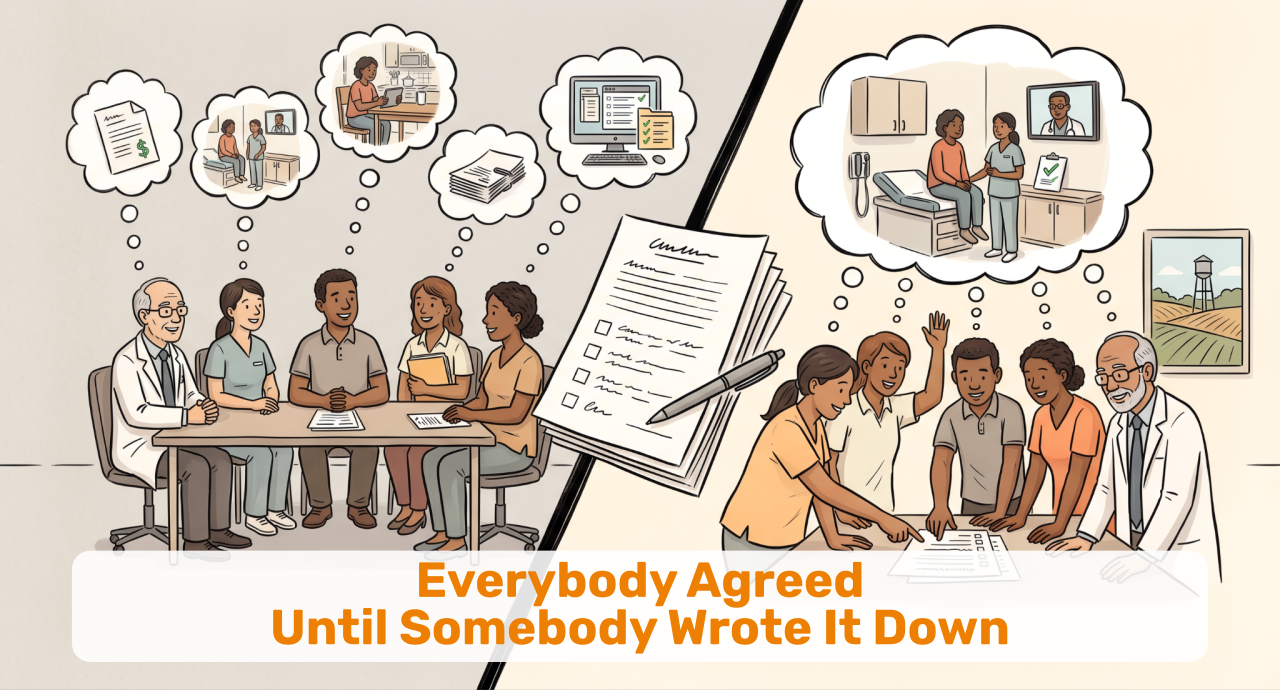
Regardless of which path a rural health organization pursues, one element is absolutely critical: meaningful clinician and staff involvement throughout the entire process.
This isn’t about getting buy-in for decisions already made. It’s about engaging your clinical teams as partners in designing new care delivery models. Their insights about workflow realities, patient needs, and operational challenges are essential for creating solutions that actually work in practice.
Paths Two and Three consistently fail this test. Vendor-driven implementations and hope-based approaches rarely create the collaborative environment necessary for meaningful staff engagement. Without this engagement, you might achieve technical implementation, but you won’t achieve practice transformation.
Building Your Strategic Foundation
Before selecting your approach to leveraging the RHTP funding to implement new services, senior leaders must establish clarity around three foundational questions:
Strategic Alignment: How does this RHTP investment advance our organization’s core mission and long-term sustainability goals? Technology for technology’s sake doesn’t create value. Winning the hearts and minds of clinicians and staff is crucial for success and strategic alignment helps.
Performance Framework: What specific, measurable outcomes will define our success, and how will we track progress throughout implementation and beyond? Hope is not a measurement strategy.
Cultural Readiness: How prepared is our organization to embrace the changes required for success? An honest assessment here prevents painful surprises later.
The Path Forward
The RHTP opportunity is real, substantial, and time-limited. Organizations that choose Paths One or Four — with clear-eyed assessment of their capabilities, honest acknowledgment of expertise gaps, and systematic approaches to implementation — will create lasting value that extends far beyond the grant period.
Those that default to Paths Two or Three will likely find themselves explaining to CMS why their measurable outcomes fell short of expectations or stated goals.
The choice lies with leadership. But they must choose deliberately, with full understanding of what successful transformation actually requires.
Patients, clinicians, staff, and rural communities deserve nothing less than the most thoughtful, strategic approach to this unprecedented opportunity.
Please share this article with rural health leaders in your network.
Which path will your organization take? Want to talk through which approach would work best for your organization? Then set up a complimentary chat with Christian!

To receive articles like these in your Inbox every week, you can subscribe to Christian’s Telehealth Tuesday Newsletter.
Christian Milaster and his team optimize Telehealth Services for health systems and physician practices. Christian is the Founder and President of Ingenium Digital Health Advisors where he and his expert consortium partner with healthcare leaders to enable the delivery of extraordinary care.
Contact Christian by phone or text at 657-464-3648, via email, or video chat.