

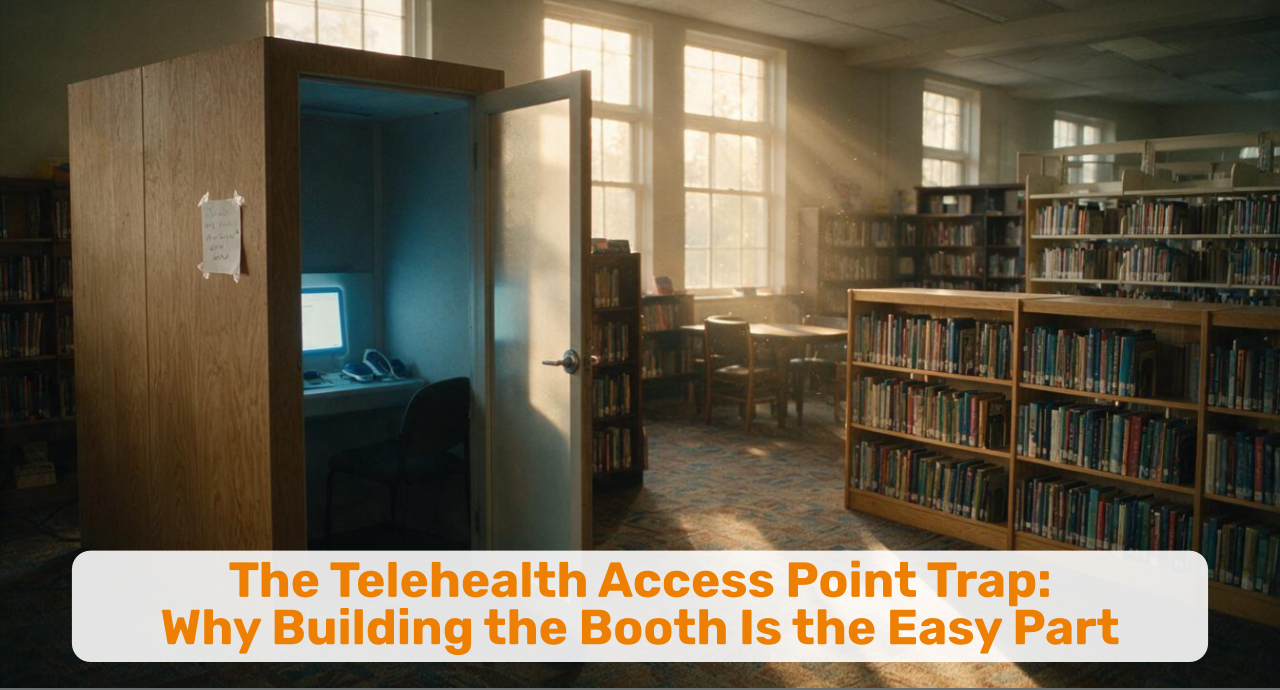
Somewhere in America right now, there is a beautifully designed telehealth access point sitting largely unused in a library corner, a community center hallway, or a pharmacy waiting room. The lighting is warm. The room has been UV disinfected. The frosted glass door offers privacy. A laminated instruction card is taped to the monitor. And almost nobody uses it.
This is not a technology problem. It is not an architecture problem. It is not even a reimbursement problem. The utilization problem at the heart of the telehealth access point movement is a human problem, and it is far more stubborn than any of the design challenges that precede it.
That is the hard truth that too few planners, vendors, and well-meaning policymakers are recognizing — or if they do, willing to say out loud.
What a Telehealth Access Point Is — and What It Promises
A telehealth access point (TAP) is a dedicated physical space — a booth, a kiosk, a converted room — where patients can connect with a clinician via video when they lack the technology, connectivity, or privacy to do so from home. The promise is compelling: bring the visit to the people who need it most — rural residents, agricultural workers, elderly patients, low-income families — by meeting them where they already go.
Libraries. Pharmacies. Community centers. Church halls. Student housing.
The logic is sound. The equity argument is real. And the design challenges — lighting, acoustics, ventilation, sanitation, accessibility — are solvable. Good engineering can handle all of them: warm LED lighting mounted at eye level, a quality speaker system that doesn’t flatten a clinician’s voice into a tinny phone call, a ramp for wheelchair access, surfaces that wipe down easily, space for two people to sit side by side — because a caregiver, a spouse, or a parent often needs to be in the frame.
These details matter for the patient experience once someone is inside the booth. But they are, ultimately, the easy part.
The Utilization Trap: Aiming at the Wrong Population
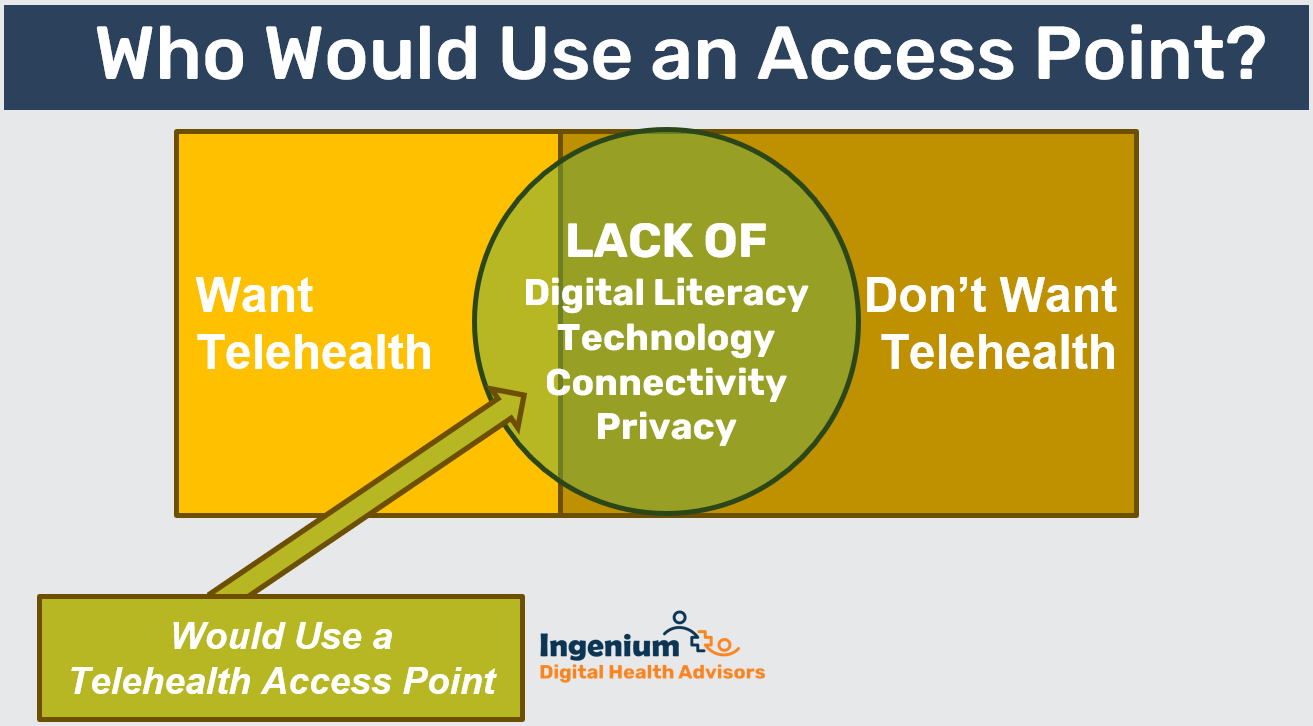
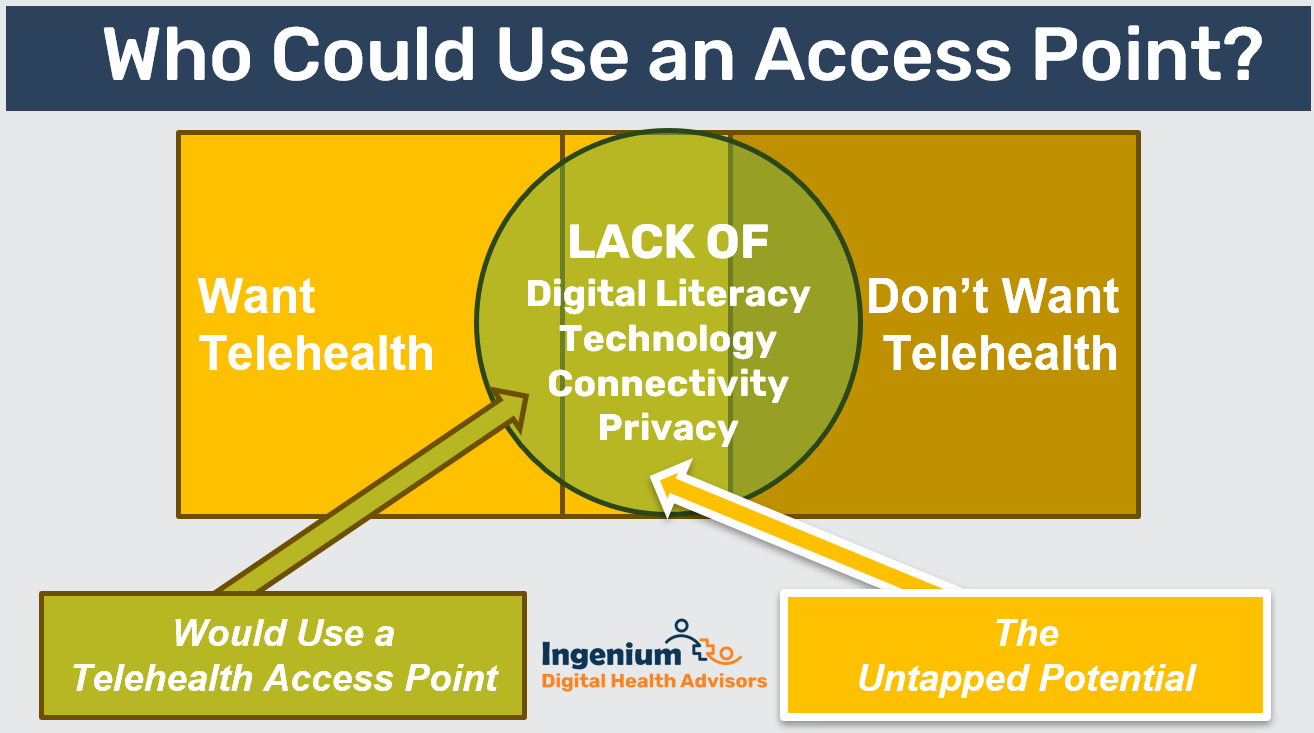
Here is the insight that most TAP deployments miss entirely — and it is best understood visually.
Picture the population of patients in a given community. On one side are those who want telehealth. On the other are those who don’t. Sitting in the middle, overlapping both, is a group defined not by attitude but by circumstance: people who lack digital literacy, technology, connectivity, or privacy.
The conventional assumption is that a TAP serves the overlap between “want telehealth” and “lack the means” — the patients who are motivated but blocked by practical barriers. And that population does exist. But it is smaller than almost anyone building a TAP expects. Because here is the uncomfortable truth: most people who want telehealth already have the tools to do it. They have a smartphone, a data plan, and enough digital confidence to click a link. They do not need a booth.
The patients who don’t have those things are, in large numbers, also the patients who don’t want telehealth. And this is not coincidence. The lack of digital literacy, technology, connectivity, and privacy is not just an access barrier — it is the root cause of the reluctance itself. People do not want to try something they have never seen work. They do not want to look incompetent in a public space. They do not want to trust a technology-mediated encounter with a system they already have complicated feelings about. The barrier and the resistance are the same thing.
This means that a TAP aimed only at the narrow existing overlap between “want” and “lack” is aimed at the smallest possible target. It explains why so many thoughtfully designed, well-intentioned access points sit underutilized despite genuine community need.
The answer is not to abandon the TAP. It is to fundamentally rethink what the TAP is for.
TAP DANCE: A Different Mission
We call this reframe the TAP DANCE model: Driving Adoption through Nurturing Care Experiences.
The insight is this: the telehealth access point’s most important job is not to serve patients who already want telehealth. It is to grow the population of patients who want it — by giving reluctant, digitally hesitant individuals a first experience so supported, so comfortable, and so successful that it dissolves the barrier that was generating the resistance in the first place.
One good experience changes everything. A patient who has never done a video visit and is afraid of looking incompetent, guided through a five-minute orientation by a trusted community navigator, connected successfully to their own clinician, and able to see and hear clearly — that patient leaves the booth different from how they entered. They have evidence now. They have confidence. And they will tell three people.
That is the TAP DANCE: not a service delivery channel, but an adoption on-ramp. Not a convenience for the already-converted, but a conversion experience for the not-yet-convinced.
What Makes the DANCE Work
The “nurturing” in TAP DANCE is not decorative. It is the mechanism. And it depends on three interlocking elements.
The Navigator. Not a clinical navigator in the formal sense — a trusted community guide who is already embedded in the lives of the patients you are trying to reach. For seasonal agricultural workers, this might be a nonprofit caseworker who helps them find housing and navigate bureaucracy. In a small rural town, it might be a library staff member trained to offer a five-minute booth orientation. The navigator does not need to know telehealth deeply. They need to know the patient — and be trusted by them. That trust is the bridge across the threshold.
The Referral Loop. The single most powerful driver of telehealth adoption is a clinician recommendation. When a physician says, “For your next visit, we can do this over video — and if you don’t have the setup at home, there’s a booth right at the library that someone can walk you through” — that is when the reluctant patient considers it for the first time. This means the TAP cannot be a standalone installation. It must be woven into the clinical workflow. Schedulers should offer it as a standard option. EHR flags should prompt the question at every relevant touchpoint.
The Easy Link. Once a patient is inside the booth, the experience lives or dies on one question: how do they actually connect to their clinician? This sounds simple. It is not. Most telehealth video platforms generate a unique link per visit — which means that link has to somehow arrive on the booth computer before the patient sits down. For a booth dedicated to a single clinic, there are workable solutions: a persistent room link, a standing virtual waiting room. But for a community access point serving multiple clinical partners — and potentially social services, benefits enrollment, or other agencies — the problem multiplies. Each provider needs a reliable, patient-facing connection pathway.
Our approach is straightforward in concept, though it requires careful implementation: the booth desktop is configured with clearly labeled shortcuts linking directly to each provider’s virtual waiting room. The patient sits down, sees a simple set of easy buttons — their clinic, their specialist, their social services agency — clicks once, and is in the waiting room. The complexity is invisible. The experience is clean. This kind of intentional connection architecture is what separates a booth that works from one that creates a new barrier at the moment it matters most.
Where to Put the Booth
Our TAP DANCE mindset also reframes the location question. The goal is not to find the most visible location — it is to find the most trusted one, where the navigator already lives and where the target population already goes.
Burger King does not open stores across town from McDonald’s by accident. They go where people already are buying fast food. Telehealth access points need the same logic applied with discipline: study the community first, then select the location. Where do underserved residents go when they are not at home or at work? Is there a cultural center? A church that serves as a social anchor? A pharmacy they visit weekly? A farm office where seasonal workers check in? A County Health Department?
The form factor matters far less than the context. A converted meeting room with a monitor, a good light, and a lockable door is every bit as functional as a $30,000 commercial kiosk — and often more trusted, because it does not look like a television studio and is better sound insulated, too. Complexity and gadgetry intimidate the very patients you are trying to reach. A blood pressure cuff and a pulse oximeter bolted to the wall signals “medical procedure.” A clean desk, a warm light, and a familiar face signals “you can do this”.
A TAP placed in a wealthy neighborhood where everyone already has broadband and a smartphone is a show pony. A TAP placed in a community with genuine access barriers, paired with a navigator, a referral loop, and a set of easy links — that is a TAP DANCE.
The Harder, More Important Work
None of this means telehealth access points are a bad idea. They are a good idea with a hard implementation problem — which is precisely the kind of problem that the RHTP is designed to help states and health systems address. The program’s emphasis on access, equity, and community integration maps directly onto what TAPs can accomplish when deployed well.
But “deployed well” means starting with the human system, not the hardware. It means asking: Who is going to refer patients to this booth? Who will walk someone through their first visit? What does the navigator relationship look like in this community? How will we know if adoption is growing — not just visit volume, but the size of the “want telehealth” population itself?
Every system is perfectly designed to get the results it gets. A telehealth access point installed without a referral pathway, without a navigator, and without a nurturing first-experience protocol is a system designed to sit unused. Change the system — and the booth becomes what it was always meant to be: not just a bridge to care, but a bridge to wanting care delivered this way.
That is the promise of TAP DANCE. And it is worth getting right.
If you are working on community access strategies as part of your state’s RHTP planning or implementation, Ingenium would welcome the conversation. Reach out at ingeniumdigitalhealth.com.

To receive articles like these in your Inbox every week, you can subscribe to Christian’s Telehealth Tuesday Newsletter.
Christian Milaster and his team optimize Telehealth Services for health systems and physician practices. Christian is the Founder and President of Ingenium Digital Health Advisors where he and his expert consortium partner with healthcare leaders to enable the delivery of extraordinary care.
Contact Christian by phone or text at 657-464-3648, via email, or video chat.