

Why most programs plateau — and what it takes to reach the top
Rural health systems across the country are now sitting on a significant opportunity. The CMS Rural Health Transformation Program has made it possible to invest in telehealth infrastructure at a scale that simply wasn’t available before — video visit platforms, remote patient monitoring (RPM) programs, community telehealth access points, and more.
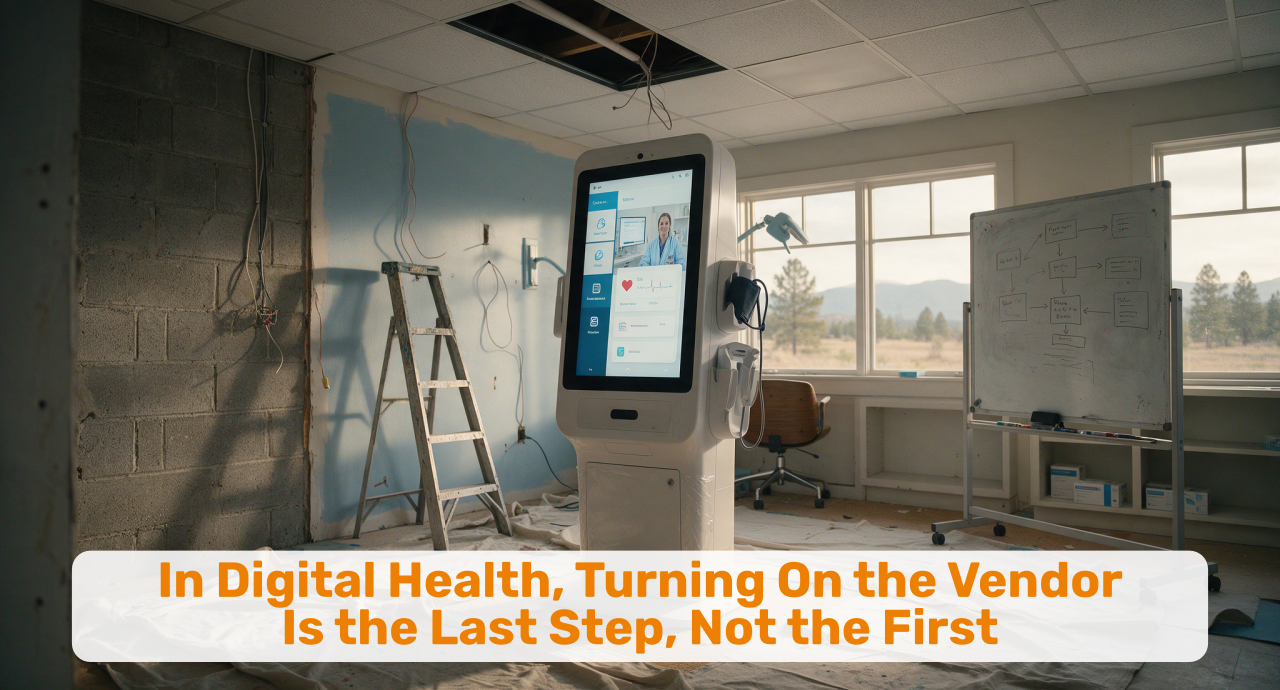
But funding doesn’t automatically translate into extraordinary care. In fact, the organizations that struggle most with telehealth aren’t struggling with money. They’re struggling with something more fundamental: they’ve built on an incomplete foundation.
There’s a framework most of us encountered in our education that turns out to be remarkably useful here.
Maslow’s Hierarchy — Applied to Telehealth
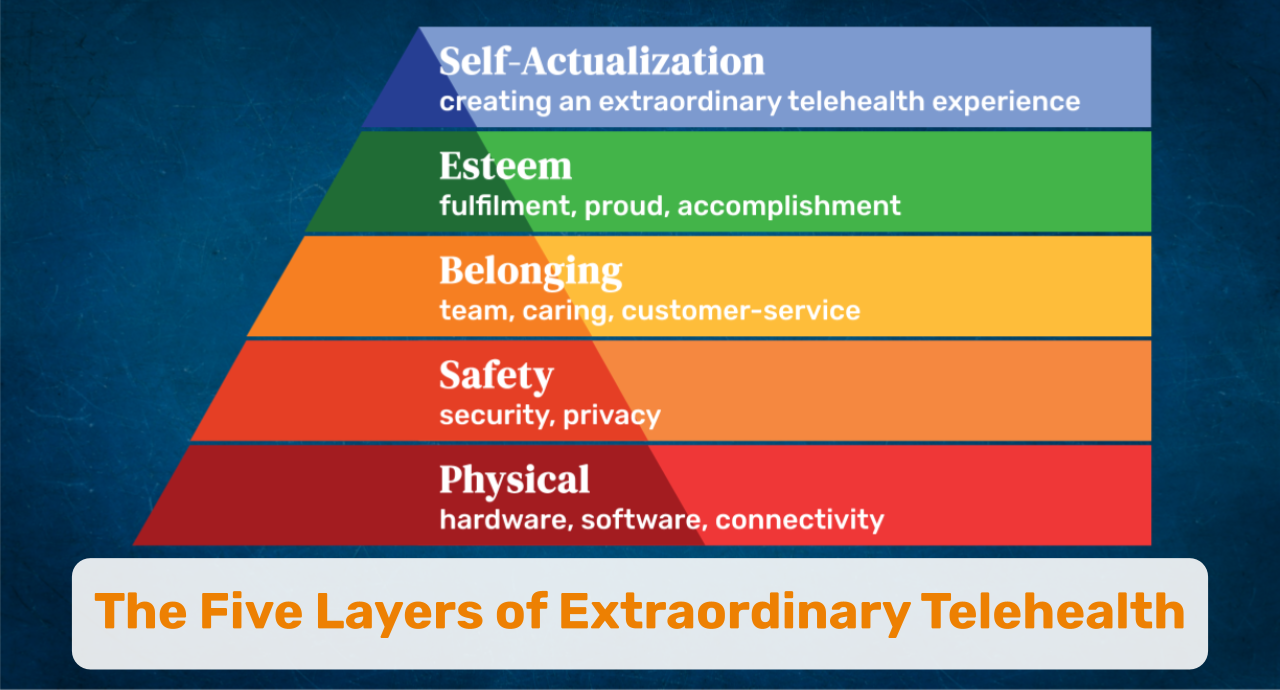
Abraham Maslow’s hierarchy of needs describes a layered model of human motivation. At the base are physiological needs — breathing, food, water, sleep. Above that, safety. Then belonging, esteem, and finally self-actualization: the ability to reach one’s full potential.
Maslow’s central insight wasn’t just about what people need. It was about order. You cannot sustainably operate at a higher level until the lower levels are met. A person who can’t breathe isn’t thinking about self-esteem.
That same principle — and that same ordering — applies directly to telehealth. Organizations that skip layers don’t reach extraordinary care. They plateau, backslide, or burn out clinicians and patients trying to navigate a broken experience.
There are five layers in the Telehealth Hierarchy of Needs.
Layer 1: Physical — The Foundation
At the base of extraordinary telehealth are the physical requirements — everything that has to work before a single visit can happen.
On the clinician side, that means adequate hardware: a good monitor, webcam, microphone, speakers, proper lighting, and a computing device with the processing power to handle video smoothly. On the patient side, it means equivalent access — a device that works, in a space that works and is private.
It also means reliable connectivity on both ends. Not just bandwidth — which determines audio and video quality — but latency, which determines whether the conversation feels like a conversation or a frustrating game of talking over each other.
And it means software that delivers a good experience before, during, and after the visit. Not merely software that functions — software that doesn’t get in the way.
RHTP funding can directly address this layer. Equipment grants, broadband infrastructure investments, and community telehealth access points all resolve Physical-layer gaps. For many rural health systems, this layer is now within reach in ways it wasn’t three years ago.
But it’s only the foundation.
Layer 2: Safety — What People Need to Trust the System
Once the technology physically works, the next question is whether patients and clinicians feel safe using it.
Safety in telehealth has three components:
Security — the technical protection of the connection and the patient’s health information. Encryption, secure platforms, HIPAA-compliant workflows. Patients and clinicians need to know that what happens in a virtual visit stays between them and their care team.
Privacy — not just digital, but physical and contextual. Can a patient speak candidly without being overheard? Is the clinician in a space that conveys appropriate confidentiality? Is sensitive information visible to others on either end?
Cost — both for the organization and for the patient. Telehealth that is technically available but financially inaccessible isn’t really available. This includes platform licensing fees, reimbursement coverage, and the patient’s out-of-pocket burden. For rural populations — where insurance gaps and financial strain are common — cost is a real safety-layer barrier.
RHTP funding can address cost barriers significantly. But security and privacy require deliberate process design, not just money.
Where Does Your Program Stand?
Before investing in the next layer, it’s worth knowing which layer you’re actually on. Most organizations assume they’ve cleared the foundational levels. Many haven’t — not fully.
Here’s a sample from our Telehealth Hierarchy Readiness Assessment. Two layers, a handful of questions. Be honest.
Physical Layer
-
When a patient joins a video visit from home, do you actually know what device and connection they’re using — or do you find out when the call fails?
-
Do your clinicians have a dedicated, properly lit, acoustically adequate space for telehealth — or are they working from wherever they happen to be?
-
Does your telehealth software allow patients to join without downloading an app, creating an account, or calling IT for help?
Safety Layer
-
Do your patients have a genuinely private space when they connect — and does your intake process ask about this, or assume it?
-
Can your clinicians confirm, before a visit begins, that the connection is secure and that PHI is protected end-to-end?
-
Are you capturing telehealth reimbursement for every eligible service you’re delivering — or are revenue gaps hiding in your billing workflow?
If any of those questions gave you pause, you’re not alone. Most rural health programs have gaps in the first two layers that RHTP funding can help resolve — but only if those gaps are identified before the money is committed.
Our full Telehealth Hierarchy Readiness Assessment covers all five layers — Physical, Safety, Belonging, Esteem, and Self-Actualization — and gives your leadership team a clear picture of where your program is strong, where it’s vulnerable, and what to address first.
Send me an email if you’d like to go through the full assessment.
Layer 3: Belonging — The Experience of Being Cared For
Once the technology works and people trust it, the experience of telehealth becomes a team sport.
On the clinical side, this means every person who touches a telehealth encounter — schedulers, medical assistants, nurses, clinicians, billing staff, technical support, marketing, leadership — is contributing to a coordinated experience. When one piece is clunky or disconnected, the patient feels it.
On the patient side, Belonging means feeling genuinely cared for throughout the encounter — not just during the video visit itself, but in the scheduling process, the reminders, the follow-up. Courtesy. Communication. Being kept in the loop.
This is where many technology-first telehealth programs quietly fail. They invest in excellent hardware and software, pass basic security audits, and still produce a patient experience that feels transactional and cold. The technology is fine. The belonging layer was never built.
Layer 4: Esteem — The Feeling of Mastery and Accomplishment
Esteem, in Maslow’s original framework, is about respect, recognition, and a sense of competent contribution. In telehealth, it’s about both clinicians and patients feeling capable — and occasionally feeling like heroes.
For clinicians, esteem comes from two directions.
The first is story: the moments when telehealth unmistakably made a difference. Years ago, a psychiatrist shared with her team how a Friday afternoon telehealth visit with a patient in crisis had prevented a hospitalization — the patient, who lived 40 miles away, would never have been able to get transportation for an in-person visit. That story circulated for weeks. The whole team felt it. That’s esteem, created by telehealth.
The second is design: making it easy for clinicians to feel in control. Software that is unnecessarily cumbersome, workflows that require constant workarounds, and technical failures in front of patients erode esteem quickly. Nothing frustrates a clinician more than feeling incompetent because a platform behaved badly.
For patients, esteem is the feeling of mastery over a technology that could easily feel intimidating. Clear instructions. Patient-facing training (like our Telehealth TechCheck) that assumes nothing and dignifies the learner. A process that ends with the patient thinking I can do this — not I hope someone can help me next time.
Layer 5: Self-Actualization — Extraordinary Telehealth
When all four lower layers are solidly in place, something remarkable becomes possible.
The technology fades away. The process disappears into the background. And what’s left is the clinical encounter — a physician and a patient, focused entirely on the patient’s health and care plan.
No-shows drop significantly. Video visits that would have converted to phone calls because of technical failures no longer do. Clinicians operate fully at the top of their license, focused on practicing medicine rather than troubleshooting connections or hunting for information they should have at their fingertips.
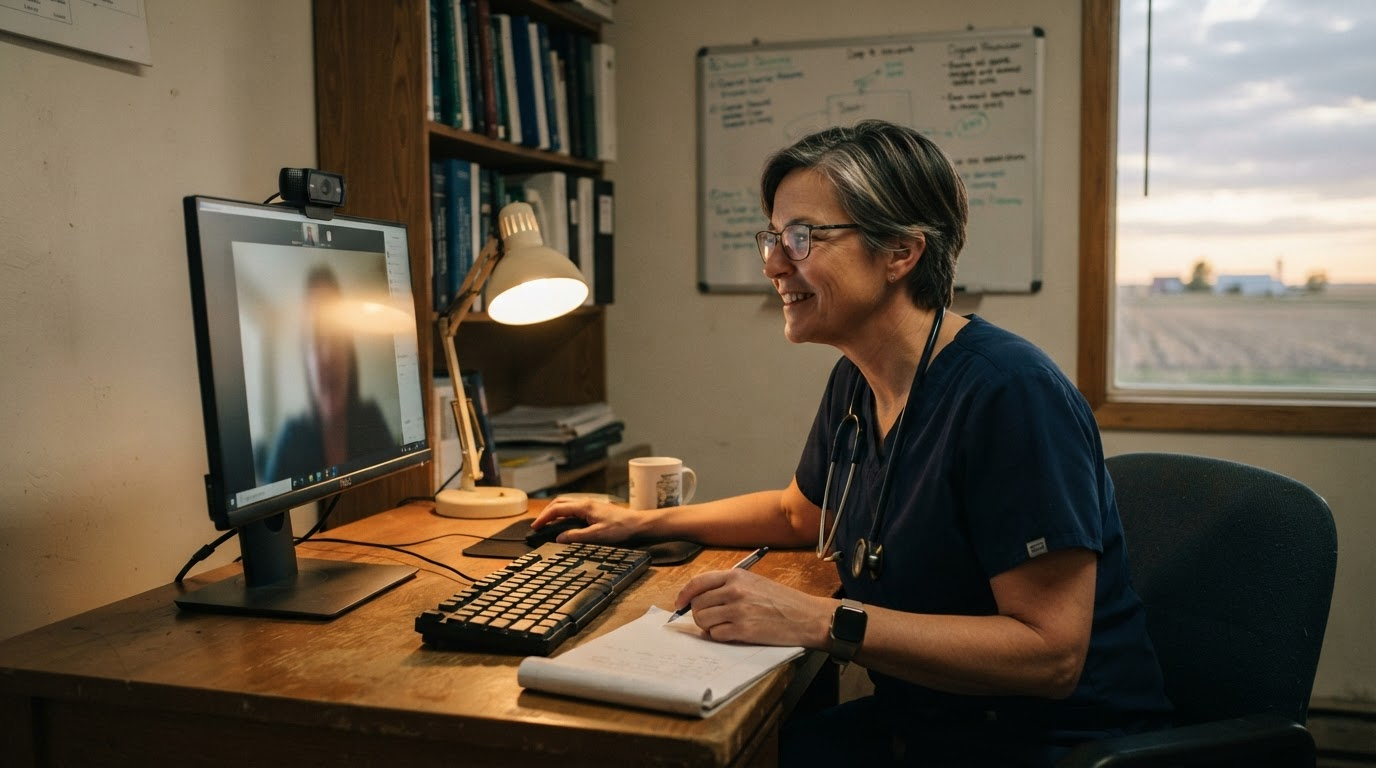
With a well-designed telehealth environment, clinicians can share resources with patients in real-time, annotate test results together, play educational video clips, or draw on a virtual whiteboard to illustrate a diagnosis. The visit becomes collaborative and creative in ways that in-person encounters often are not.
This is what extraordinary telehealth looks like. This is the level that delivers on the promise of the technology — not just access, but genuinely excellent care delivered at a distance.
And it’s available to any rural health system willing to build the foundation deliberately, layer by layer.
Building Up, Not Across
The temptation — especially in a period of significant funding availability — is to invest broadly and simultaneously. New platforms, new programs, new use cases, all at once.
The Hierarchy of Needs suggests a different approach: build up, not across. Make sure the Physical layer is solid before worrying about Belonging. Make sure Safety is genuinely addressed before expecting clinicians to feel Esteem.
RHTP presents a unique opportunity to build rural telehealth infrastructure right. The organizations that use it to methodically address each layer — not just the most visible ones — will be the ones still delivering extraordinary care five years from now.
The question isn’t whether your organization can afford to invest in telehealth. For many rural systems, that question has been answered.
The question is whether you’re building on the right foundation.
Ingenium Digital Health Advisors helps rural clinics, health centers, health systems and critical access hospitals implement telehealth with the systematic discipline that sustainable programs require. To explore where your organization stands across all five layers of the Telehealth Hierarchy of Needs, reach out to start a conversation or visit ingeniumdigitalhealth.com/resources.

To receive articles like these in your Inbox every week, you can subscribe to Christian’s Telehealth Tuesday Newsletter.
Christian Milaster and his team optimize Telehealth Services for health systems and physician practices. Christian is the Founder and President of Ingenium Digital Health Advisors where he and his expert consortium partner with healthcare leaders to enable the delivery of extraordinary care.
Contact Christian by phone or text at 657-464-3648, via email, or video chat.