

In this first wave of RHTP funding, many rural healthcare leaders in all 50 states either have or are about to receive their award notice. But once the excitement wears off (usually during the time it takes the state to finalize an actual contract), reality sets in: now your organization must actually deliver. Forward this to whoever on your team is carrying the project — it’s written for them as much as for you.
The RHTP program is different from most other grants. CMS explicitly wants to see outcomes, not just money spent or people trained. One RHTP RFP in California made this very explicit: increase the controlled population for hypertension and diabetes and increase colorectal screening. Those are real metrics that can directly be traced to better health and cost savings.
Another key hallmark of the RHTP program is sustainability: can your program continue to generate the value, the benefits, the outcome without grant funding? Can the staff you hired with RHTP funding continue to be paid out of service revenue or shared savings? Hiring new staff to make up for the anticipated Medicaid shortfall is not a sustainability strategy — it’s a temporary band-aid that CMS may just rip off again in the form of a clawback from the state.
Not every state may yet realize the CMS mandates for outcomes and sustainability, so not every contract will be written to fulfill that aim. But what is real and non-negotiable is the reporting deadline of June 30, 2027 to demonstrate results and the deadline of September 30, 2027 for the funds of the first funding period to be fully spent.
Are You Ready to Perform?
Here’s what makes this urgent even if your contract isn’t finalized yet: the time your state spends finalizing paperwork doesn’t get added back onto the calendar. It comes out of it. Whatever’s left between a signed contract and your reporting deadline is what you actually have to work with — and for a lot of organizations, that number is already smaller than the one that felt real on the day the award notice arrived.
So the question isn’t whether your organization will eventually deliver.
It’s whether it can, right now, actually produce what CMS and your state are going to need to see — and that’s worth answering honestly before a single dollar gets spent. Producing real evidence — not just spending the money or standing up a service — is a narrower, more specific bar than most newly funded organizations are set up to clear right now.
The Four Pitfalls That Sink RHTP Projects
Our real-time RHTP readiness check asks nine questions built to surface exactly that, before a vendor is chosen or a kickoff is scheduled. Four of them explain almost every gap we see:
1. Nobody owns it. Ask who’s delivering this project, and in a lot of organizations the honest answer is everyone, which in practice means no one. A grant coordinator, a clinical director, and an IT lead are each carrying a piece of it on top of the job they already had, and each assumes someone else is tracking the whole picture. Nobody is. This isn’t a staffing failure — it’s what happens when a project this size arrives without a decision about who its one accountable owner is. Without a named person whose primary job, this month, is delivering the project — not their fifth priority — “in progress” can mean almost anything, and it usually means less than everyone assumes. Ask a follow-up question — when did the three of you last sit down with the full project plan together — and the room tends to go quiet.
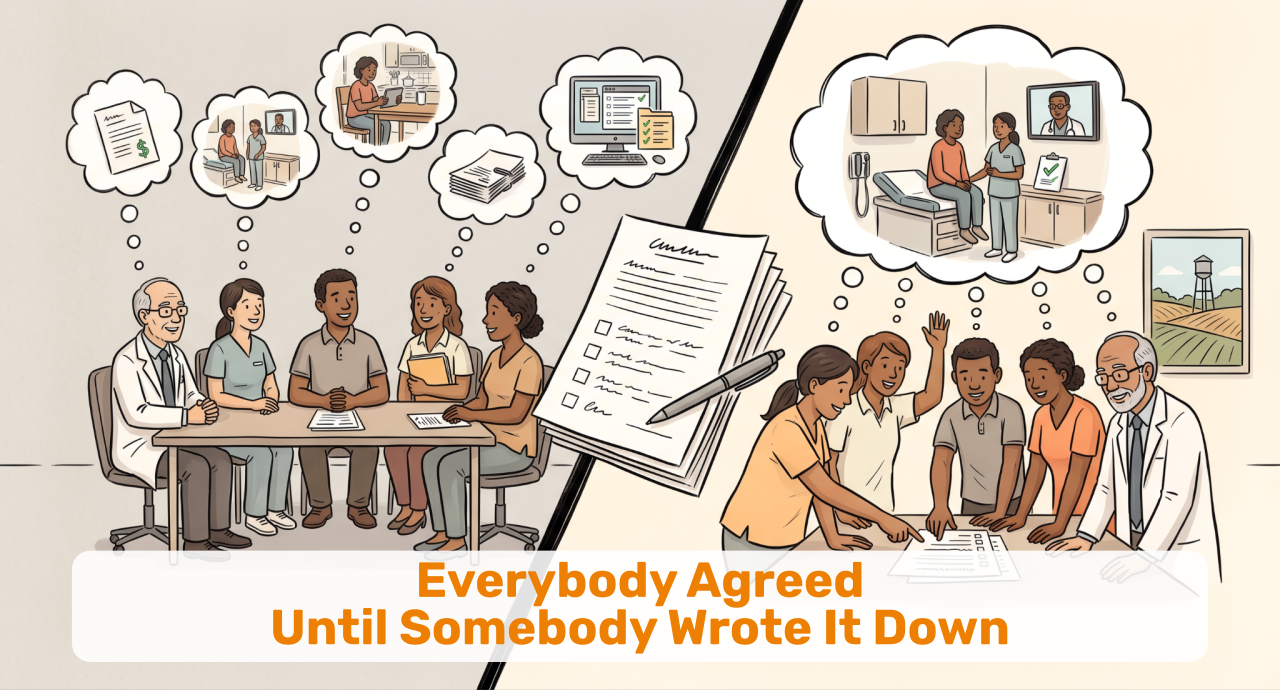
2. Clinicians were told, not asked. Somewhere in the rollout plan there’s usually a line that reads “communicate to clinical staff”, as if engagement were a memo. It isn’t. Clinicians support a new way of working when they can see the clinical case for it — what it does for their patients, and for their day — not when they’re informed it’s happening. Skip that step and the workflow gets designed around what leadership assumes clinicians will accept, which is a different thing from what they’ll actually adopt. The gap between those two shows up months later, quietly, as underuse: a service that launched on schedule and never got used the way it was designed to be.
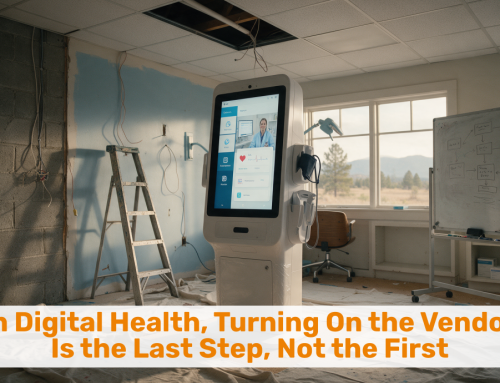
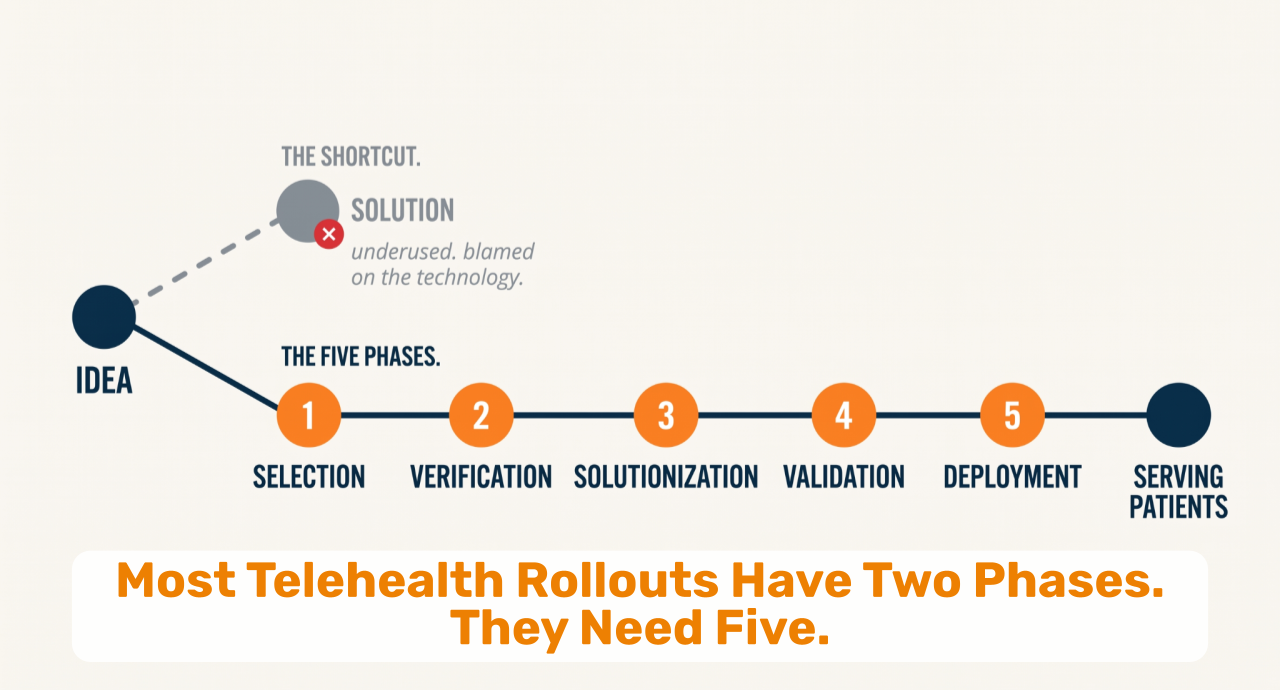
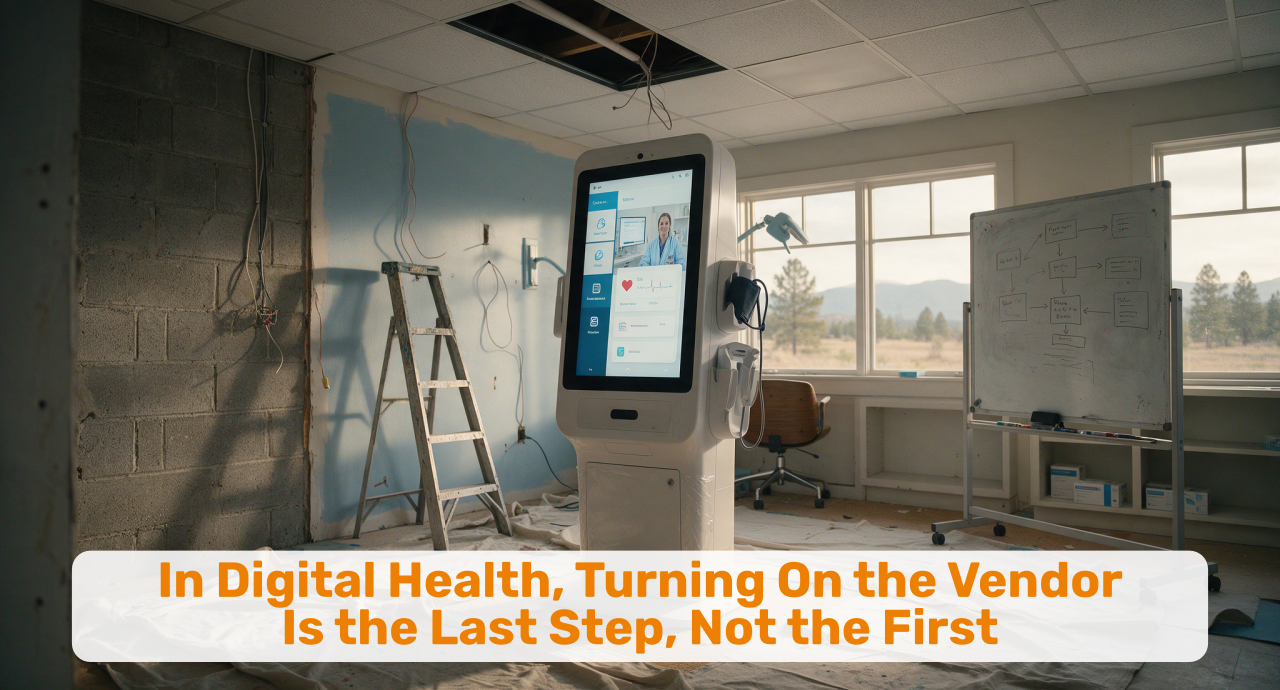
3. The vendor is not going to do this for you. This is the pitfall that costs the most time, because it feels like relief instead of risk. A vendor that sells the technology is not the same as a partner accountable for the outcome, and treating a signed contract as the hard part done is how organizations end up managing the vendor’s implementation timeline instead of their own. Technology is only roughly 10% of what makes any digital health solution succeed. The other 90% — the workflow that has to exist before the tool ever gets used, the policy that governs it, the training that makes clinicians confident with it — doesn’t design itself just because a vendor is now under contract. If the plan for that ninety percent is “the vendor will handle it”, you have fallen into the vendor trap.
4. You have no way to know if it’s working. Ask your team three quick questions: Do you have a written success metric you’d actually stand behind, including what happens if the number comes in low? Do you know exactly what your state will require you to report, and how you’ll produce it? And can you tell, month to month, whether the project is working — not whether it launched? Most organizations can answer one of these cleanly. Almost none can answer all three without hesitating. That hesitation is the actual gap, and it’s the one that eventually gets found by an audit, a board question, or a site visit — at a much worse moment than now.
These four pitfalls rarely show up alone.
An organization with no named owner is often the same one where clinician engagement quietly becomes an afterthought, because no one’s job is to make time for it.
An organization leaning on the vendor to handle the other ninety percent is often the same one that can’t yet say whether the project is working, because nobody defined what working would mean before the technology arrived.
These four root causes compound — which is good news in one specific way: fixing the first one, naming an owner, tends to surface and start fixing the rest, because someone is finally accountable for closing all four instead of hoping they close themselves.
None of these four gaps is about competence.
Every organization that won an RHTP award already proved it was capable enough to write a strong application and get selected.
The gap is capacity — the same team, the same hours in the week, plus one enormous new project that arrived without its own dedicated owner. That’s solvable, and it doesn’t require a bigger team. It requires naming an owner, engaging clinicians as partners instead of notifying them as recipients, treating the vendor as one accountable piece instead of the whole plan, and writing down, now, what “working” will look like before someone else asks.
A 6-Step Plan
None of this has to stay abstract. Here’s where to start, concretely, in the next thirty days:
-
Name an experienced project manager. Not a coordinator adding this to an already full plate — someone whose primary job, starting now, is this project. If nobody on staff can take that on full-time, say so out loud and figure out who can, rather than leaving the role quietly vacant.
-
Run your funded application back through the strategic, financial, and clinical lens. The same three-case discipline that should verify any new service before it launches works just as well applied retroactively to a project that’s already funded. It shows you exactly where leadership and clinical buy-in are solid, and where they were assumed rather than earned.
-
Start with the end in mind. Write down, in plain language, the outcomes this project has to produce — not activities, outcomes — and what you’d do if the early numbers come in low. Do this before the workflow gets designed, not after.
-
Design the future workflow before you lean further on the vendor. Who does what, in what order, on a normal day — decided by the people who’ll actually do it, not inferred from whatever the technology happens to make easy.
-
Bring clinicians into the room now, not the training session later. Ask what they need to see to say yes, rather than telling them what’s already been decided. That’s the difference between engagement and notification, and it’s cheaper to do now than to undo later.
-
Ask your state program contact, in writing, exactly what they’ll need from you and by when. Then make sure the person named in step one is the one who owns producing it.
None of these six require more headcount, a bigger budget, or a different vendor. They require someone with the authority and the time to make them happen — which loops back to step one.
For a fast, personalized read on which of these matters most for your organization right now, check out our nine-question self-service RHTP readiness check that takes about three minutes and does not collect any personal information.
If you and your team realize that outside experience would help you to achieve the goals of your project, then let our team of experienced implementation consultants support you. It’s what we have done in rural health since 2012.

To receive articles like these in your Inbox every week, you can subscribe to Christian’s Telehealth Tuesday Newsletter.
Christian Milaster and his team optimize Telehealth Services for health systems and physician practices. Christian is the Founder and President of Ingenium Digital Health Advisors where he and his expert consortium partner with healthcare leaders to enable the delivery of extraordinary care.
Contact Christian by phone or text at 657-464-3648, via email, or video chat.