

Telehealth comes in many different flavors including store & forward (sending photos), remote patient monitoring (automatic vital sign upload) and interactive care that can be synchronous (video visits, phone calls) and asynchronous (secure texting, messaging). This article is about the emerging, AI-enhanced version of the tried and tested “phone call” – only that it is not humans making the call.
Health outcomes depend on patients staying activated in their own care — following through on the medication, the follow-up visit, the warning sign they were told to watch for. That follow-through has always run on human touch: someone checking in, someone listening.
Healthcare has embraced AI in some areas and remains highly skeptical in others. But real use cases are emerging, and they play to what AI actually does well — absorbing large volumes of information, listening carefully, recognizing patterns. That covers most of what post-discharge follow-up requires: the standard, predictable calls where the questions and the red flags are well understood. What AI still can’t do is know when it’s out of its depth. The system around it has to catch that moment and hand off to a human without the patient noticing a seam.
Meanwhile, the staffing shortfall in health systems and health centers isn’t a temporary dip. It’s chronic, and it won’t be solved by hiring harder — there simply aren’t enough nurses and care managers available at a cost that rural or even urban systems can sustain.
Readmissions are where this gap shows up most plainly. The reasons are rarely mysterious: a patient overwhelmed by discharge paperwork, confused about a medication change, scared about needing to go back in, maybe still angry about a diagnosis nobody had time to sit with them on. Someone needs to catch that in the first few days — and too often, no one does. The handoff to primary care doesn’t happen as reliably as it should, and a meaningful share of patients don’t have a primary care relationship to hand off to at all, or can’t get an appointment for weeks.
AI can fill that gap: calls that sound human, that take a patient’s complaints and fears seriously, at a scale no follow-up team could staff on its own. But it is not a standalone fix. It only works integrated — into the workflow, into the escalation path, into a human team still accountable for what happens on the other end of the call. That’s exactly the kind of investment rural systems will be sizing up as states begin allocating Rural Health Transformation Program dollars to infrastructure like this one — and it’s worth getting the evaluation right before the funding makes moving fast feel urgent.
Diagnose the Use Case Before You Sit Through a Demo
Most health IT vendor selection approaches start backwards. A platform gets pitched, a demo gets scheduled, and only afterward does anyone ask which patients this is actually for — or the vendor simply told them what they thought their use case should be. That order needs to flip. Before a vendor is in the room, name the specific call type — medication reconciliation, symptom check, appointment confirmation — and the specific cohort it serves. A single discharge unit. A single condition. A vendor that claims to handle everything for everyone is usually a vendor that hasn’t been tested rigorously at anything.
Diagnosis before prescription applies to technology selection just as much as it applies to medical care: know precisely what you’re solving for before anyone shows you a solution. That diagnosis is also what makes the proof of concept that follows actually mean something — a narrow, well-defined test that can succeed or fail on its own terms, rather than a rollout with no clear bar to clear.
Five Questions Every Vendor Should Be Able to Answer
Once the use case is defined, five questions separate a vendor worth pursuing further from one that isn’t.
1. Is the Evidence Strong Enough to Survive Scrutiny?
Vendors lean on strong-sounding numbers, and not all of them carry equal weight. A randomized controlled trial run by an independent research team is a different category of evidence than a vendor-published retrospective, and a single-site quality-improvement result is not the same thing as a peer-reviewed trial — even when both get cited on the same page of a sales deck. Ask directly: is this outcome from an Randomized Controlled Trial, an observational study, or an internal customer engagement? All three can be informative. Only the first should be treated as proof, and the other two should come with the caveats attached.
2. Where Does the Script End and the Human Begin?
A single call has parts that should never vary — identity verification, red-flag symptom screening, medication read-back — and parts where sounding natural genuinely helps, like acknowledging a frustrated patient or finding a better time to call back. Ask the vendor to walk through exactly which parts of the call are scripted and deterministic, which are generative, and what specific criteria trigger an escalation to a live person. “The AI knows when to hand off” is not an answer. A named rule, tied to a specific patient response, is.

3. Whose Name Is on the Compliance Risk?
Every outbound healthcare call sits under overlapping telecom law, healthcare privacy law, and a fast-moving patchwork of state-level AI-disclosure requirements — and the rules differ state by state, which matters the moment a program crosses a state line or serves a multi-state system. Ask plainly: if a call runs afoul of one of these rules, whose liability is it? Get that answer written into the contract, not left in the sales conversation.
4. Will Patients Actually Answer the Phone?
None of the rest matters if the call gets ignored or flagged as spam before it ever connects. Ask how the vendor manages caller ID and number reputation, and ask what happens to answer rates when a carrier mislabels a legitimate call as “Spam Likely.” A vendor without a concrete answer here is asking you to fund a program patients will never pick up for.
5. Where Does the Data Land, and Who Actually Reads It?
A completed call is only useful if what it surfaces reaches the right person, fast enough to matter. Ask exactly how results write back to the record, who gets notified when a call surfaces a real problem, and how quickly. If the honest answer is a dashboard nobody has committed to checking, the call happened and nothing changed.
Selection Is the Easy Part
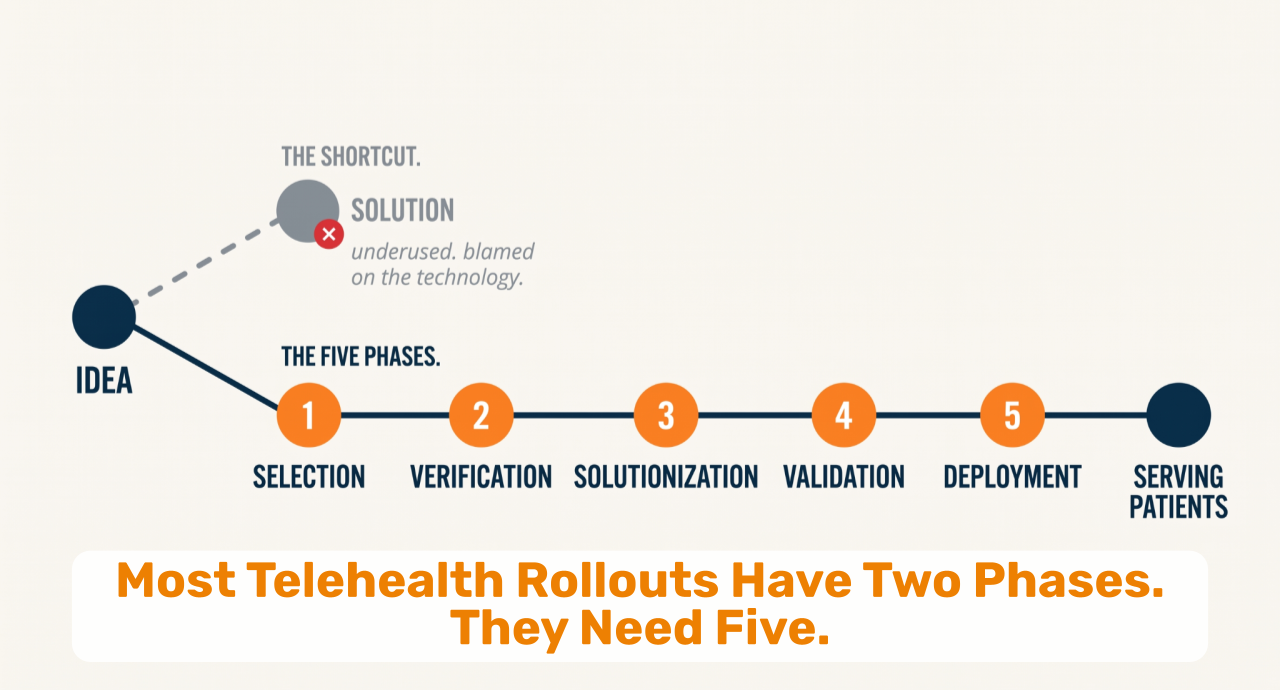
None of this is a reason to avoid automation — the staffing math makes that case on its own, and no amount of caution about vendors changes the underlying shortage. It’s a reason to slow down for a few weeks at the front end, before a proof of concept becomes a full rollout across every discharge in the building.
The vendor conversation is, genuinely, the easiest part of this work. What determines whether the investment holds up — whether it earns the trust of staff and patients six months in — happens after the contract is signed, in decisions almost no one budgets time or ownership for. That’s the part rural systems preparing Rural Health Transformation Program applications should be planning for now, not after the funding lands.
Coming next in this series: signing the contract is the easy decision. What happens when an AI call goes wrong — and whether anyone catches it in time — is the harder one.

To receive articles like these in your Inbox every week, you can subscribe to Christian’s Telehealth Tuesday Newsletter.
Christian Milaster and his team optimize Telehealth Services for health systems and physician practices. Christian is the Founder and President of Ingenium Digital Health Advisors where he and his expert consortium partner with healthcare leaders to enable the delivery of extraordinary care.
Contact Christian by phone or text at 657-464-3648, via email, or video chat.