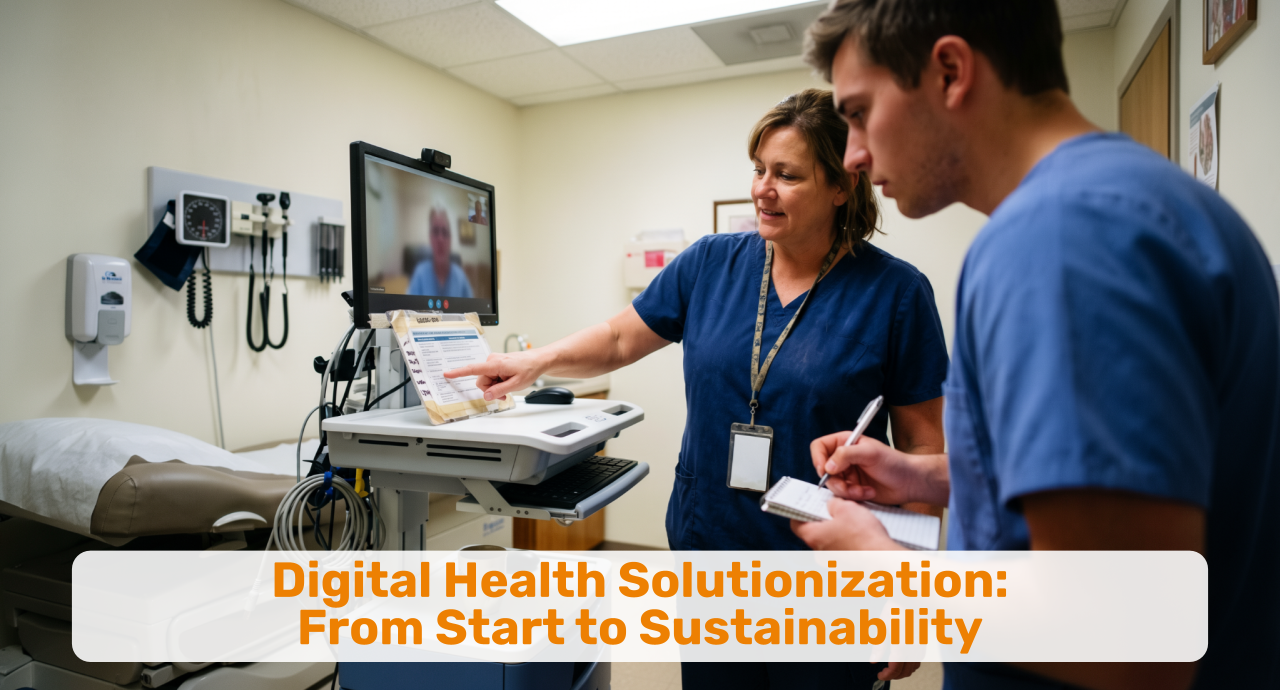


This article is based on a webinar presented by Jen Donathan, Shari Snyder, Ryan Baker, and Christian Milaster for Generation West Virginia’s Broadband Technical Assistance Webinar Series.
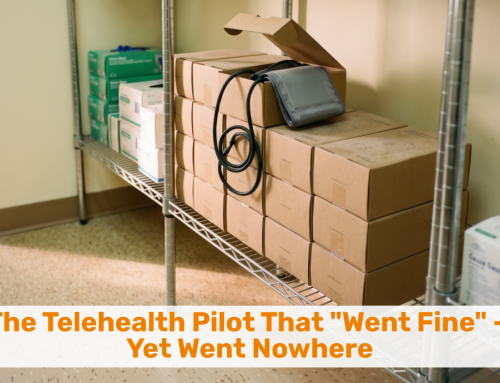
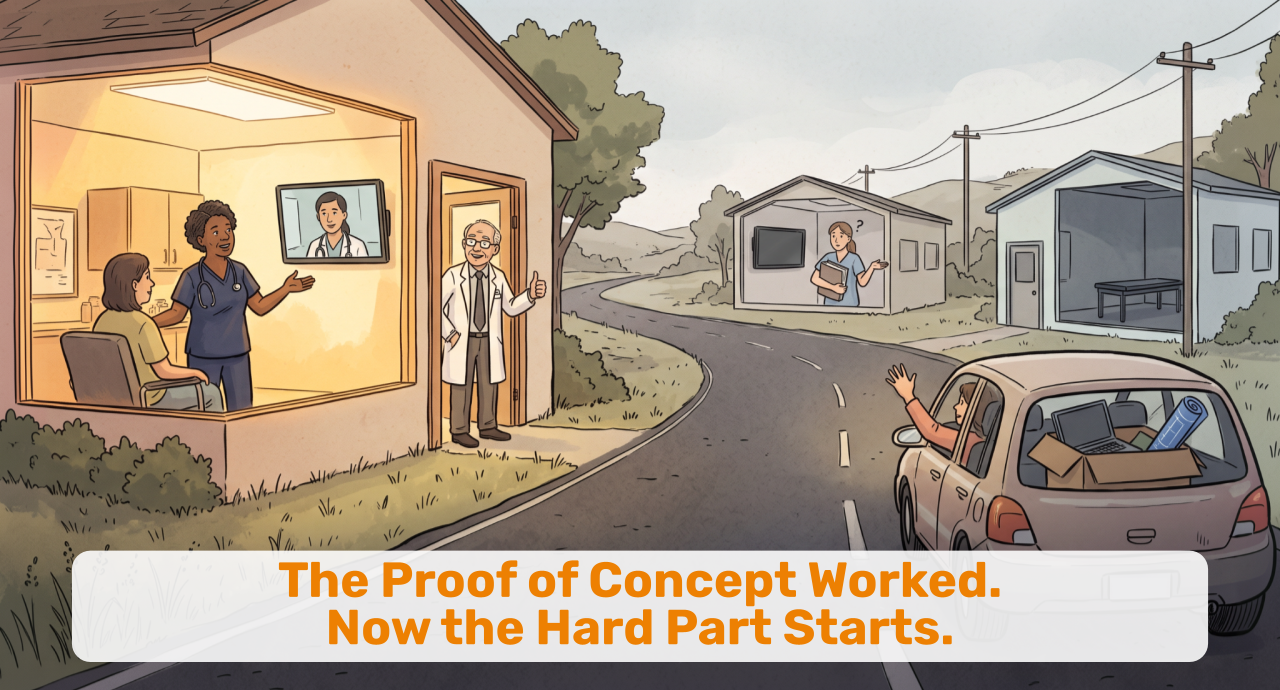
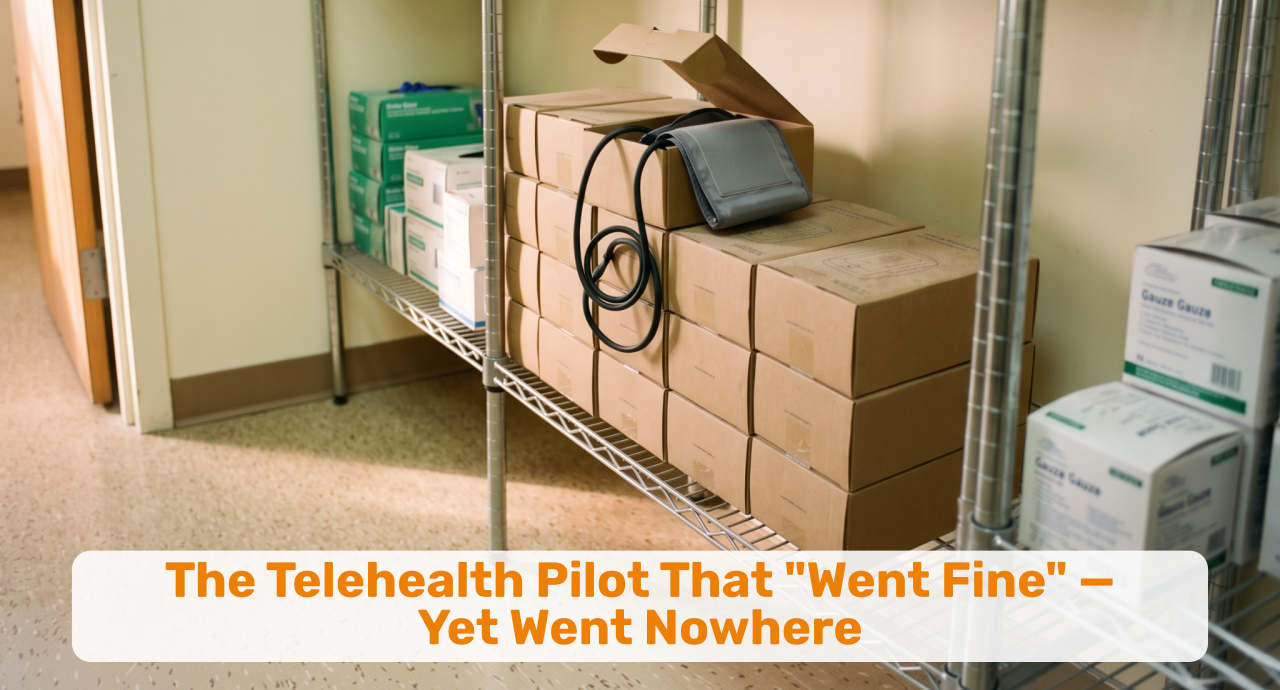
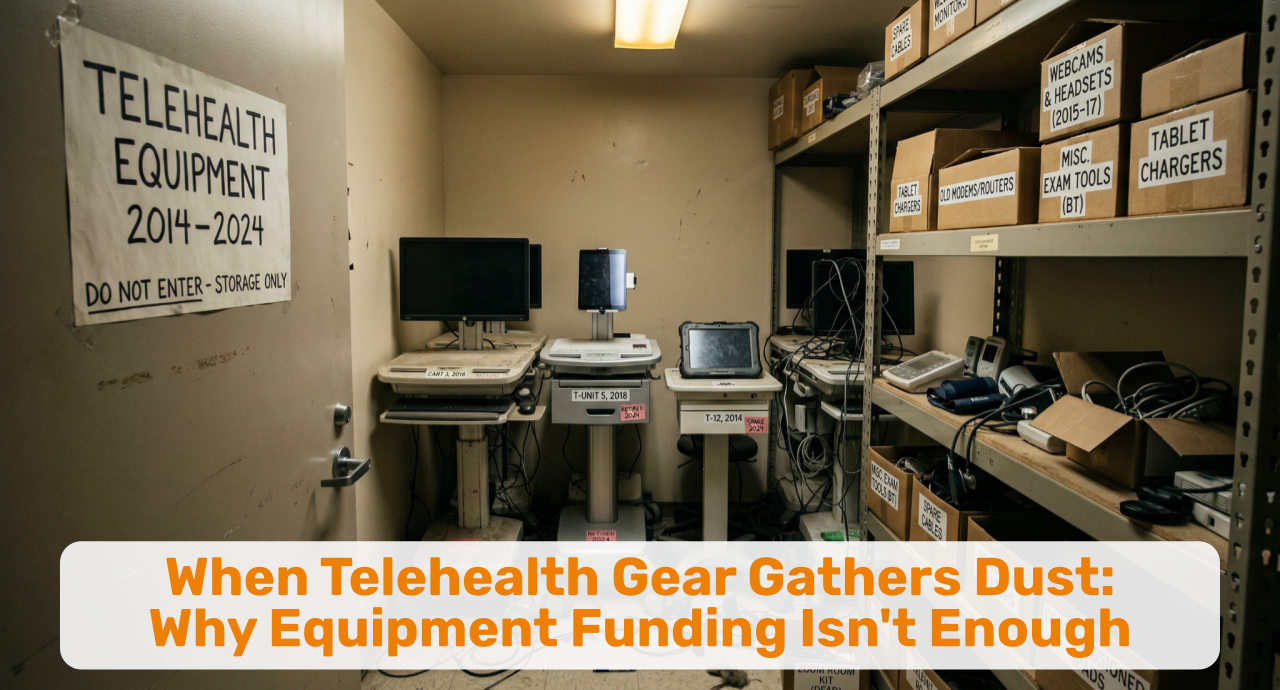
There is a pattern we have seen play out across community health organizations more for many decades. A grant comes through. Equipment arrives. A laptop gets unboxed, a webcam gets plugged in, maybe a telehealth booth gets installed in a corner of the library. And then — nothing. The equipment sits. The visits never happen. The program that looked so promising on paper quietly disappears.
It’s the gear-gathers-dust syndrome. And it is almost entirely preventable.
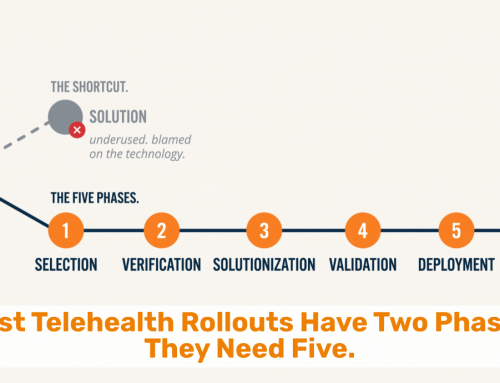
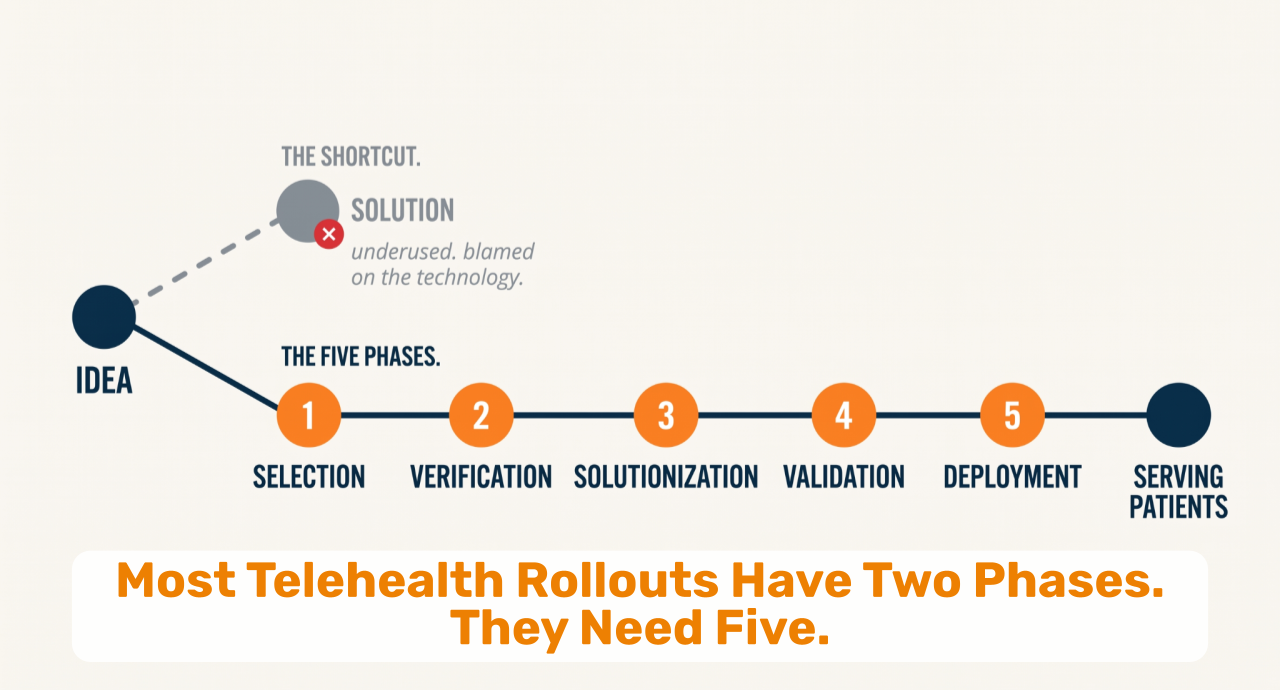
The reason it happens is not a lack of funding. It is not malperforming or hard to use technology. It is a fundamental misunderstanding of where funding fits in the process of building a sustainable community telehealth program. Most organizations treat securing a grant as step one. In reality, it is step four.
Getting that sequence right is the difference between a thriving program and an expensive lesson. Especially as we are preparing for the biggest investment in health technology through the RHTP, the Rural Health Transformation Program.
The Four Barriers That Determine Whether Telehealth Actually Works
Before any funding conversation begins, healthcare organizations need to honestly assess what stands between their patients and successful telehealth participation. There are four distinct barriers — and most organizations only take two of them seriously.
Access is the one everyone understands: distance, lack of transportation, no gas money, multiple jobs with no flexibility, no device, no broadband, no data plan. The solutions are also fairly well understood — public telehealth access points in libraries and community centers, intermittent staffed clinics, mobile units on regular schedules. Access is real, and it matters.
Digital literacy is the second barrier, and it deserves more attention than it typically gets. Managing an email account, setting up a patient portal, installing an app, troubleshooting audio or video problems — these tasks are routine for some and genuinely intimidating for others. Digital navigators, community health workers, in-clinic assistance after in-person visits, and Telehealth TechChecks conducted a few days before a patient’s first video visit are all proven interventions that help patients cross this threshold with confidence rather than frustration.
Patient engagement is the third barrier, and it is the one most organizations underestimate or ignore entirely. Engagement is not limited to telehealth — it is the central challenge of chronic care management. Will patients keep their appointments? Will they fill their medications and complete their tests? Will they communicate when something is wrong? Telehealth can actually help here: converting cancellations and no-shows to virtual visits, enrolling patients in remote patient monitoring to maintain connection between visits, integrating on-demand video interpretation for non-English speakers. But these solutions require intentional design, not just technology.
Clinician and staff engagement is the fourth barrier — and the one that is most often assumed rather than earned. No virtual patient care happens without clinical staff taking the initiative to recommend it, deliver it, and champion it. Clinician resistance is real, and it is frequently misread as technology aversion when it is actually something more legitimate: concern about patient safety, uncertainty about how to conduct a quality exam at a distance, and frustration from COVID-era video experiences that were often chaotic and unsupported. The good news is that this resistance is remarkably easy to overcome with the right approach. A structured virtual exam training — showing clinicians exactly how to conduct and document a telehealth visit — can transform a skeptic into an advocate in thirty minutes. The key is involving clinicians from the very beginning, not presenting telehealth as a fait accompli and asking for their buy-in after the fact.
There is an important nuance worth naming when it comes to telehealth access points specifically: The population most likely to use a library booth or community kiosk is actually quite small. People who are ready and willing to use telehealth tend to already have the devices, connectivity, and skills they need — so they do it from home. The people who stand to benefit most from an access point are those who lack digital literacy, technology, connectivity, or privacy for a home visit. Reaching them requires trusted human relationships — a clinician referral, a community health worker visit, a school nurse who already knows the family. The technology alone will not bring them in.
Three Funding Buckets — and How to Use Them Well
Once an organization has done the work to understand its community’s needs, funding sources generally fall into three categories, each with distinct tradeoffs.
Federal funding offers the highest impact and the heaviest burden — competitive application processes, intense reporting and compliance requirements, and timelines that can stretch from application to contract by years, not months. Federal dollars are best suited for multi-partner, long-term initiatives where the infrastructure and partnership are already in place.
State and local funding is faster to deploy, more aligned with regional priorities, and generally more flexible in its requirements. It is well suited to pilot programs, readiness-building work, and expansions that need to move quickly. For organizations that are just getting started, state and local grants are often the right first step.
Foundations and private funders offer the most flexibility and are relationship-driven by nature. They place strong value on storytelling, lived experience, and community impact — and a successful partnership with a foundation funder often opens the door to future support. Foundations are excellent partners for filling gaps that other funding sources cannot cover.
Regardless of source, one principle should govern how funds are allocated: grants are for startup costs, not for keeping the lights on. A well-designed telehealth service should be financially self-sustaining through reimbursement from the beginning. Medicare and Medicaid cover most telehealth visits and many commercial insurers do as well.
Grants should fund the launch — the technology and equipment (roughly 10-20% of the budget), any necessary remodeling (0-20%), and above all, the technical assistance required to design the workflows, train the staff, and deploy the program (70-90%). Staffing and clinician time should not depend on grant dollars, because when the grant ends, the program needs to continue.
There are three patterns we see most often when telehealth grants fail.
First, staffing and operations are under-budgeted, leading to burnout and eventual collapse when one or two key people leave. Second, there is no clear sustainability plan — organizations hope something will work out after the funding ends, rather than designing for financial independence from the start. Third, and most visibly, the investment goes into equipment rather than people. The technology arrives. The training, workflow design, and change management do not.
Gear gathers dust.
Three Examples of Telehealth Funding Used Well
What Funded Programs Actually Look Like
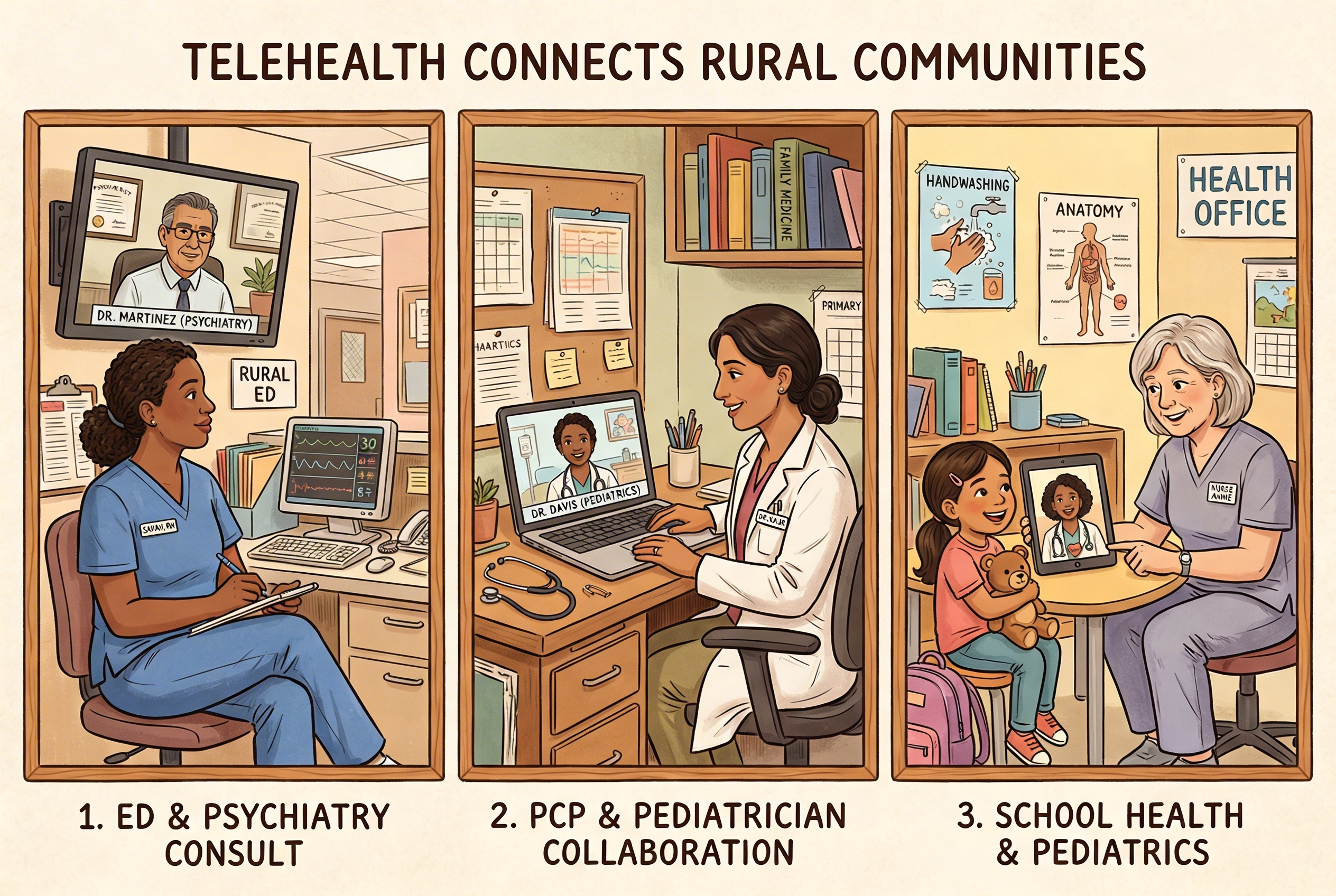
Three examples illustrate how sustainable programs have been built — with different funding strategies, different models, and different communities, but remarkably consistent lessons.
The North Carolina Statewide Telepsychiatry Program grew out of a genuine crisis. Mental health reform in 2009 closed facilities across the state, and emergency departments began absorbing the overflow. Universities and health systems came together to provide virtual psychiatric consultations — first in hospital EDs using a “firehouse” model that responds as referrals come in, then expanding into scheduled community clinic settings where patients see a psychiatrist virtually through their primary care office. Initial funding came from the Duke Endowment and the North Carolina General Assembly. Over time, the program built such a clear case for its value that the legislature codified it into permanent state statute, with recurring annual funding.
The lesson: start with the crisis, build the coalition, prove the model, earn permanence. (contact Ryan for more info).
Pediatric Mental Health Care Access programs, federally funded through HRSA and operating across all fifty states and territories, provide teleconsultative services to primary care providers, emergency departments, and schools. Michigan, Maryland, Virginia, and California have each adapted the core model to their own geography and population, but the through-line is consistent: specialist support, delivered virtually, to providers who need it when they need it. Because HRSA funding requires annual reapplication, the most resilient programs have built academic partnerships and private foundation relationships alongside their federal base.
The lesson: structure adapts to local context; provider support always matters more than platform selection. (contact Jen for more info)
A school-based telehealth program in Hamlin, West Virginia demonstrates what it looks like to embed telehealth into existing community relationships rather than building something new. School nurses — trusted, known, already serving as the first point of contact for families — serve as the backbone of the program. Telehealth extends their reach without replacing their relationship. Families do not have to navigate unfamiliar systems or travel to unfamiliar places. Care comes to where they already are, supported by someone they already trust.
The lesson: technology is most powerful when it amplifies existing human relationships rather than substituting for them.
Across all three programs, the same factors drove success: workflow integration embedded telehealth into existing operations rather than adding it as an extra task; centralized infrastructure reduced workforce strain by sharing specialty resources across multiple sites; and partnerships — between state agencies, academic centers, rural health systems, and community organizations — provided the foundation for long-term sustainability.
Build the Case Before You Apply
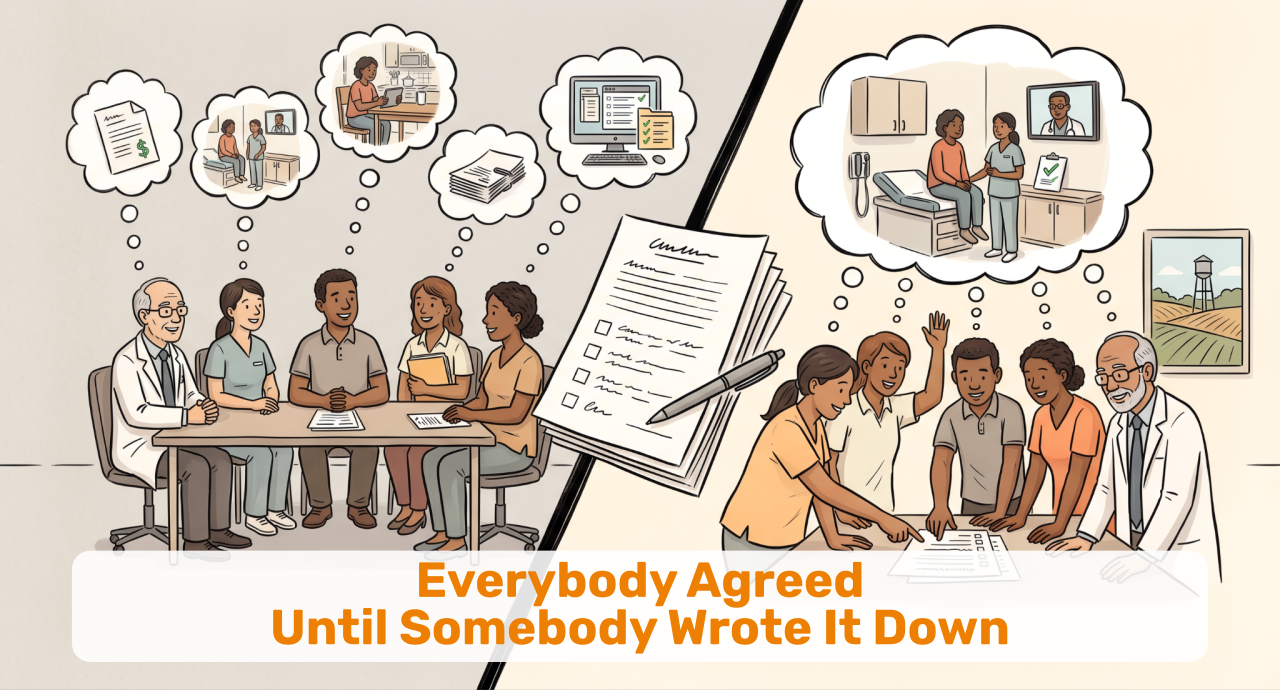
The clearest signal that a telehealth program is worth funding is alignment across three distinct cases before a single grant application is submitted.
The strategic case answers why this matters to the organization and community — how telehealth serves the mission, addresses documented needs, and aligns with organizational priorities. The business case answers whether the financial model works — what services are reimbursable, what the ROI looks like, how the program sustains itself after grant funding ends. The clinical case answers whether the care model is sound — whether it improves outcomes, integrates into clinical workflows, and has the support of the clinicians who will deliver it.
When the CEO, CFO, and CMO are all aligned, a program is ready to seek funding. When only one or two of those cases have been made, funding that arrives prematurely will accelerate failure rather than prevent it.
That alignment is step three in building a community telehealth program. Here is the full sequence:
-
Create a coalition of willing partners
-
Quantify the need, qualify the opportunity
-
Define a set of services and initiatives
-
Identify funding sources, submit a proposal, get funded
-
Design the workflows, acquire the technology
-
Win the hearts and minds of patients, clinicians, staff, and leaders
-
Launch a proof of concept; scale with performance management
Notice where technology acquisition appears: step five. After the coalition. After the case. After the funding. Technology is not the foundation of a successful telehealth program. It is the tool that a well-designed, well-supported, community-rooted program uses to deliver care at a distance.
The funding is out there. The reimbursement landscape is better than it has ever been. The models are proven. What separates the programs that thrive from the ones that gather dust is the intentionality of everything that happens before the equipment arrives — and the discipline to keep people, workflows, and relationships at the center of the work long after it does.

To receive articles like these in your Inbox every week, you can subscribe to Christian’s Telehealth Tuesday Newsletter.
Christian Milaster and his team optimize Telehealth Services for health systems and physician practices. Christian is the Founder and President of Ingenium Digital Health Advisors where he and his expert consortium partner with healthcare leaders to enable the delivery of extraordinary care.
Contact Christian by phone or text at 657-464-3648, via email, or video chat.