


Recently, I came across a comprehensive analysis by Khandaker Sabit Bin Razzak examining telehealth adoption trends. His post — “Telehealth Adoption Trends: Why Scalable Digital Infrastructure Matters More Than Ever” — was packed with solid data, such as utilization rates, market projections, AI integration statistics, security concerns.
His research was thorough, the numbers were compelling, and his conclusion was clear:
“Infrastructure that can’t handle what we’ve built is the primary barrier to telehealth adoption.”
After spending 25 years helping healthcare organizations adopt innovation — with 15 of those years focused almost exclusively on rural health — I have to respectfully disagree.
Not with the data. The data is good.
Not with the challenges he identifies. Those challenges are real.
But with the conclusion that infrastructure is what’s truly holding us back.
The 80/20 Reality We’re Not Talking About
Here’s what I’m seeing across hundreds of implementations: The technology improvements being suggested — better connectivity, seamless integration, enhanced user experience — represent the remaining 20% that will get us to perfection.
We’re already 80% there, if not even more. And for the vast majority of clinical use cases, it’s good enough for now.
Is the technology perfect? No. Could it be better? Absolutely. But that’s not what’s preventing the 78.6% of US hospitals with telemedicine solutions from achieving more than the 4-6% utilization.
What I Learned 25 Years Ago (That Still Holds True Today)
When I came to healthcare as a German software engineer, I naturally assumed the problem was poorly developed technology. The EHRs at the time were indeed horribly insulting to clinicians — I wasn’t wrong about that.
But I was wrong about where the real problem lived.
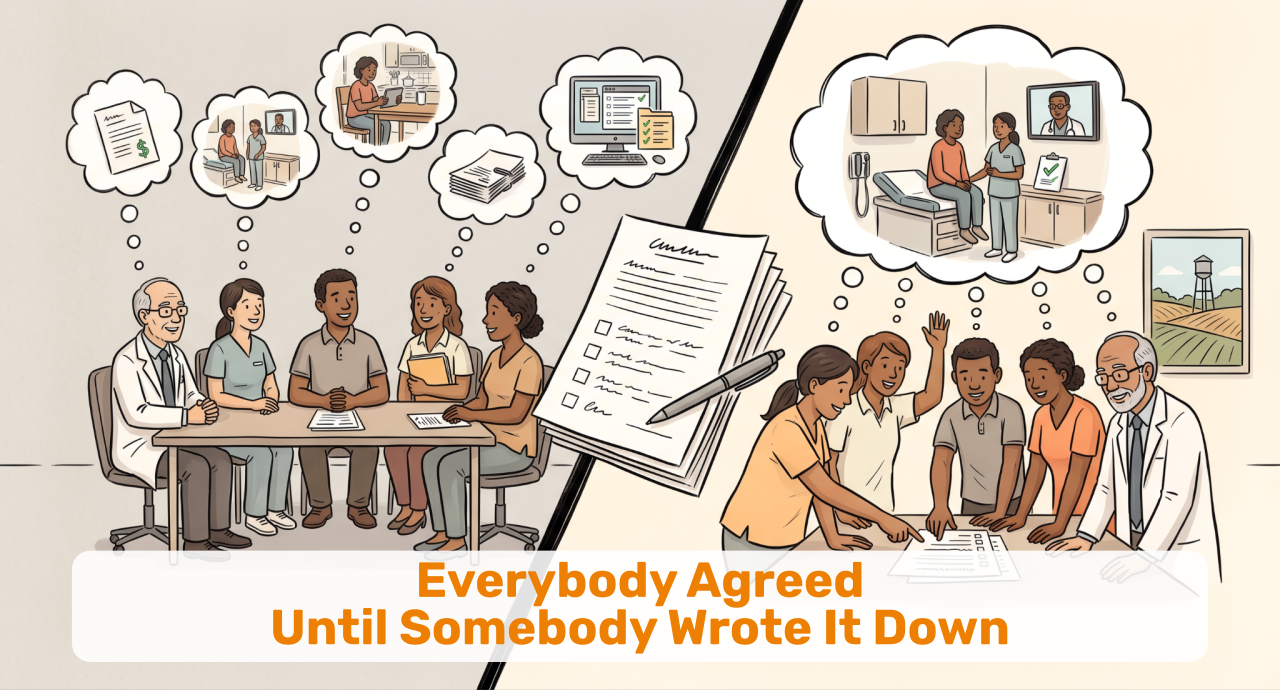
The problem wasn’t the technology. The problem was resistance to change by clinicians, staff, and patients.
And here’s the critical part: they were often resisting for very good reasons.
Why the Infrastructure Argument Misses the Mark
Focusing on infrastructure feels productive. It’s tangible. You can measure bandwidth, count pixels, track latency. You can build something.
Also: spending money on improving technology feels more measurable, more demonstrable than spending time and resources on changing people.
But that doesn’t make it the right answer.
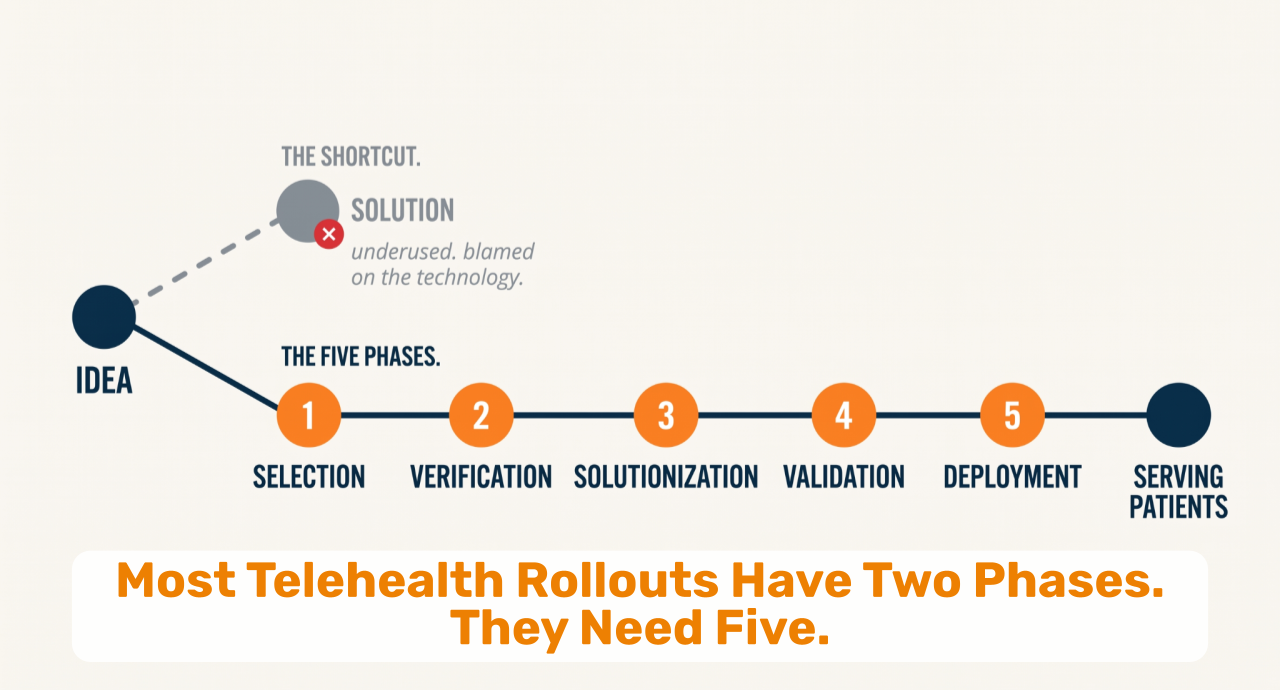
Even in the rural areas where our firm has spent 90% of its engagements — places with genuinely challenging connectivity issues — infrastructure is rarely the primary barrier to adoption. When telehealth programs fail, it’s almost never because the video quality wasn’t crisp enough or the connection too flaky or because the platform couldn’t scale.
It’s because:
-
Clinicians weren’t asked to participate in the selection process and don’t trust the solution
-
Workflows weren’t redesigned for telehealth, so the technology creates more work instead of enabling better care
-
Training was inadequate, ongoing support was nonexistent, and nobody’s measuring whether it’s actually working

The Three Things That Actually Matter
After 25 years and hundreds of implementations, three factors consistently separate successful telehealth programs from failed ones:
1. Engaging Clinicians and Staff From the Beginning
These are not frontline factory workers you can simply mandate a new program for. Clinicians are highly trained professionals with legitimate concerns about patient safety, quality of care, and their professional competence.
When you design with clinicians rather than for them, resistance transforms into ownership. They become the champions who drive adoption among their peers.
2. Relentless Focus on Optimized Workflow Redesign
The goal isn’t to digitize existing workflows — it’s to redesign care delivery so everyone practices at the top of their license. When people achieve a state of flow in their work, change becomes sustainable because it genuinely improves their professional lives.
This is where the “High-Tech to enable High-Touch” philosophy becomes real. Technology should amplify human relationships in care delivery, not replace them.
3. Superb Training, Ongoing Support, and Continuous Performance Management
Telehealth excellence doesn’t happen by chance—it’s trained, tested, and sustained. This means:
-
Role-specific training that builds genuine competence and confidence
-
Continuous support that addresses challenges as they emerge
-
Performance management that tracks outcomes across patient satisfaction, clinician satisfaction, quality of care, financial performance, regulatory compliance, and reputation
Without these three elements, you can have the most scalable, AI-powered, perfectly integrated infrastructure in the world — and still achieve just 4-6% utilization.
What’s Really Happening in Healthcare
I’ve said it for many years:
“The problem in healthcare is not the lack of digital health innovation. The problem is the slow pace and ineptitude of sustainable innovation adoption.”
We have proven solutions. We have reliable technology. What we’re missing is the systematic approach to implementation that enables people to change the way they deliver care.
This is particularly urgent now, as states prepare to deploy CMS’s $50 billion Rural Health Transformation Program investment. The organizations that will succeed aren’t those with the most advanced technology platforms. They’re the ones who understand that sustainable transformation is 90% about implementation and only 10% about technology.
The Path Forward
I’m not suggesting infrastructure doesn’t matter. Of course it does. Better user experience, improved integration, enhanced scalability — these are valuable improvements.
But they’re not the bottleneck.
If you’re a healthcare leader looking to scale telehealth services, ask yourself:
-
Are your clinicians genuinely engaged in designing these solutions, or are they being told to use them?
-
Have you redesigned workflows to enable better care, or are you just digitizing existing processes?
-
Do you have structured training, ongoing support, and performance management in place?
If the answer to any of these questions is no, improving your infrastructure won’t solve your adoption problem.
Because in the end, healthcare transformation isn’t about electrons — it’s about human hearts and minds.
The infrastructure will follow once we get the people part right.
Want to discuss how to shift your organization’s focus from improving technical infrastructure to improving human infrastructure? Give me a call: (657) 464-3648.

To receive articles like these in your Inbox every week, you can subscribe to Christian’s Telehealth Tuesday Newsletter.
Christian Milaster and his team optimize Telehealth Services for health systems and physician practices. Christian is the Founder and President of Ingenium Digital Health Advisors where he and his expert consortium partner with healthcare leaders to enable the delivery of extraordinary care.
Contact Christian by phone or text at 657-464-3648, via email, or video chat.