


When CMS started reimbursing Remote Physiological Monitoring in 2019, a gold rush mentality swept through healthcare. Overnight, vendors promised small clinics easy revenue through RPM billing codes. Large health systems invested millions in platforms and devices, expecting outcomes to follow naturally from technology deployment.
The result? Small clinics chased billing while patients remained disengaged. Large health systems saw disappointing adoption rates and unclear clinical benefits. The promised revenue never materialized — or when it did, staffing costs to support the technology far outweighed the reimbursement.
Last May, I facilitated a private meeting with seven telehealth directors from large health systems. The consensus was sobering: “RPM is losing money.” One Connected Health executive from a Pennsylvania health system told me they are now considering giving all their RPM patients to a vendor and letting them keep the revenue, just to see if someone could make it work while patients still benefit through increased engagement and better health outcomes.
The frustration is real. Despite years of availability and clear reimbursement pathways, most RPM programs fail to deliver on their clinical and financial promises.
But here’s the thing — the question isn’t whether RPM can work. Multiple research studies prove it does. The real question is why it works extraordinarily well for some organizations and fails spectacularly for others.
We decided to find out what the evidence actually shows.
How We Think Differently About RPM
At Ingenium, we’ve built our RPM implementation approach on a fundamentally different foundation than most programs. Our definition of RPM centers on empowering primary care physicians to make care decisions that improve outcomes — not maximizing revenue extraction from patient populations.
This might sound like semantics, but it changes everything.
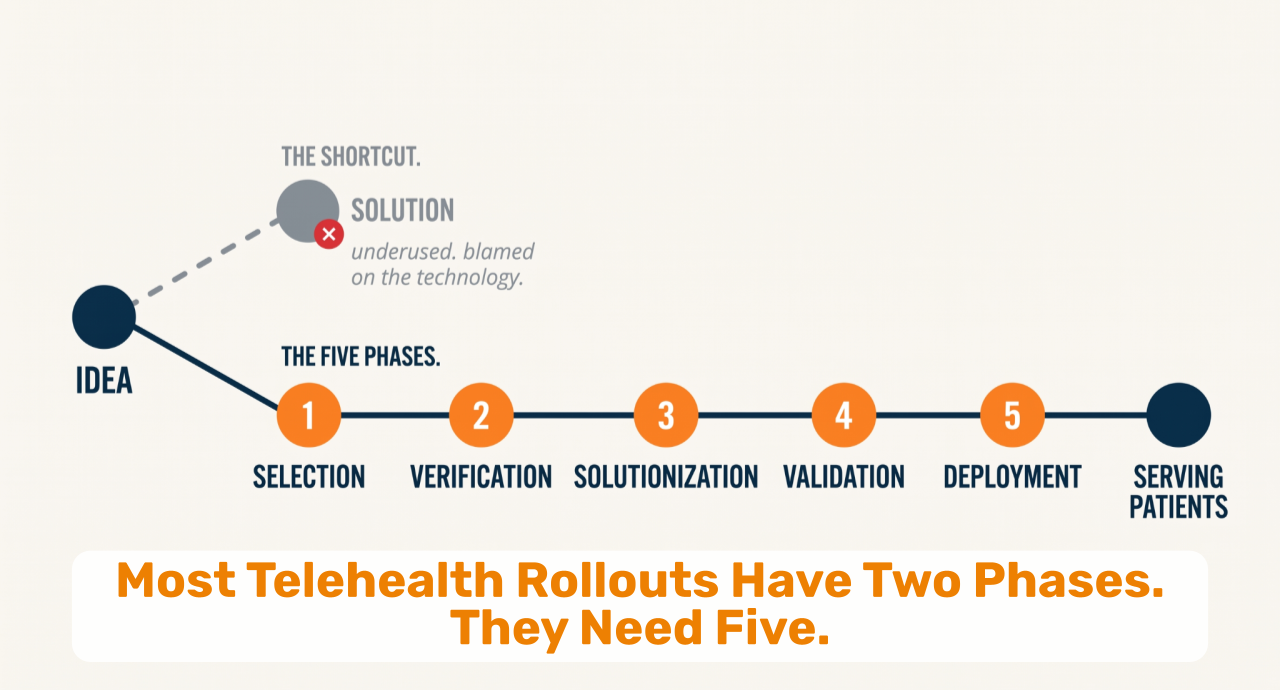
We treat RPM as a technology-enabled clinical service, not a technology purchase. This means 90% of our effort focuses on implementation — the systematic design of workflows, protocols, and support systems — while only 10% involves technology selection and deployment.
Our systematic patient identification process assesses clinical, social, and technical criteria before enrollment. We don’t enroll every diabetic or hypertensive patient just to hit volume targets. We identify patients most likely to benefit and most capable of sustained engagement.
Most critically, patient activation drives our approach. We focus on empowering patients to be more engaged in their self-care through personal enrollment by the PCP, thorough assistance during setup and first uses, and personalized calls to remove barriers to consistent participation.
For each clinical diagnosis group, we develop clinically-reviewed intervention and escalation protocols. We design workflows optimized for staff practicing on top of their license — with 90%+ of monitoring and support provided by MAs or CHWs, not RNs, PAs, or MDs/DOs.
And we start with our signature Proof of Concept. We validate for the leading clinician, their colleagues, and the organization that the system works, patients engage, and outcomes improve — before scaling to 30, 50, or 100 patients.
This approach stands in stark contrast to vendor-driven full deployments that promise results through technology and outsourced staff alone.
What the Global Research Actually Reveals
We recently initiated a deep analysis of peer-reviewed evidence from over 100 meta-analyses, systematic reviews, and landmark trials across multiple international studies. The findings validate what we’ve been seeing in our implementation work — and they’re far more nuanced than RPM advocates suggest.
Where RPM demonstrates compelling evidence:
Heart failure shows the strongest results. Meta-analyses involving 36,000+ patients consistently demonstrate 17-34% all-cause mortality reduction when RPM includes 24/7 clinical response capability and medication titration authority. The landmark TIM-HF2 trial showed a 30% mortality reduction with telemedical center support, translating to 6.4 additional days alive and out of hospital per year.
Hypertension management produces clinically meaningful results across the board. The TASMINH4 trial demonstrated 4.7 mmHg systolic blood pressure reduction with telemonitoring versus usual care. Multiple meta-analyses confirm consistent 4-8 mmHg reductions — translating to approximately 10% reduction in cardiovascular events at the population level.
Diabetes management with continuous glucose monitoring achieves 0.3-0.5% HbA1c reduction and improves time in target range by 7.9% (114 additional minutes daily). More impressively, CGM reduces hypoglycemia time by 27-48%, with severe hypoglycemia events reduced by up to 72%.
Post-surgical monitoring shows dramatic benefits. After liver transplantation, RPM reduced 90-day readmissions from 58% to 28% — a 52% relative reduction.
Where the evidence does NOT support RPM:
COPD monitoring fails consistently. The 2021 Cochrane review concluded with “very low to low” quality evidence. Telemonitoring did not reduce hospitalizations in most studies, and remote monitoring alone proved “no better than usual care.”
Quality of life improvements remain elusive. Most meta-analyses show no significant QoL improvement with RPM across conditions.
One frail elderly trial showed higher mortality in the telemonitoring group (14.7% vs 3.9%) — a concerning signal that technology without proper clinical infrastructure can harm patients.
Cost-effectiveness remains questionable in many implementations, with some UK analyses showing costs three times higher than willingness-to-pay thresholds.
The pattern that emerges is unmistakable:
Technology alone consistently fails. Short-duration programs (less than 6 months) show no benefit. Low patient adherence (below 70%) predicts failure. Alert overload without smart triage creates clinician burnout rather than better outcomes.
Programs that succeed share these elements: sustained monitoring of 12+ months, high-risk patient selection with recent hospitalizations, clinical infrastructure with defined escalation protocols, and authority to adjust medications — not just collect data.

Critical Success Factors Backed by Evidence
The research reveals exactly why our implementation approach works when vendor-driven technology deployments don’t.
High-risk patient selection matters. Studies consistently show greater benefits in patients with recent hospitalizations and elevated disease burden. We target these populations based on clinical need, not revenue maximization potential.
Duration of engagement predicts outcomes. The Umeh meta-analysis found that prolonged telemonitoring (12+ months) reduced both all-cause and heart-failure-related hospitalizations, while shorter programs showed no benefit. Our approach designs for sustained engagement from day one, not just initial deployment.
Clinical infrastructure enables intervention. The most successful trials included medication titration authority, 24/7 response capability, and defined escalation protocols. We build these intervention pathways before deploying devices, ensuring data informs actual care decisions.
Patient activation drives adherence. Programs achieving above 70% adherence see outcomes; those below don’t. Our personal PCP enrollment process — where clinicians compassionately outline the value patients stand to gain — creates emotional commitment that logistics-only onboarding cannot achieve.
Support infrastructure removes barriers. The evidence shows alert fatigue and technical issues derail programs. We design configurable alert parameters to reduce workforce burden and create personalized support systems that troubleshoot barriers before patients disengage.
Proof before scale prevents failure. Unlike vendors pushing immediate full deployment, we validate that the system works, patients engage, and outcomes improve before scaling. This mirrors the research showing that rushed, large-scale implementations consistently underperform focused, well-designed programs.
The Real ROI Calculation Most Programs Miss
Most RPM programs focus their ROI calculation narrowly on RPM billing codes. That leaves out several other significant value streams.
The comprehensive ROI calculation must include RPM revenue, Chronic Care Management (CCM) revenue from parallel time spent, increased PCP visit frequency driven by higher patient engagement, quality metric improvements for value-based arrangements, and avoided hospitalizations or readmissions.
When a Connected Health executive told me RPM was “losing money” because staffing costs exceeded reimbursement, I asked: Are you accounting for the prevented readmissions? The increased patient engagement driving more primary care visits? The quality bonuses from better hypertension and diabetes control?
Most weren’t.
The evidence supports this broader view. Successful RPM programs demonstrate value through multiple channels: clinical outcomes that improve quality scores, patient engagement that increases appropriate utilization of primary care, and prevention of high-cost acute events.
For readmission prevention specifically, calculate the actual cost (not charges) of prevented readmissions. One rural hospital CFO I worked with in 2016 calculated their readmission cost at $8,000 per stay with 3-5 readmissions a month. Cutting those in half created $200,000+ in savings per year — making the RPM investment decision trivial.
The financial case strengthens dramatically when you account for the full value chain rather than isolated billing codes.
The Bottom Line
Implementation Science Beats Technology Deployment
The research couldn’t be clearer: RPM works when implemented with rigorous clinical infrastructure and patient engagement strategies. But technology deployment isn’t implementation.
Organizations that treat RPM as a care model rather than a billing opportunity or technology distribution are the ones seeing both clinical outcomes and financial sustainability. They start with clinical needs, not vendor RFPs. They validate through a proof of concept before scaling. They design clinical protocols before deploying devices. They measure patient activation as the leading success indicator, not just technology adoption rates.
The evidence from 100+ meta-analyses and landmark trials validates this approach. Heart failure mortality drops by 17-34% — but only with proper clinical infrastructure. Hypertension improves by 4-8 mmHg — but only with sustained engagement over 12+ months. Diabetes control improves — but only when patients maintain 70%+ adherence.
Technology enables these outcomes. Implementation science drives them.
Most RPM programs fail because they deploy technology and hope implementation follows. The evidence shows it never does. RPM works — if you do it right. Doing it right means starting with implementation science, validating through proof of concept, and scaling only after you’ve proven the system delivers for patients and clinicians alike.
Want to learn more about launching or optimizing your RPM program? Explore our comprehensive RPM resources or connect with me directly to discuss your specific challenges.
Want access to the research sources and studies referenced in this article? Contact me and I’ll send you the complete bibliography.

To receive articles like these in your Inbox every week, you can subscribe to Christian’s Telehealth Tuesday Newsletter.
Christian Milaster and his team optimize Telehealth Services for health systems and physician practices. Christian is the Founder and President of Ingenium Digital Health Advisors where he and his expert consortium partner with healthcare leaders to enable the delivery of extraordinary care.
Contact Christian by phone or text at 657-464-3648, via email, or video chat.