


A question that surfaces regularly among rural hospital leaders — and deserves a direct answer:
“Are rural hospitals, critical access hospitals, and ‘tweeners’ better off financially as a result of telemedicine partnerships? Or are these partnerships driving down their Case Mix Index by encouraging earlier triaging and transfers?”
It’s a fair concern. And with CMS’s Rural Health Transformation Program now directing significant federal investment toward rural health infrastructure, the stakes of getting this right have never been higher. Rural hospital leaders who are evaluating — or expanding — telehealth partnerships need a clear-eyed framework for assessing value, not just a technology checklist.
Having spent more than 15 years implementing telehealth in rural settings with a wide range of telemedicine service providers, my answer is not a simple yes or no. But it leans strongly toward yes — with an important condition attached.
A Framework for Assessing Telehealth’s True Value
Understanding telehealth’s impact on rural hospitals requires looking beyond surface metrics like adoption rates or transfer volumes. Three factors shape outcomes most significantly: the specialist model being used, the timing of care in the patient’s episode, and the specialties being accessed.
TeleSpecialist Models
Not all telehealth partnerships are structured the same way. Three models are most common:
Virtual-only specialists provide consultations entirely remotely, with no physical presence in the community. These arrangements offer broad access but limited continuity.
Hybrid specialists split time between a nearby health system or academic medical center and the rural community — combining virtual consultations with periodic in-person visits. This model tends to strengthen relationships and care continuity.
In-house hybrid specialists are employed directly by the health system and work both on-site and virtually. This integrated model often provides the strongest alignment with community needs and clinician satisfaction.
Each model carries different implications for care delivery, patient relationships, and yes — financial performance.
Timing of Care in the Patient Episode
When telehealth is deployed matters as much as whether it’s deployed. Three stages of the care episode each offer distinct value:
Pre-treatment — most commonly in the emergency department — is where telehealth’s impact is most visible. TeleStroke, TeleTriage, and TeleCrisis services give rural EDs real-time access to specialists who can guide critical decisions before a transfer is ever considered. A patient presenting with stroke symptoms no longer needs to be automatically routed hours away; a neurologist can assess and advise in real time, keeping appropriate patients local and expediting care for those who genuinely need transfer.
In-treatment support — through TeleICU, TeleSepsis, and specialist consultation during inpatient stays — allows rural hospitals to manage higher-acuity patients they might otherwise have transferred. When a rural hospital is managing a patient with severe sepsis and the on-site team needs backup, a remote intensivist can assess, advise, and guide in real time. That kind of support keeps patients in their community and preserves hospital revenue that would otherwise leave with the transfer.
Post-treatment telehealth addresses what happens after discharge — or after a patient returns from a tertiary center. Virtual rounding, TeleTherapy, and remote follow-up by specialists like cardiologists reduce readmissions and extend the continuum of care in ways that benefit both patients and hospital performance metrics.
Specialties Commonly Accessed
Rural hospitals are accessing telehealth across a wide and growing range of specialties: critical care, intensive care, neurology, psychiatry, cardiology, pulmonology, nephrology, rheumatology, and rehabilitation services, among others. The breadth matters — a robust telehealth program is not a single service line but a coordinated portfolio aligned with the community’s actual clinical needs.

These three dimensions — specialist model, care timing, and specialty mix — form a practical framework for evaluating any telehealth partnership’s true impact.
But mapping them against a specific hospital’s service gaps, patient population, financial picture, and workforce realities is where the real strategic work begins. At Ingenium, that’s precisely the analysis we help rural hospitals conduct — cutting through the vendor noise to design a telehealth strategy that fits the community, the clinical team, and the balance sheet.
What About the Case Mix Index?
The worry that telehealth partnerships drive down the Case Mix Index by accelerating transfers is understandable, given that early telehealth models involved the tertiary care center down the road which has a suspected or real interest in directing patients to their facility.
But in practice, the opposite is true more often.
Most rural hospitals transfer patients not because telehealth nudged them toward it, but because they lack the capacity to care for those patients adequately. Telehealth, properly implemented, expands that capacity. It allows rural teams to manage more complex cases in place, which tends to preserve or improve CMI over time.
The key phrase is properly implemented. Telehealth workflows that are poorly integrated with existing processes — or that haven’t engaged clinical staff as partners in design — can create bottlenecks, workarounds, and underutilization. Similarly, reimbursement for telehealth services remains uneven, and facility fees don’t always reflect the true cost of supporting a virtual consultation. These are real implementation challenges, not reasons to avoid telehealth — but they do require deliberate attention.
So, Are Rural Hospitals Better Off?
Yes — when telehealth is implemented as a strategic, coordinated program rather than a collection of vendor contracts.
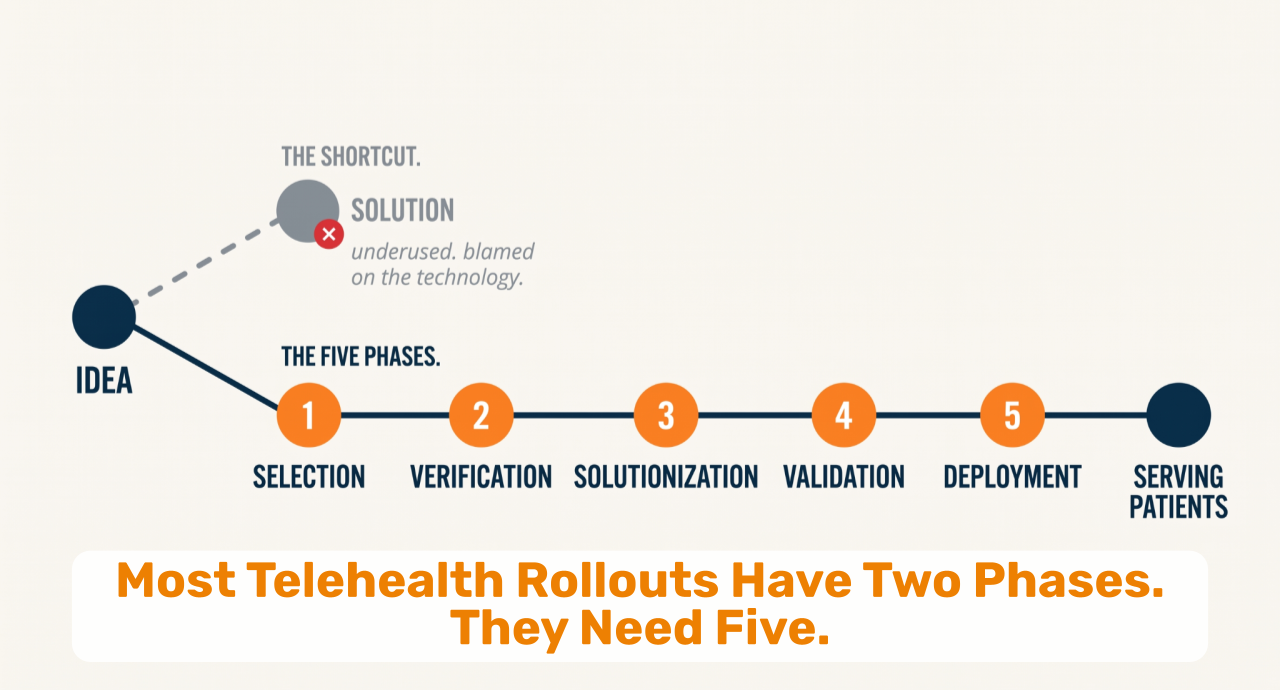
Technology selection is the easy part. The harder and more consequential work is designing workflows that integrate seamlessly into existing operations, engaging clinical staff as co-designers rather than end users, and building the organizational infrastructure to sustain the program over time. Rural hospitals that approach telehealth this way consistently see improvements across patient outcomes, clinician satisfaction, and financial performance.
RHTP creates a meaningful opportunity to invest in exactly that infrastructure — not just to acquire new technology, but to build the implementation capacity that makes technology deliver on its promise.
The question isn’t whether rural hospitals are better off because of telehealth. It’s whether they’re positioned to implement it well. If you’re not sure where your organization stands, that’s a good place to start the conversation.
Ready to assess the strategic value of a telehealth program for your rural hospital — or build the case for expanding it? Reach out to start the conversation.

To receive articles like these in your Inbox every week, you can subscribe to Christian’s Telehealth Tuesday Newsletter.
Christian Milaster and his team optimize Telehealth Services for health systems and physician practices. Christian is the Founder and President of Ingenium Digital Health Advisors where he and his expert consortium partner with healthcare leaders to enable the delivery of extraordinary care.
Contact Christian by phone or text at 657-464-3648, via email, or video chat.