


As the need for timely access to a wide variety of healthcare services, especially in rural areas, is increasing, Telehealth — “providing care at a distance” — bridges distances, transportation challenges, and lack of specialty care providers.
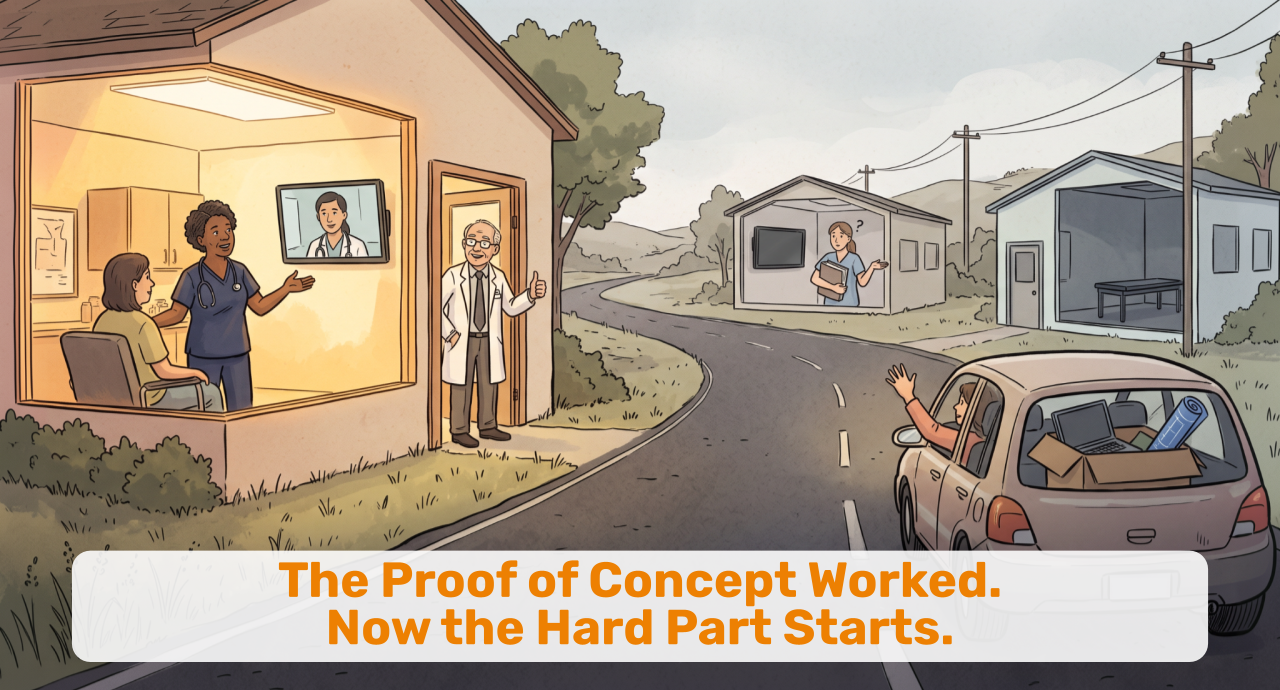
The Covid-19 health crisis proved, temporarily, how telehealth could reduce or even replace in-person care. With an investment of over $50 Billion dollars into rural health through the CMS Rural Health Transformation Program, a new opportunity exists to anchor telehealth once and for all into the care delivery system. But this time, rather than reacting in a frantic, unprepared way, the design of telehealth services and selection of vendors can be undertaken thoughtfully.
This is the first in a series of articles where — using the example of replacing an existing video visit solution with a new one — I will share the key principles behind the thoughtful way to select a telehealth vendor.
The 3 Stages of Vendor Selection
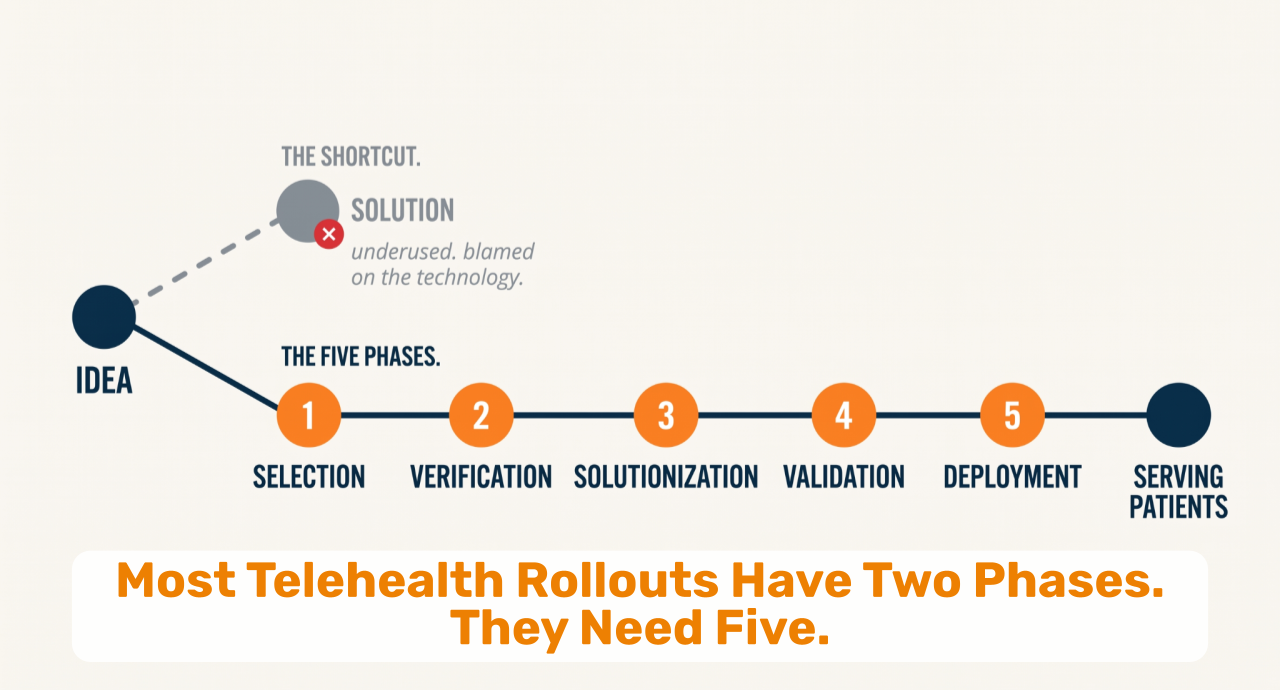
When an organization has decided to acquire or replace a telehealth solution, there are three distinct phases that should be followed:
A. Identify the needs and define the requirements
B. Evaluate and select a vendor
C. Implement and transition to the new solution
Regrettably, most organizations skip phase A entirely, leaving it up to IT to send out a Request for Proposal (RFP) to solicit bids from vendors. They also don’t pay sufficient attention to phase C, assuming the vendor will handle implementation — or relying solely on IT to “roll out” the new solution. (For more information on the latter, see “The Vendor Trap: Why Buying Telehealth Isn’t Implementing Telehealth”)
At the end of each part I will point out the consequences of not following the process, so that if your organization decides to skip a step, at least you are doing so consciously.
A. Identifying the Needs & Defining the Requirements
The first phase of selecting a telehealth vendor is all about truly understanding what kind of solution the organization needs now and in the future.
Since telehealth involves a “technology solution,” this step is oftentimes outsourced to the IT team, which in turn oftentimes only looks at the technical and integration requirements from their perspective. Some more mature IT teams have improved their technology selection process by involving key stakeholders, but many IT teams in smaller organizations (especially if the IT function is outsourced and mostly provides basic technical support) have not yet made this shift.
From my experience of evaluating and selecting telehealth vendors since 2008, here is the “best practice” process to identify needs and develop requirements:
-
Establish a multidisciplinary Vendor Selection Team
-
Identify the desired opportunities and, possibly, current problems
-
Identify the specific current and future Telehealth Services
-
Define the desired User Experience for clinicians and staff
-
Develop the desired Patient & Caregiver Experience
-
Design the desired workflows for all current and imminent telehealth services
-
Collect the technical/IT requirements
Healthcare is a Multidisciplinary Team Sport
The first step in the process is to “Establish a multidisciplinary Vendor Selection Team.” As I’ll show below, telehealth solutions will involve a multitude of users and impact numerous stakeholders.
Here is the typical composition of a multidisciplinary team that can ensure you are selecting a vendor that meets all the needs of all your users and stakeholders:
Clinicians – at least one representative from the clinicians who will be using the new solution to deliver care at a distance. In a community health center, this could be a primary care provider, a behavioral health provider, and a pharmacist. In a health system environment, specialty care providers may also be represented.
Nurses – part of a superb virtual care is the involvement of nurses, e.g., recreating the valuable “rooming” process we are accustomed to for in-person care, or for Remote Physiological Monitoring, to monitor vital the signs and support patients.
Schedulers (front office staff, patient care representatives, etc.) are at the front lines of patient communication to schedule or reschedule telehealth visits or to serve as a first line of support. While they most likely will not directly interact with the telehealth solution, they need to understand the logistics and how to communicate effectively with clinicians and patients.
IT Staff – while IT should not be leading or driving this effort (since this is more about clinical operations than a technical installation), their involvement and input is crucial to ensure appropriate support and a good technical fit of the solution. Preview: there is often less need for “integration” than most IT people would like you to believe. See Step 7 in the next article for more info.
Clinical Operations Leadership – this undertaking is about redesigning and redefining the operational support for the delivery of care, albeit at a distance. With that understanding, the selection of a telehealth solution falls under the jurisdiction of the leader for clinical operations, most likely in conjunction with their clinical counterpart (CMO or CMIO, if your organization has one). This leader would also be responsible for liaising with leadership and the CFO regarding the investment and the anticipated ROI.
Telehealth Operations Support – if your organization already has a designated Telehealth Coordinator or even a Director of Telehealth (or similar), this person is best suited to lead this effort and should definitely have a seat at the table. If you do not have a person identified for that role, think about who would be (a) developing the clinical workflows and (b) training the clinicians on the workflows and on the new solution.
If this sounds like a lot of “overhead”, consider the consequences if any of these perspectives are not represented. Ultimately the clinicians and nurses are the ones using the solution (along with patients, who rarely are directly represented in this group), so their involvement is key. Since telehealth success depends in part on good operational and technical support (including clinical training), the representation of the corresponding individuals is crucial as well.
If your organization does not already have a Telehealth Governance Team, then this group would be convening ad hoc, probably for 4-6 meetings, to discuss and prioritize the various elements and make joint consensus decisions.

Where Are We Now and Where Are We Headed?
Since the selection of a telehealth solution is about the future, a good starting point is always to assess where you are and where you want to go.
Thus the second step in our process is to “Identify the Current Problems and develop a Future Vision”.
Obviously something prompted someone at the organization to make a push for a telehealth solution. To get everyone on the same page and to ensure that the solution actually addresses current challenges and meets organizational needs, it is crucial to systematically collect, review, and prioritize these two “Yin and Yang” aspects of what’s important.
For organizations replacing an existing solution, the collection of current problems starts ideally with conversations with or a survey of clinicians using the current solution to identify the key challenges that are driving this change. Having this knowledge is not only valuable for finding a solution that fits better, it also is a key input in the change management process, as you can point to the resolution of current issues as a key benefit of embracing the new solution.
For organizations launching a new telehealth service, this step focuses on identifying the access barriers, care delivery gaps, and operational challenges that telehealth could address. What problems are you trying to solve? Is it specialty care access? Patient transportation barriers? After-hours coverage? Workforce recruitment and retention? Understanding these pain points will guide your requirements.
Regardless of where you’re starting from, you also need a perspective on the future of telehealth in your organization: What is the vision for a telehealth solution that would be a great fit? What could it do? What experience would clinicians and patients have? The details of this perspective will be further refined in the next steps, but it is important to capture, especially from executive leaders, what their vision of the future is.
If your organization already has a telehealth strategy or a digital health strategy, then the vision should be taken directly from the objectives of those strategies.
It’s All About the Service
In the third step, the goal is to “identify the specific current and future telehealth services.”
What this means is to identify the numerous different scenarios for how your clinicians could deliver care at a distance using various telehealth modalities.
To give you some ideas, here’s a quick list of different common telehealth services:
-
Primary Care prescheduled video visits, e.g., follow-up appointments
-
Behavioral Health prescheduled video visits for ongoing counseling
-
Site-to-site video visits where the patient presents at a different location – with or without live exam
-
Remote Clinician video visits where the patient is in the clinic, but the clinician is remote
-
Primary Care ad hoc video visits (same day appointments)
-
School-based, pre-scheduled primary care video visits
-
School-based ad hoc primary care visits with physical exam tools
-
School-based counseling video visits
-
Behavioral Health Crisis visits via video in the Emergency Department
-
Telestroke with outsourced neurologists in the Emergency Department
-
Post-discharge virtual medication reconciliation by a pharmacist
-
Chronic Care Management video visits with patients in an RPM program
-
Remote Physiological Monitoring for manage patients with multiple chronic conditions
-
Remote Physiological Monitoring to prevent 30-day readmissions or admission to
-
etc.
For more ideas, see the MATRC Vendor Selection Toolkit or articles like “96 Common Video Telemedicine Scenarios” and “9 Ways to Deliver Extraordinary Care Virtually”.
The purpose of this “exercise” (typically prepared by the Telehealth Coordinator and then reviewed by the multidisciplinary Vendor Selection team) is to get a feel for how your organization is planning to use telehealth in the future to serve its patients better. This will help you become clear about the substantive, foundational “use cases” for the solution that you want the new vendor to support flawlessly.
As you’ll see later, vendors will share with you all the bells and whistles they’ve developed (of course, all AI-enabled!) but it’s the day-to-day basics that matter most. It’s the functionality that clinicians, patients, and staff will use 80% or 90% of the time.
As you identify what telehealth services you are delivering now and what you want to do in the foreseeable future, this understanding will greatly enhance your ability to find and confirm a vendor that best fits your needs.
Building a Solid Foundation
At this point, we’ve completed step 3 of 7 in the first phase of vendor selection. With a multidisciplinary team established to drive the selection process, coupled with a documented understanding of current challenges and future vision, your organization has built a strong foundation for making an informed decision.
In the next article, we will continue with the remaining four steps of systematically gathering the needs and requirements of key stakeholders.
Have you selected a new video visit vendor in the past 2 years? I’d love to hear how you approached this undertaking and what you learned from it. Please set up a quick chat with me so I can pass on your learnings to the readers of Telehealth Tuesday.

To receive articles like these in your Inbox every week, you can subscribe to Christian’s Telehealth Tuesday Newsletter.
Christian Milaster and his team optimize Telehealth Services for health systems and physician practices. Christian is the Founder and President of Ingenium Digital Health Advisors where he and his expert consortium partner with healthcare leaders to enable the delivery of extraordinary care.
Contact Christian by phone or text at 657-464-3648, via email, or video chat.