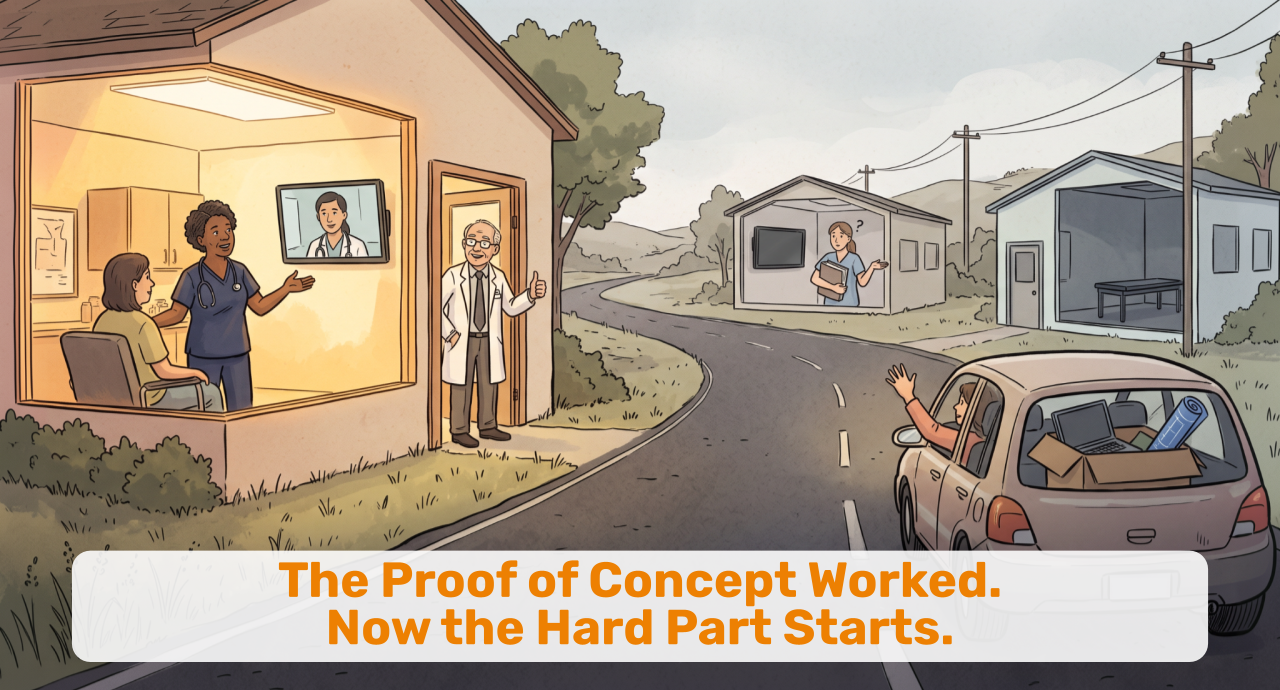


The Rural Health Transformation Program (RHTP) has attracted a lot of attention — and a lot of vendors. Within weeks of states announcing their RHTP funding awards, technology companies began marketing aggressively to rural healthcare organizations. Telehealth Booths. AI platforms. Remote monitoring solutions. Digital health tools of every description. The message, stated or implied, is consistent: here is your solution. Here is how to spend your funding.
That is what vendors do, and it is hard to fault them for it. $50 billion creates a market.
But here is the harder question — the one nobody seems to be asking:
What are YOU trying to build?
The Survival Trap
To understand why that question goes unasked, it helps to understand the mindset most rural healthcare leaders bring to RHTP. These are organizations that, in many cases, are running on thin margins, managing workforce shortages, watching neighboring facilities close, and trying to maintain access to care for communities that have few alternatives. Survival is not a metaphor. It is a daily operational reality.
So when RHTP funding arrives, the instinct is entirely understandable: How does this help us? What can we do with this money to stabilize what we have? That is not a failure of vision. It is a reasonable response to genuine pressure.
CMS demands outcomes. States need to demonstrate results to CMS. Healthcare leaders want to keep the doors open. Vendors want contracts. Everyone has a legitimate interest in RHTP — and every single one of those interests is focused on the immediate: the program, the technology, the deliverable, the money.
But here’s the thing. Not one of those parties is thinking:
This is our chance to permanently change how we adopt innovation.
The Gap Nobody Is Naming
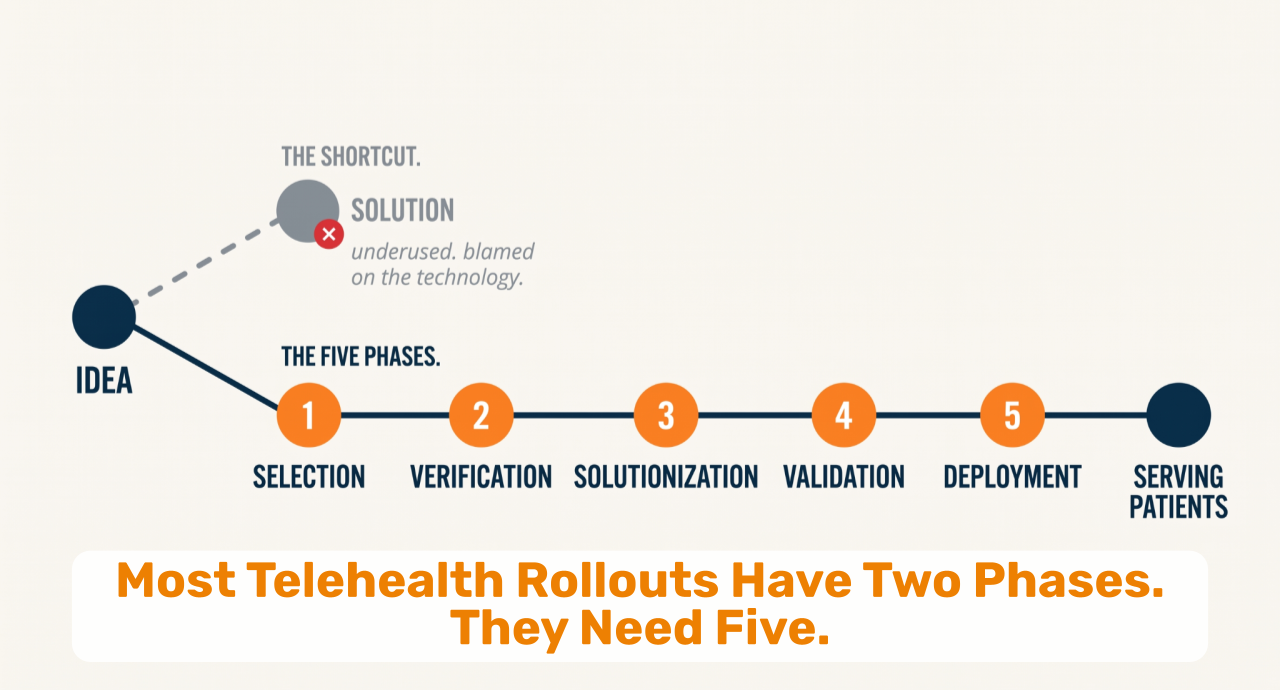
Healthcare has a well-documented problem with innovation adoption. The solutions exist. The evidence exists. The funding, periodically, exists. What consistently fails is the systematic implementation — the organizational discipline to take a promising innovation from concept to sustained, measurable performance.
Most rural healthcare organizations have never built that discipline. They are, as many leaders will readily admit, very good at running things, maybe even at optimizing things.
They are far less practiced at launching new things. Running operations and launching innovation require fundamentally different skills, different mindsets, and different organizational infrastructure. Project management. Change management. Clinical workflow design. Proof-of-concept validation. Performance monitoring. These capabilities do not develop on their own.
For the past two decades, digital health grants have followed a familiar pattern: money arrives, programs launch, grant periods end, programs quietly disappear. The technology gets shelved. The clinicians return to familiar routines. The organization moves on — no better equipped to launch the next innovation than it was before.
Outcome accountability alone does not build organizational capability.
RHTP was designed to break that pattern. CMS built in outcome accountability specifically to prevent funding from evaporating without results. That is meaningful progress. But outcome accountability alone does not build organizational capability. It measures what happens. It does not change how organizations approach the work.

The Savior in Sheep’s Clothing
At the risk of mixing a metaphor or two: RHTP arrives dressed like a grant cycle. It looks like RFPs, deliverables, compliance reports, and outcome metrics. Mostly unremarkable wool, as grant programs go.
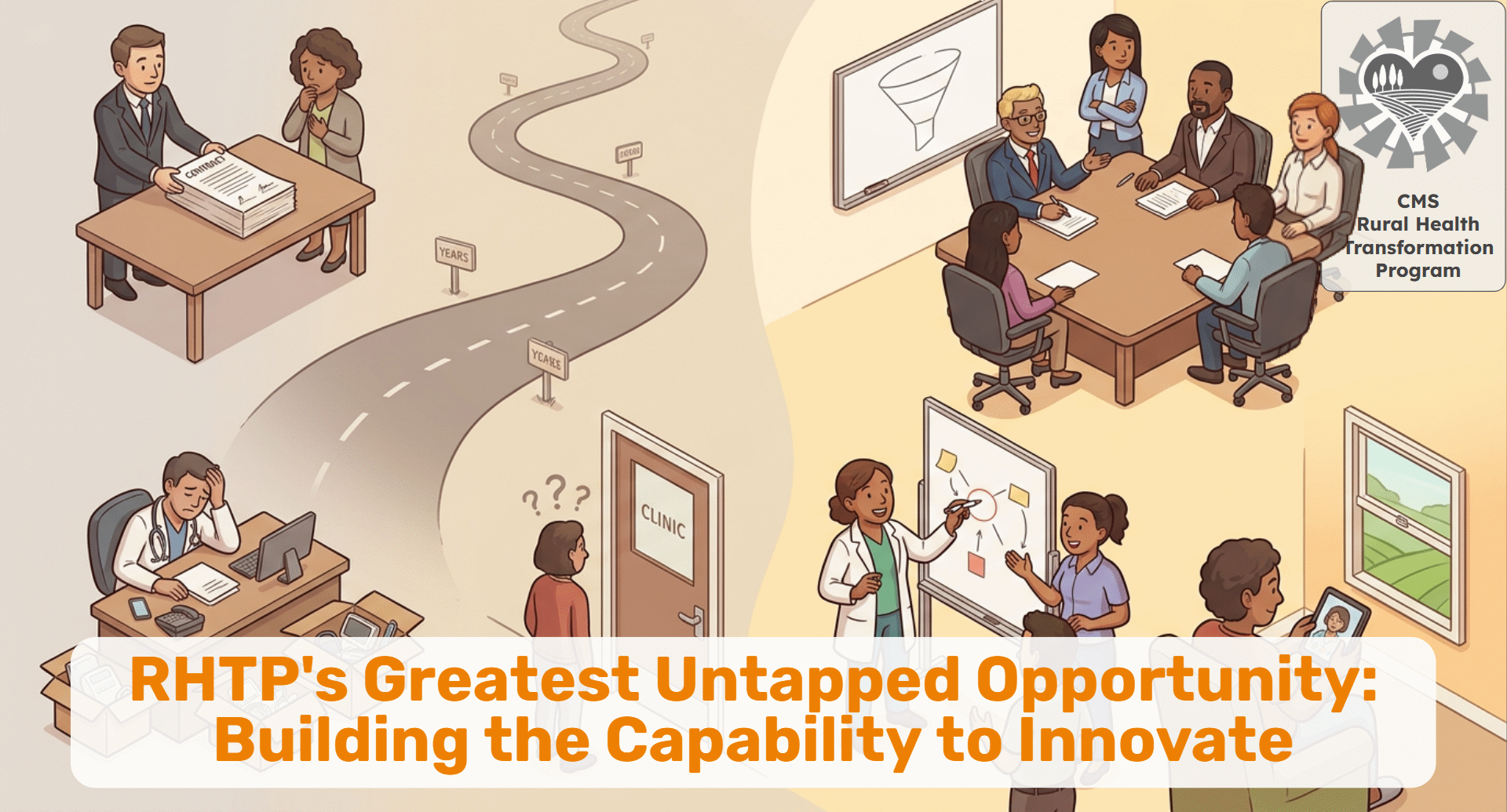
But inside that wool is something that rural healthcare has rarely had access to all at once: the external pressure, the dedicated resources, and the structured five-year timeline to build something most organizations have never been able to justify building on their own — to build the internal capacity for a systematic, repeatable approach to selecting and implementing innovation. Over and over again, long after the RHTP funding is gone and innovative technologies continue to bombard healthcare leaders.
Here is the mindset that changes everything: every RHTP initiative, implemented well, is also an exercise in mastering implementation science.
When a rural health organization successfully launches a remote patient monitoring program — not just deploys the devices, but engages clinicians as co-designers, builds the workflow, trains every role, runs a proof of concept, monitors performance, and adjusts — it learns something that no vendor can provide and no grant can buy outright. It learns how to do this.
That knowledge compounds. The second initiative is easier than the first. The third is easier still. The organization begins to develop what we call Innovation Adoption Maturity — the internal capability to evaluate innovations systematically through a strategic, financial, and clinical lens; to prioritize based on genuine need rather than vendor enthusiasm; to implement with discipline rather than hope.
But this capability will not develop spontaneously. It is transferred. The organizations that emerge from RHTP with genuinely stronger innovation adoption muscles will be the ones that partnered with experienced implementation advisors — not vendors selling a platform or a service, but partners who have launched these programs before, who bring a proven methodology, and whose measure of success is not whether the technology is deployed but whether the organization can do it again without them.
That knowledge transfer — from experienced implementer to organizational leadership — is the investment that outlasts any single RHTP program.
But it only happens if someone is intentional about it. And right now, in most organizations, nobody is.
What Intentional Looks Like
Building Innovation Adoption Maturity through RHTP does not require a separate initiative or a new budget line. It requires a different frame for the work already planned or already underway.
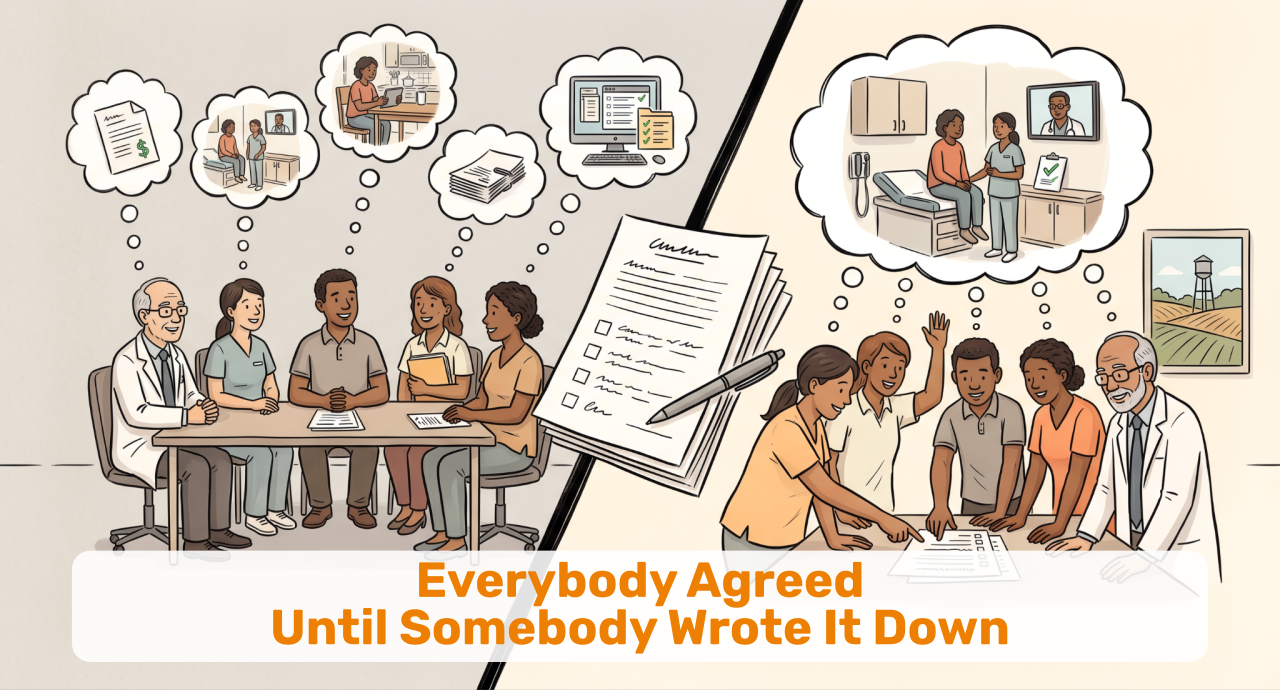
It starts with how an organization selects its RHTP initiatives. Rather than responding immediately to vendor pitches or state’s RHTP funding offers, the question is:
What urgent, costly problem are we trying to solve?
That problem-first approach — defining the challenge before discovering the solution — is the foundation of systematic innovation adoption, and it produces far better outcomes than technology-first procurement.
It continues with how the organization structures implementation.
Every RHTP program launch should first be treated as a proof of concept validation before it is treated as a deployment. Assumptions should be named and tested. Clinical workflows should be designed with clinician input, not handed down as requirements. Training should be role-specific and ongoing, not a one-time event at launch. Performance should be monitored against defined indicators from day one.
And it extends to how leadership reflects on what it is learning.
After each initiative, the questions worth asking are not only “did we hit our metrics?” but “what did we learn about how we implement? What would we do differently? What capability do we now have that we did not have before?”
The Vision Worth Pursuing
In the fall of 2031, when RHTP funding cycles are complete and CMS is assessing outcomes, four very different kinds of rural healthcare organizations will exist.
Some never pursued the funding at all — too stretched, too cynical, or simply too consumed by the daily demands of keeping their doors open. They watched from the sidelines while others took the field.
Some pursued the funding but, regrettably, did not achieve the outcomes. The programs stalled. The technology went unused. The clinicians disengaged. CMS came knocking. These organizations will carry the hard lessons of what happens when implementation is treated as an afterthought or punted to the vendors.
Some will have successfully launched programs, hit their metrics, and satisfied every requirement — only to quietly return to business as usual when the funding ends. The technology will remain. The organizational capability to build on it will not have grown. They succeeded at RHTP and missed the larger opportunity.
And then there will be a fourth group. These organizations used RHTP not just to launch programs but as the forcing function to build something that has eluded rural healthcare for decades: a systematic, repeatable capability to adopt innovation. They will be able to launch new initiatives quickly in months rather than years. Their clinicians will be genuine partners in care delivery innovation. Their leaders will approach the next challenge — whatever it is — with the confidence that comes from having done this before, and done it well.
That fourth path is available to every organization participating in RHTP. But it requires asking a different question than the one most are asking right now.
Not: how do we spend this money?
But: how do we use this moment to become an organization that knows how to innovate?
At Ingenium Digital Health Advisors, helping rural healthcare organizations build lasting innovation adoption capability is at the core of everything we do.
Don’t believe me? Check out Sheila’s testimonial attesting to our achievement to transform their organizational thinking in this rural community health center.
If your organization is navigating RHTP implementation and wants to make the most of this moment, we’d welcome the conversation. Contact Christian to set up a call.

To receive articles like these in your Inbox every week, you can subscribe to Christian’s Telehealth Tuesday Newsletter.
Christian Milaster and his team optimize Telehealth Services for health systems and physician practices. Christian is the Founder and President of Ingenium Digital Health Advisors where he and his expert consortium partner with healthcare leaders to enable the delivery of extraordinary care.
Contact Christian by phone or text at 657-464-3648, via email, or video chat.