

Ask a rural health leader how their telehealth program is doing, and you will usually hear a number: visits per month, the share of behavioral health appointments delivered by video, or the name of the one physician who loves it.
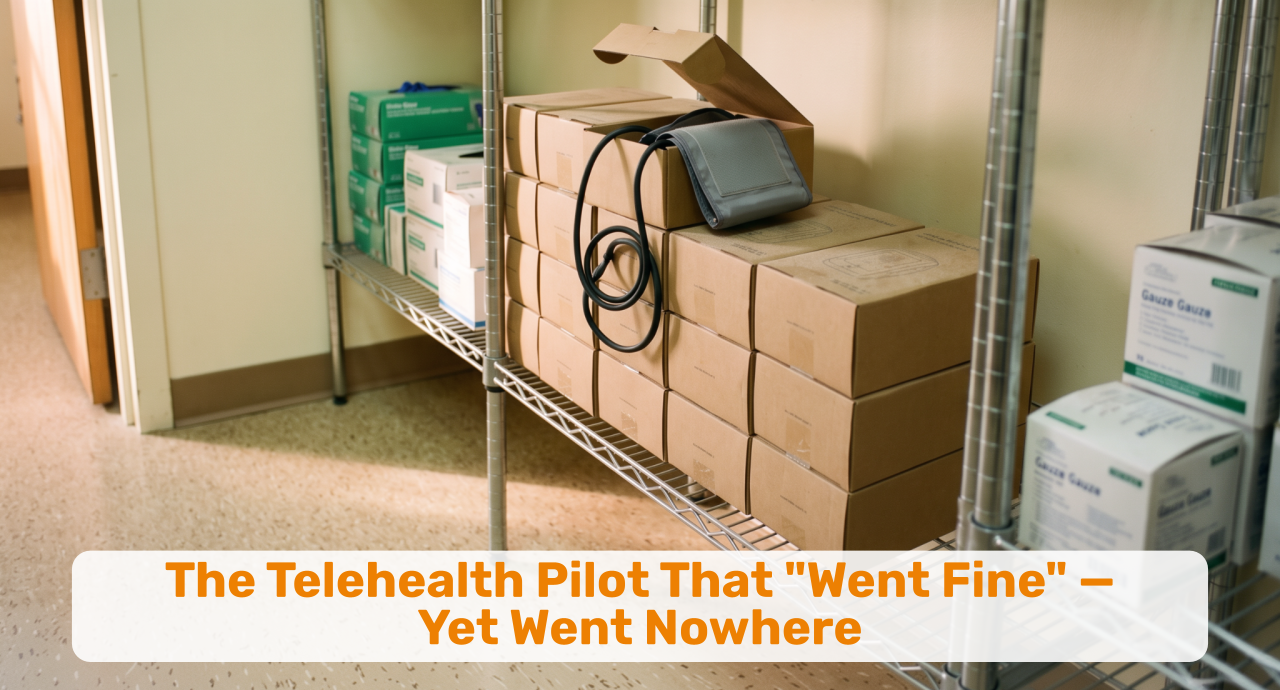
Those numbers matter. But they don’t tell you whether the program will survive its champion leaving, the end of a grant, or a request to launch a new service in six weeks. They describe activity, not capability.
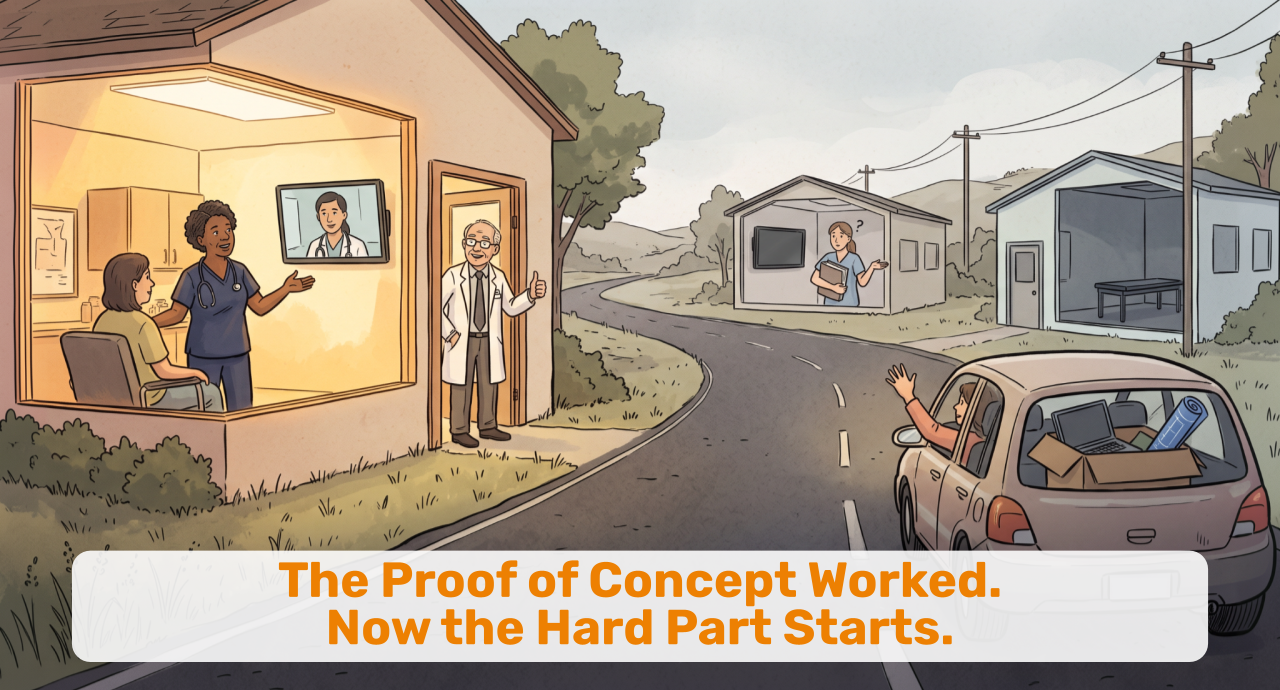
That difference becomes expensive as states invest Rural Health Transformation Program (RHTP) funds in telehealth and digital health. Funding can buy platforms, devices and access points. It cannot buy an organization’s ability to run, support and grow those services. That ability has to be built, and it is built in a predictable order.
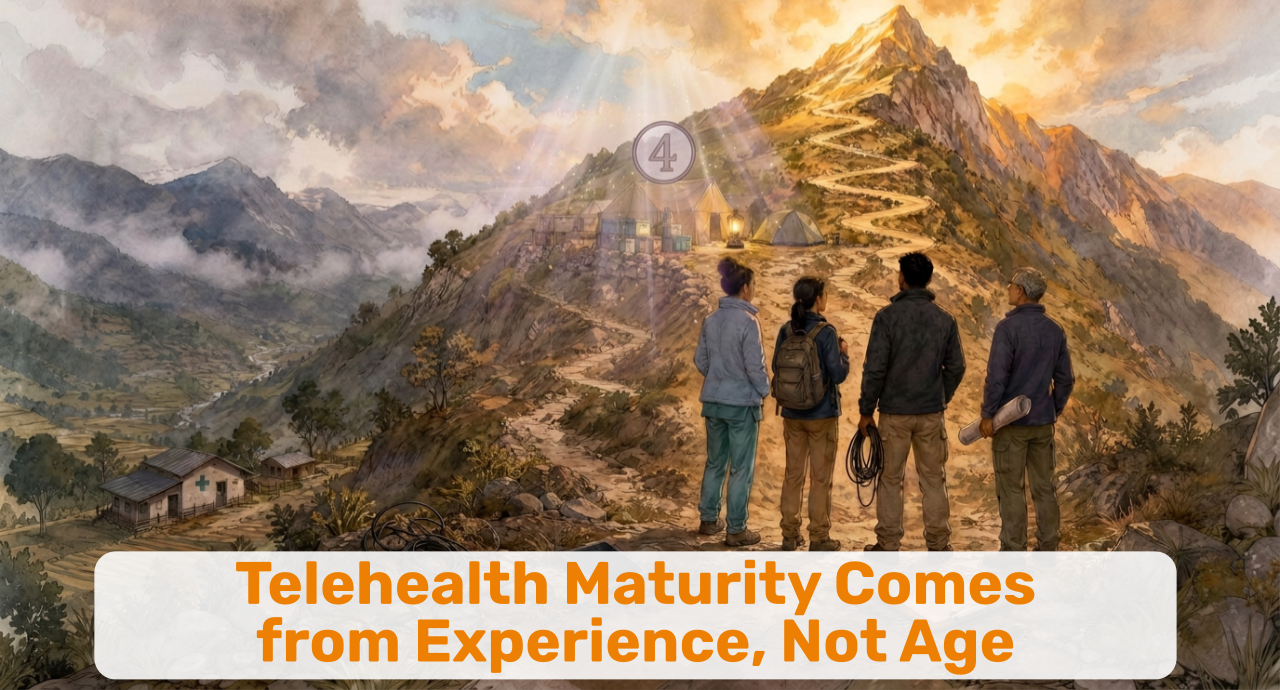
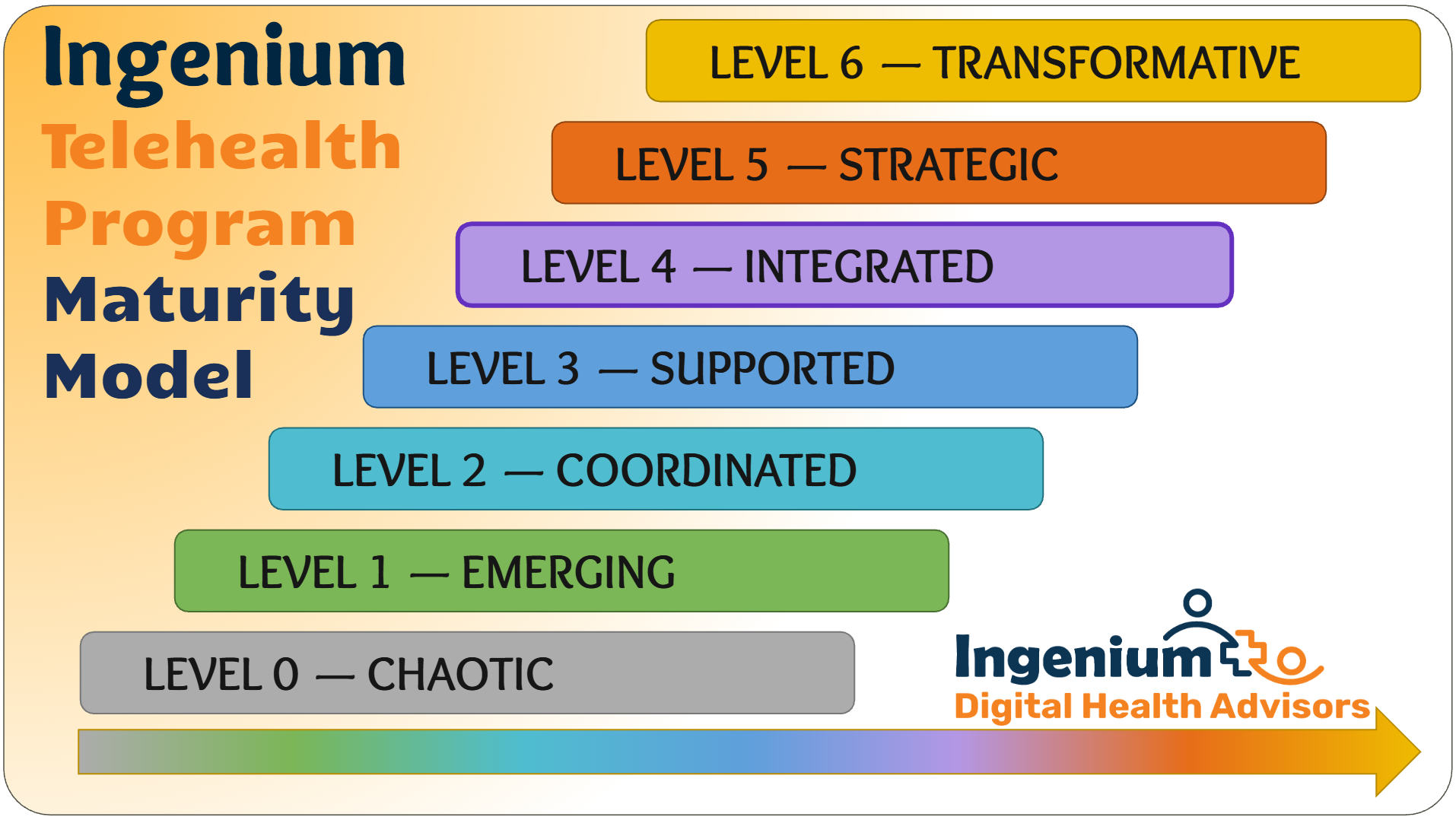
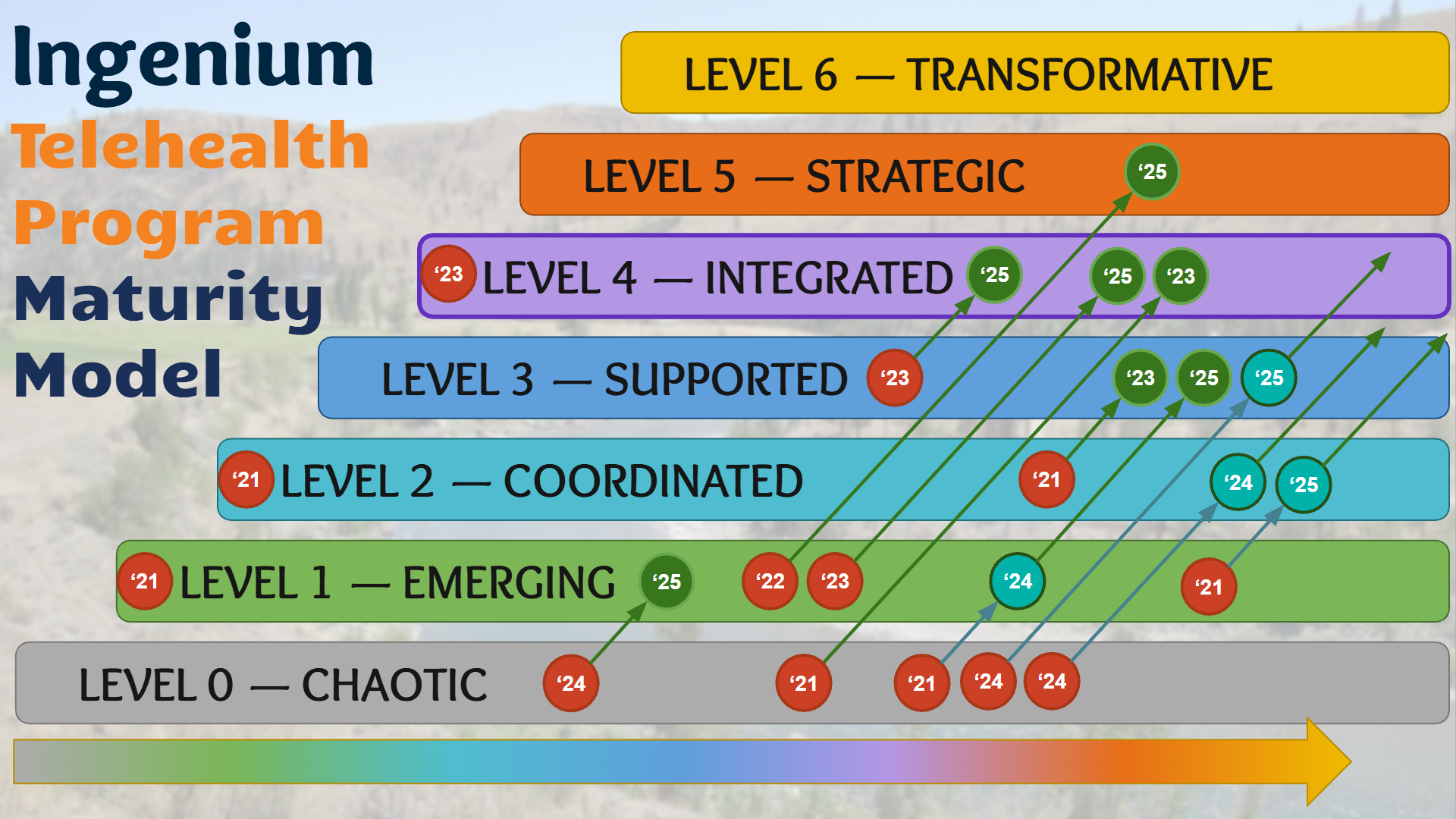
Our Telehealth Program Maturity Model maps that order in seven levels, from Level 0: Chaotic, to Level 6: Transformative. Think of it as a climb. Level 6 is the summit, but Level 4: Integrated, is base camp: the point every program should reach first, and the one that makes the rest of the climb possible.
What “capability maturity” means
The concept comes from software engineering. In the early 1990s, the Software Engineering Institute at Carnegie Mellon University published the Capability Maturity Model. It described how organizations move from improvised, hero-dependent work to processes that are repeatable, managed and continuously improved.
The central insight carries over to telehealth: maturity comes from experience, not from age. A program launched in 2020 is not mature because it has been running for years. It is mature when the organization can deliver, support and expand telehealth services reliably, regardless of who happens to be on staff.
Three principles follow from that:
-
Maturity is mostly sequential. Each level builds the foundation the next one needs. You can move faster with good guidance, but you can’t skip the lessons.
-
Maturity is a profile, not a score. An organization can offer many telehealth modalities and still have no governance or sustainable funding. The uneven spots are where programs break.
-
Maturity is built, not bought. In our 90/10 Rule, technology accounts for about 10% of telehealth success. The other 90% is implementation: support, workflows, leadership and governance.
We developed the Telehealth Program Maturity Model to make that progression visible. We have used it with rural hospitals, FQHCs, and behavioral health agencies for years, and have now revised it with twelve dimensions that reflect what we see in the field.
The seven levels of telehealth program maturity
The model has seven levels, numbered 0 through 6. Each describes how an organization delivers and sustains telehealth, not just how much of it there is.
-
Level 0, Chaotic. Telehealth starts ad hoc, often reactively, with little thought to clinical or financial viability. Every clinician does what works for them, and no one is responsible for the whole.
-
Level 1, Emerging. Word gets out that telehealth is happening. Leadership is aware, someone in IT helps when asked, and sustainability is assumed rather than measured.
-
Level 2, Coordinated. Clinicians and teams begin to coordinate. Leadership is supportive but has not assigned resources, so success depends on the passion of a few individuals.
-
Level 3, Supported. A central team provides formal technical and operational support, often with part-time assigned staff. Governance appears, telehealth has a budget, and patients are interested rather than reluctant.
-
Level 4, Integrated. Support is funded with dedicated staff, governance is established, and leadership is actively engaged. Telehealth spans most specialties and many modalities, and services at least break even.
-
Level 5, Strategic. Telehealth drives the organization’s strategic objectives. Growth is managed, support is proactive, and services generate value rather than merely covering costs.
-
Level 6, Transformative. The organization uses telehealth to redefine how care is delivered, with virtually all modalities in use and support that keeps evolving.
A simpler way to hear the same progression: programs at Levels 0 and 1 are trying to survive. At Levels 2 and 3 they are alive. At Level 4 they arrive. At Levels 5 and 6 they thrive.
Twelve dimensions, two kinds
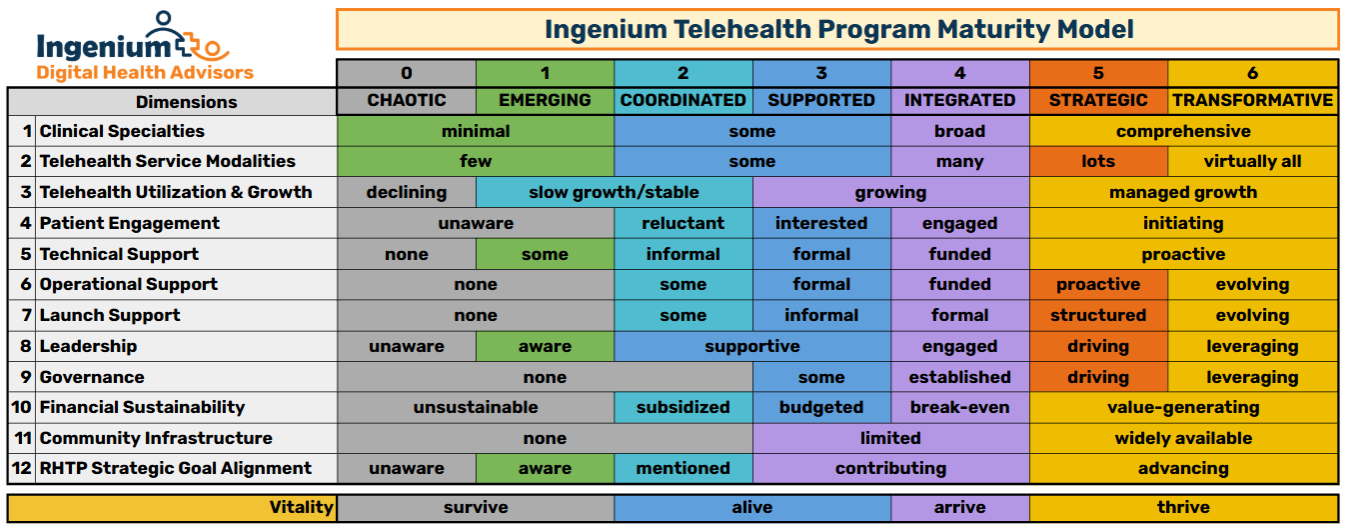
A single level is too blunt to act on. So the model assesses twelve dimensions, each rated on the same 0–6 scale. They fall into two groups.
Reach: what your program delivers
-
Clinical Specialties: how many specialty areas actively use telehealth for patient care.
-
Telehealth Service Modalities: the range of service types in use, such as video visits, remote patient monitoring and asynchronous care.
-
Telehealth Utilization & Growth: the pace and intentionality of expansion.
-
Patient Engagement: how well patients are prepared and supported to use telehealth, through tech checks, onboarding and education.
-
Community Infrastructure: the access points that let patients connect, such as school or library sites, mobile units, device lending and broadband.
Capability: what sustains it
-
Technical Support: the existence and formality of IT support for telehealth.
-
Operational Support: non-technical support for day-to-day telehealth delivery.
-
Launch Support: structured help to launch new services, including workflow design, training and go-live assistance.
-
Leadership: how aware, engaged and active senior leaders are in driving telehealth.
-
Governance: whether a formal telehealth governance structure exists and how mature it is.
-
Financial Sustainability: whether services run on durable revenue, such as reimbursement and payer contracts, rather than grants.
-
RHTP Strategic Goal Alignment: for our clients, as part of our RHTP engagements, we also assess how well the organization’s telehealth program supports its state’s RHTP goals.
The split is intentional. Leaders tend to measure reach, because it is visible. But reach follows capability. You can’t sustainably add specialties or modalities faster than your support, governance and funding can carry them. That is the 90/10 Rule again, in a different form.
Why Level 4 is the goal
Level 4: Integrated, is base camp, and it is the goal we set with every client. It is the point where telehealth stops depending on heroes.
Look at the assessment chart above at what changes between Levels 3 and 4: Technical and operational support move from formal to funded, with dedicated staff rather than borrowed hours. Governance moves from “some” to established. Leadership moves from supportive to engaged. Telehealth services move from budgeted to break-even.
Patients feel the difference too. At Level 3, a pre-visit tech check happens when a patient asks for one. At Level 4, it is standard routine.
Level 4 is also what makes Levels 5 and 6 possible. An organization can’t use telehealth to drive its strategy, or to redesign care delivery, while it is still fighting to keep video visits running.
There is one rule about how to get there: If any dimension sits below Level 3, bring everything up to Level 3 first. Then move to Level 4. A program with many modalities but no governance, or broad specialty use but no funded support, is fragile. Its weakest dimensions set the ceiling for everything else.
We have watched this play out. Over five years, we mapped the telehealth maturity of 13 rural health care organizations in Virginia, Vermont and Washington. Where leaders engaged, programs climbed: four reached Integrated or beyond, and one moved from Emerging to Strategic in about three years. Where leaders stayed on the sidelines, programs barely moved. Three organizations never engaged, and two only made it from Chaotic to Emerging.
The technology was much the same across all 13. What differed was leadership, which is why it is one of the twelve dimensions, and often the one that sets the ceiling.
Where this series goes next
RHTP is giving rural organizations a rare chance to build telehealth programs that last beyond the funding period. The organizations that get the most out of it will be the ones that invest in capability, not just reach.
The rest of this series takes the model apart. The next two articles walk through the reach and capability dimensions in detail. Then we look at how to assess where you stand and chart a course to Level 4, and finally at what becomes possible at Levels 5 and 6.
In the meantime, ask yourself one question: which of the twelve dimensions is holding your program back? If you’d like a second opinion, or help assessing where your telehealth program stands, reach out. We’re happy to talk it through.

To receive articles like these in your Inbox every week, you can subscribe to Christian’s Telehealth Tuesday Newsletter.
Christian Milaster and his team optimize Telehealth Services for health systems and physician practices. Christian is the Founder and President of Ingenium Digital Health Advisors where he and his expert consortium partner with healthcare leaders to enable the delivery of extraordinary care.
Contact Christian by phone or text at 657-464-3648, via email, or video chat.