

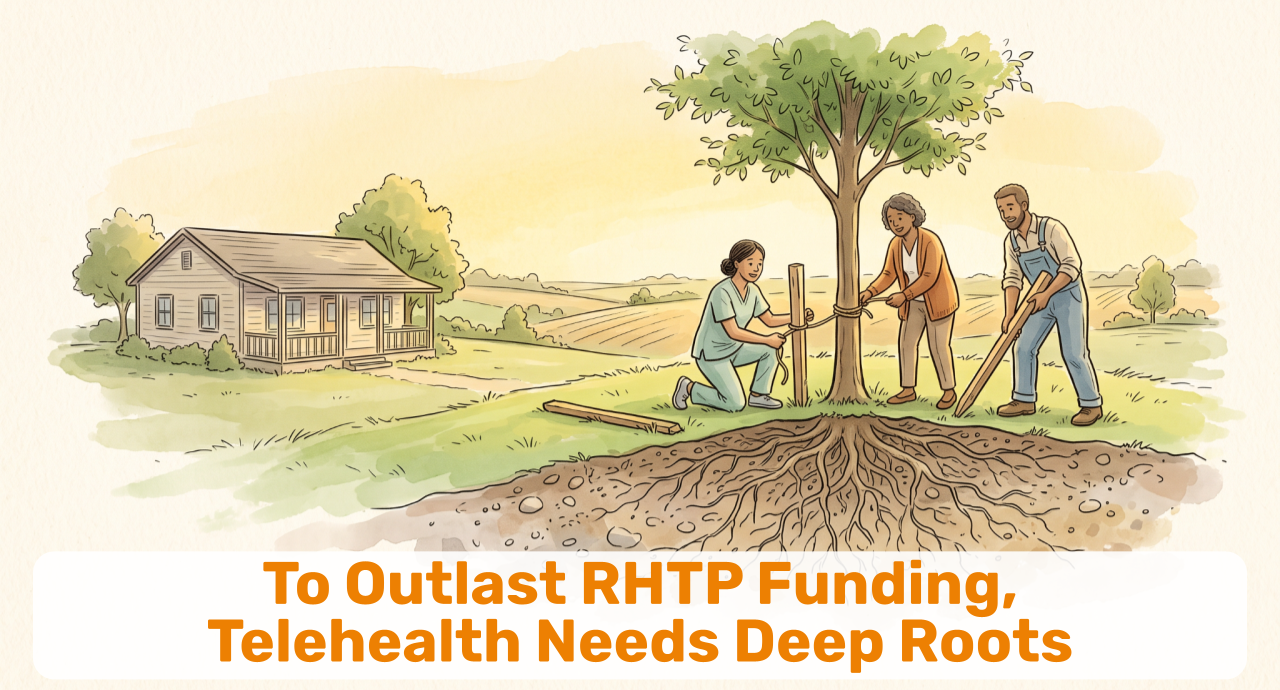
Most rural telehealth programs started with outside money: a pandemic-era grant, a foundation award, a federal program. That money did its job. It bought the platform, the carts and the first year of a telehealth coordinator’s salary.
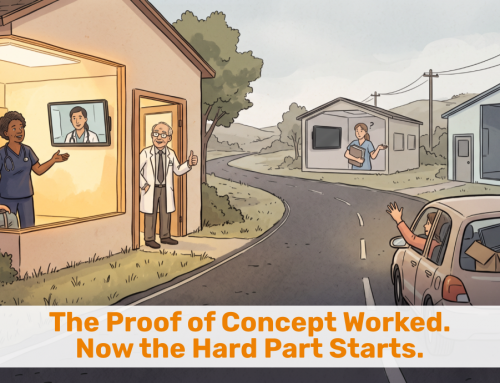
The harder question comes later. When the grant ends, does the program keep running? Too many programs answer that question the hard way, when a coordinator position isn’t renewed and the services quietly shrink.
The Rural Health Transformation Program (RHTP) makes the question more urgent, not less. It is putting significant funds into rural telehealth, for a limited time, oftentimes just 9 to 12 months. The organizations that benefit most will be the ones that use the funding to plan for the day the funding ends.
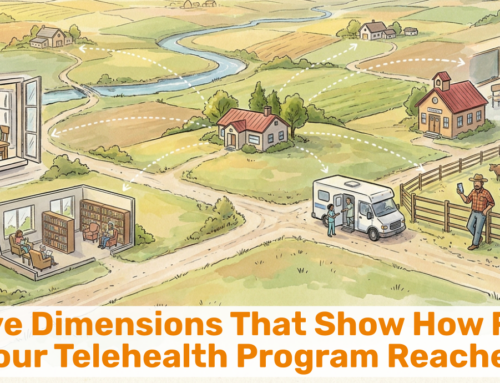
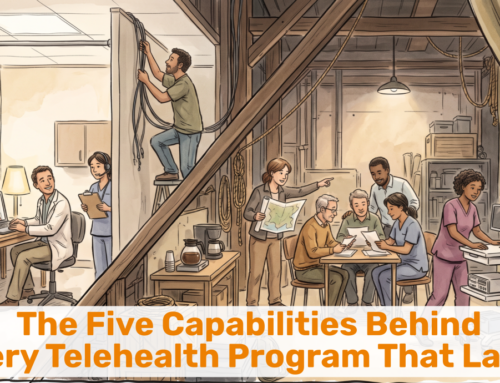
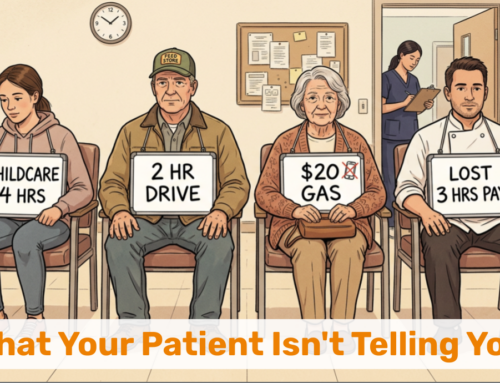
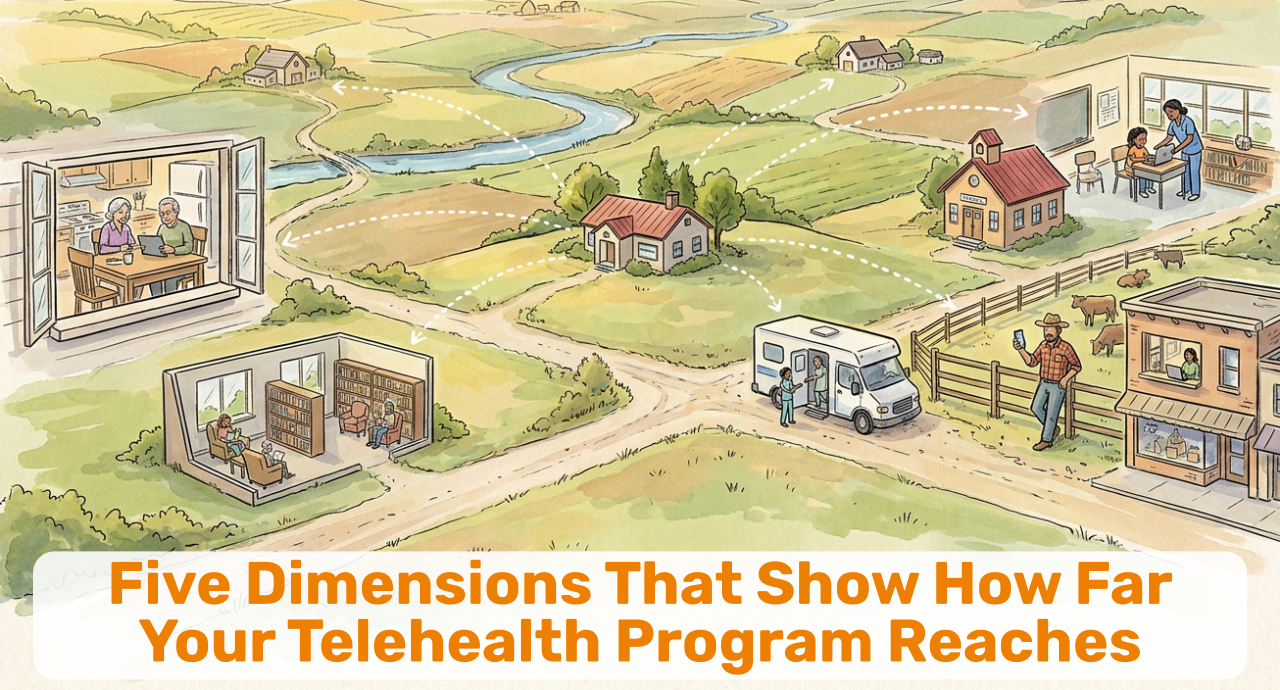
Our Telehealth Program Maturity Model rates a program on twelve dimensions, each across seven levels, from Level 0, Chaotic, to Level 6, Transformative. Level 4, Integrated, is the goal we set with every client. The dimensions fall into three groups: capability, what builds the program; reach, what it delivers; and sustainability, whether it lasts. The previous two articles covered capability and reach. This one covers the two sustainability dimensions: financial sustainability and alignment with your state’s RHTP goals.
1. Financial Sustainability: from ‘unsustainable’ to ‘value-generating’
This dimension measures how telehealth is funded, long-term.
At Levels 0 and 1, telehealth is unsustainable: it depends mainly on grants or other temporary funding. At Level 2 it is subsidized, as the organization covers the costs that reimbursement doesn’t. At Level 3 it is budgeted, with a defined budget and a business case. At Level 4 it breaks even: reimbursement and savings together cover the cost of providing it. At Levels 5 and 6 it is value-generating, producing direct and indirect financial value that funds further investment and growth.
Two things are easy to miss. First, grant funding isn’t the problem. Depending on it is. A grant that pays for a launch while the organization builds a business case is good use of outside money. A grant that pays for operations indefinitely is a countdown.
Second, break-even rarely comes from reimbursement alone. Increasing revenue and savings count too: fewer no-shows, fewer patient transfers, less staff travel between sites, and clinician time used more efficiently. Reimbursement matters, of course. As of this writing, Medicare’s telehealth flexibilities for video and audio visits are extended through the end of 2027. Bipartisan support for making them permanent is strong, but until Congress acts, building value beyond reimbursement is the prudent path.
What holds this dimension back from the top levels is a lack of managed performance. Most rural health clinics and community health centers don’t even track telehealth revenue, let alone the indirect value, such as patient loyalty, patients kept in the community, specialists reached without a three-hour drive, and clinicians retained because their schedules work. A program can’t be recognized as value-generating until someone measures the value it generates. Our Measuring Telehealth Success series shows where to start.

2. RHTP Strategic Goal Alignment: from ‘unaware’ to ‘advancing’
For our clients, as part of our RHTP engagements, we also assess how well an organization’s telehealth program supports its state’s RHTP goals.
At Level 0, the organization is unaware of those goals. At Level 1 it is aware of them, but its telehealth work isn’t linked to them. At Level 2 telehealth is mentioned in its plans or applications in connection with RHTP. At Levels 3 and 4, telehealth is contributing: its goals are linked to RHTP priorities, and the organization tracks how telehealth contributes to them. At Levels 5 and 6, telehealth is advancing those goals as a key part of the organization’s longer-term plans.
Why is this a sustainability dimension? Because alignment is what keeps a program relevant once the funding period ends. Programs that measurably advance their state’s priorities are the ones states, payers and partners keep investing in. Programs that were mentioned in an application and then left to run on their own are the first to fade.
What holds this dimension back from the top levels is treating RHTP as a funding source rather than a strategic investment. Many organizations write telehealth into an application, receive the funds, and report on spending. The organizations that reach “advancing” build their state’s goals into their own strategic plan, so telehealth keeps serving those goals whether or not a grant is attached.
With our clients, we aim to build telehealth programs that make their state’s RHTP look good, which increases the likelihood of future funding, even beyond telehealth.
Sustainability Starts with Leadership
Sustainability is first and foremost a leadership responsibility, shared with governance. Clinicians focus on their patients, the coordinator on keeping services running, IT on keeping systems up. Nobody’s job description includes asking whether telehealth will still be paid for three years from now. If leaders don’t put emphasis on sustainability, nobody will.
In practice, that means leaders and the governance group own three decisions: they require a business case before a new service launches, they decide when grant-funded roles move to the operating budget, and they review telehealth’s financial performance as routinely as any other service line.
It is no coincidence that leadership and governance are also the first two capability dimensions. Leaders can’t make a program sustainable by decree. Sustainability is the result of the other ten dimensions, and leadership is where those dimensions start.
Consider the composite Critical Access Hospital we follow through this series. Its telehealth program started during the pandemic. Since COVID-19 subsided, utilization has been low and flat. Now an RHTP grant pays for part of the clinic manager’s time as telehealth coordinator, and the grant ends after twelve months. Financially, the program is subsidized at best.
The hospital can’t reach break-even by negotiating better reimbursement alone. Break-even needs more patients using telehealth, which is reach. More patients need funded support and a formal launch process, which is capability. And funded support costs money before it pays for itself.
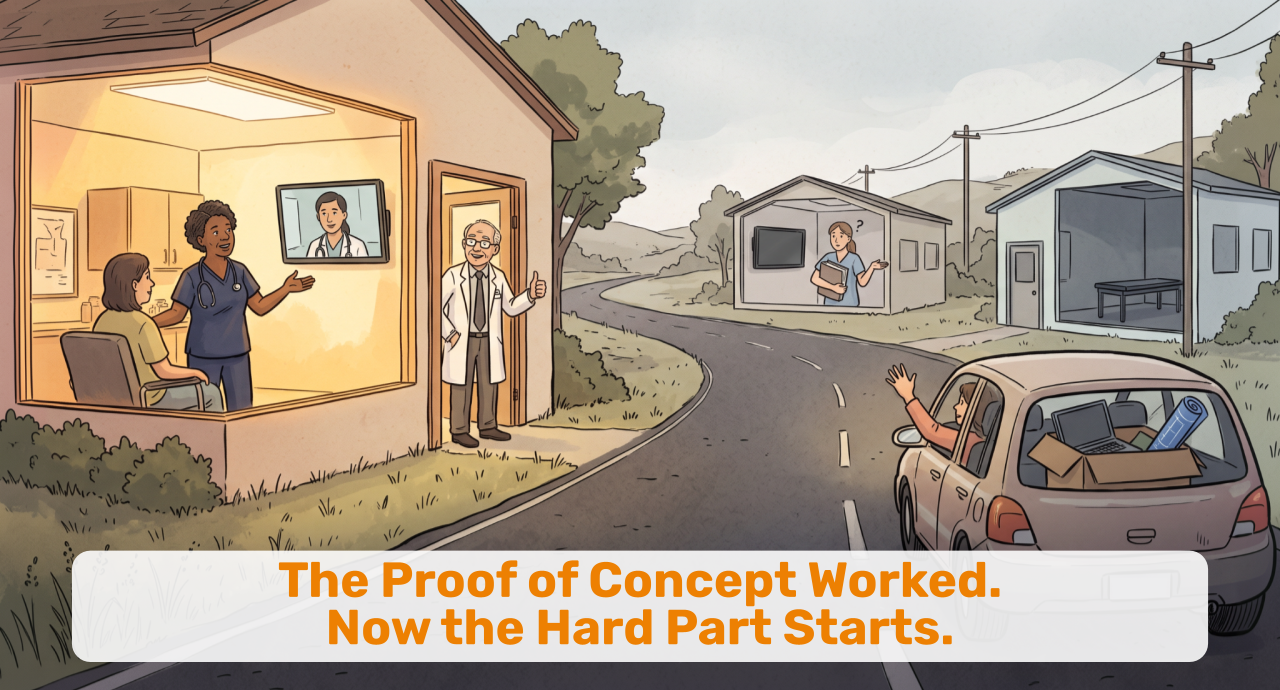
The way out starts with the CEO. Leadership decides to use the remaining grant period deliberately and charges the governance group with building a business case at Level 3: what a funded coordinator would cost, how many more visits and how much in savings that role should produce, and how the program advances the state’s RHTP priorities. Then it tests the business case with a proof of concept in one or two services, with the measures agreed up front. By the time the grant ends, leadership has the evidence to fund the role from the operating budget, and the state has a program worth continuing to support.
That is the pattern we see again and again: reach follows capability, sustainability follows both, and all three start with leaders who make sustainability a priority.
All twelve dimensions at a glance
With this article, the series has covered all twelve dimensions of the model:
-
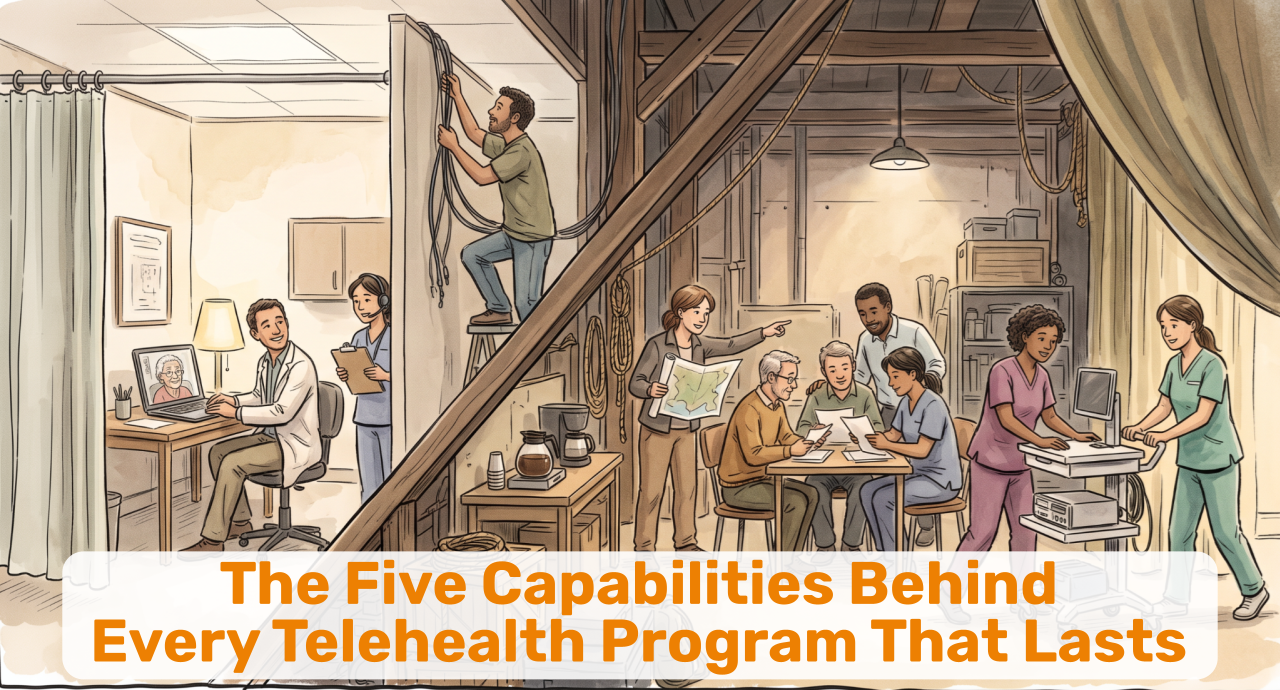
Capability: what builds the program. Leadership, governance, and technical, operational and launch support. At Level 4, each moves from being assigned to being owned: engaged leaders, established governance, and funded, formal support.
-
Reach: what the program delivers. Utilization and growth, patient engagement, service modalities, clinical specialties, and community infrastructure. Reach follows capability.
-
Sustainability: whether the program lasts. Financial sustainability and alignment with your state’s RHTP goals. Sustainability follows both.
Planning for the day the funding ends
RHTP funding is a rare opportunity for rural telehealth, and a temporary one. The best time to plan for sustainability is at the start of a funded program, not in its final quarter. Every grant-funded role and service should come with an answer to one question: who pays for this when the grant is gone?
The next article in this series brings all twelve dimensions together: how to assess where your program stands, and how to chart a course to Level 4.
In the meantime, ask yourself which of your telehealth services would still be running a year after the funding ends. If the answer worries you, reach out. We’re happy to help you build the business case while there is still time to test it.

To receive articles like these in your Inbox every week, you can subscribe to Christian’s Telehealth Tuesday Newsletter.
Christian Milaster and his team optimize Telehealth Services for health systems and physician practices. Christian is the Founder and President of Ingenium Digital Health Advisors where he and his expert consortium partner with healthcare leaders to enable the delivery of extraordinary care.
Contact Christian by phone or text at 657-464-3648, via email, or video chat.