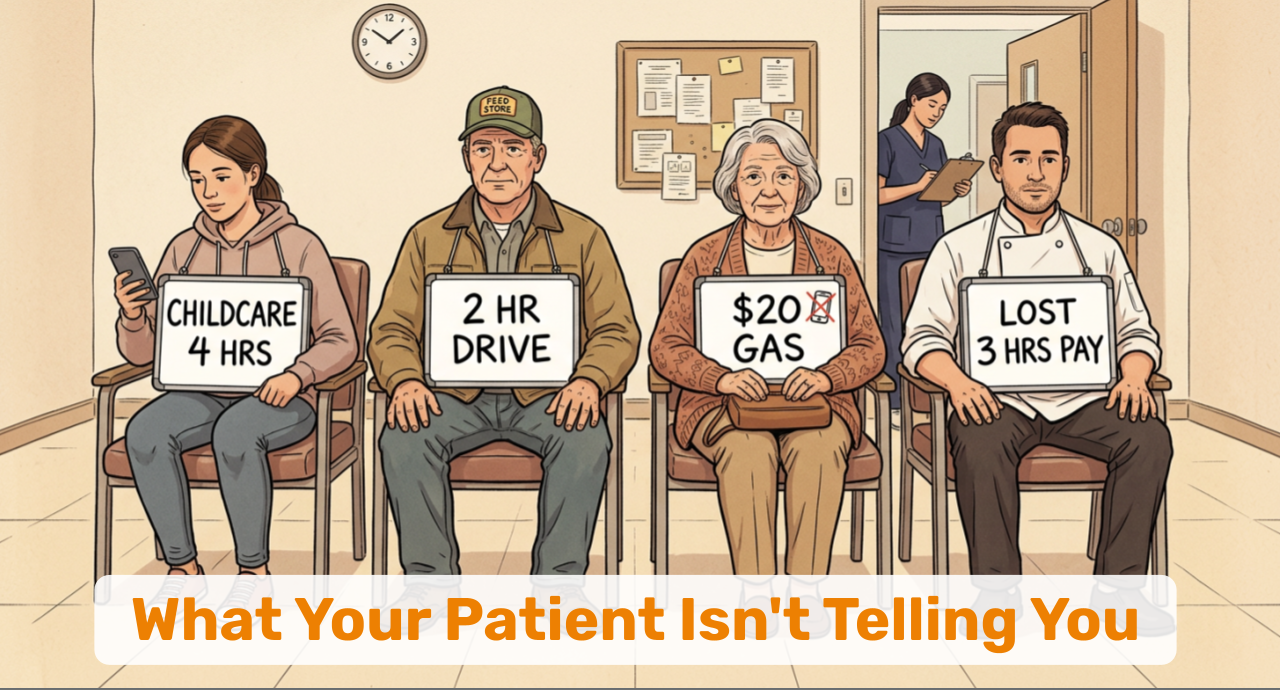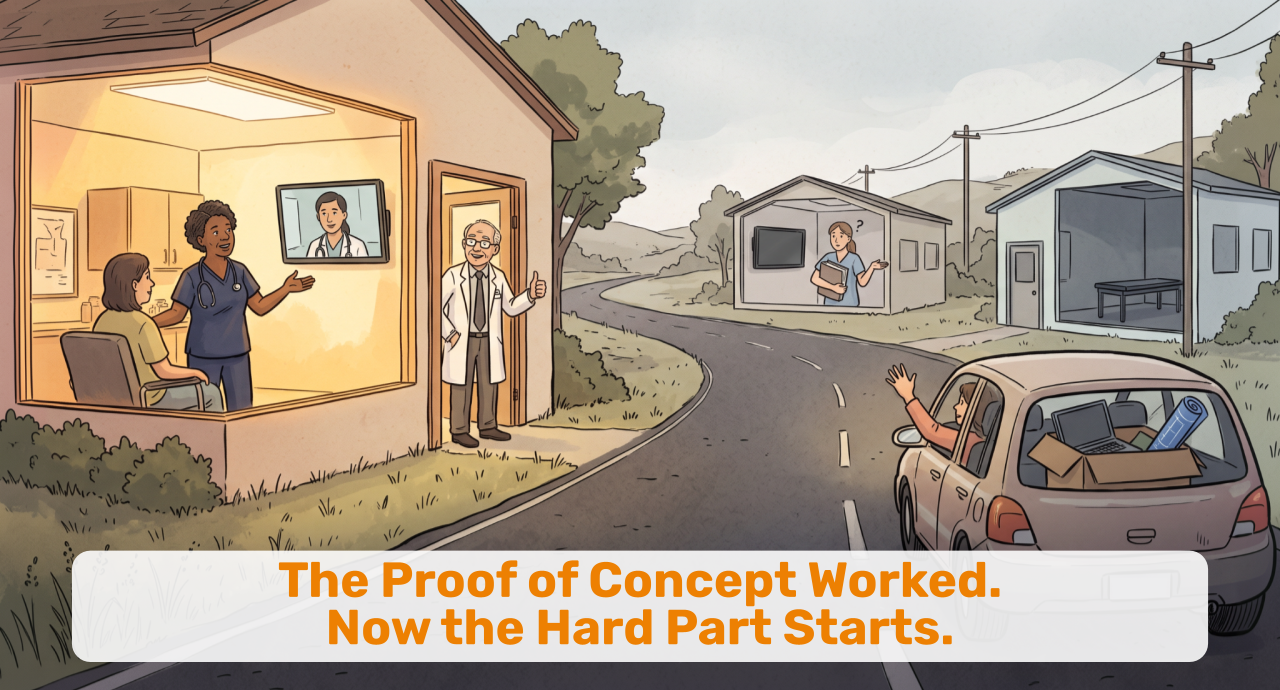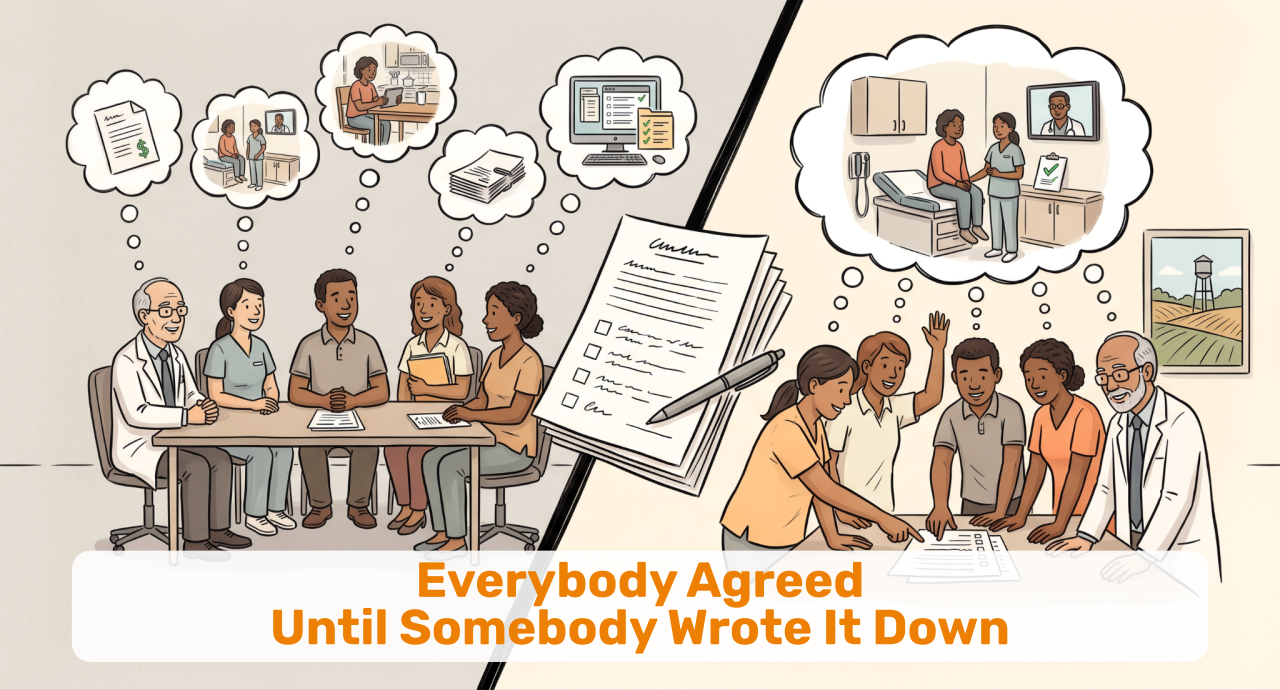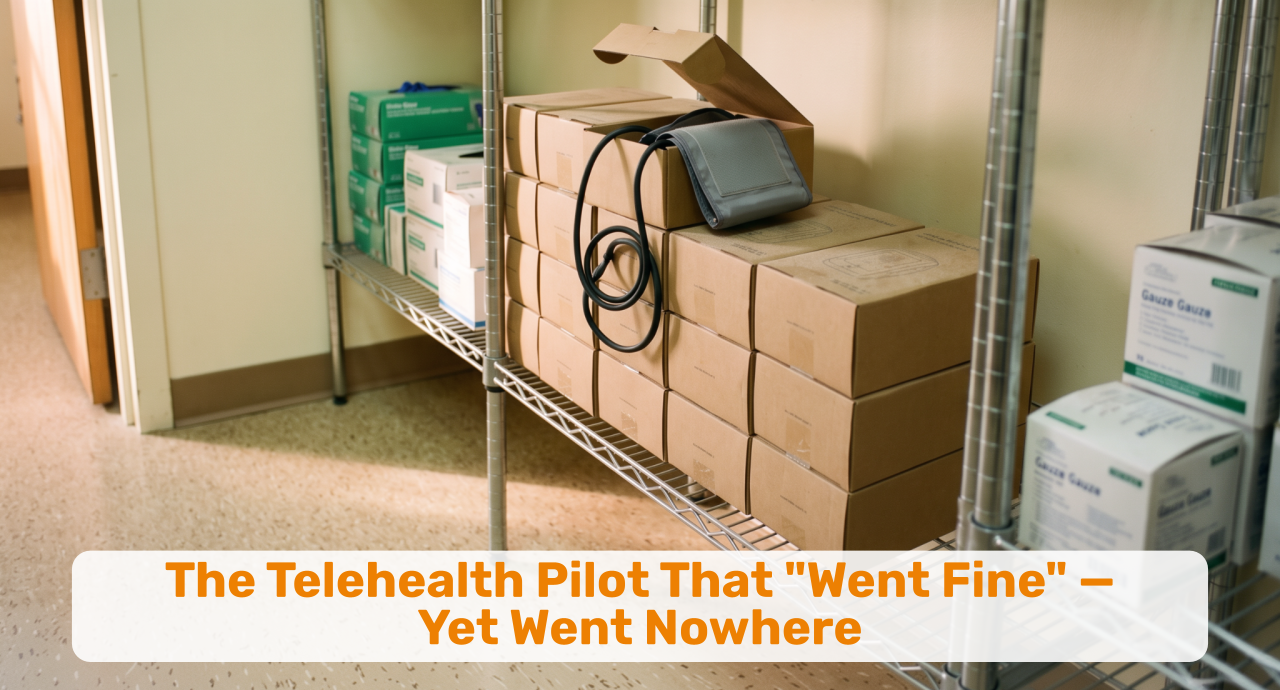


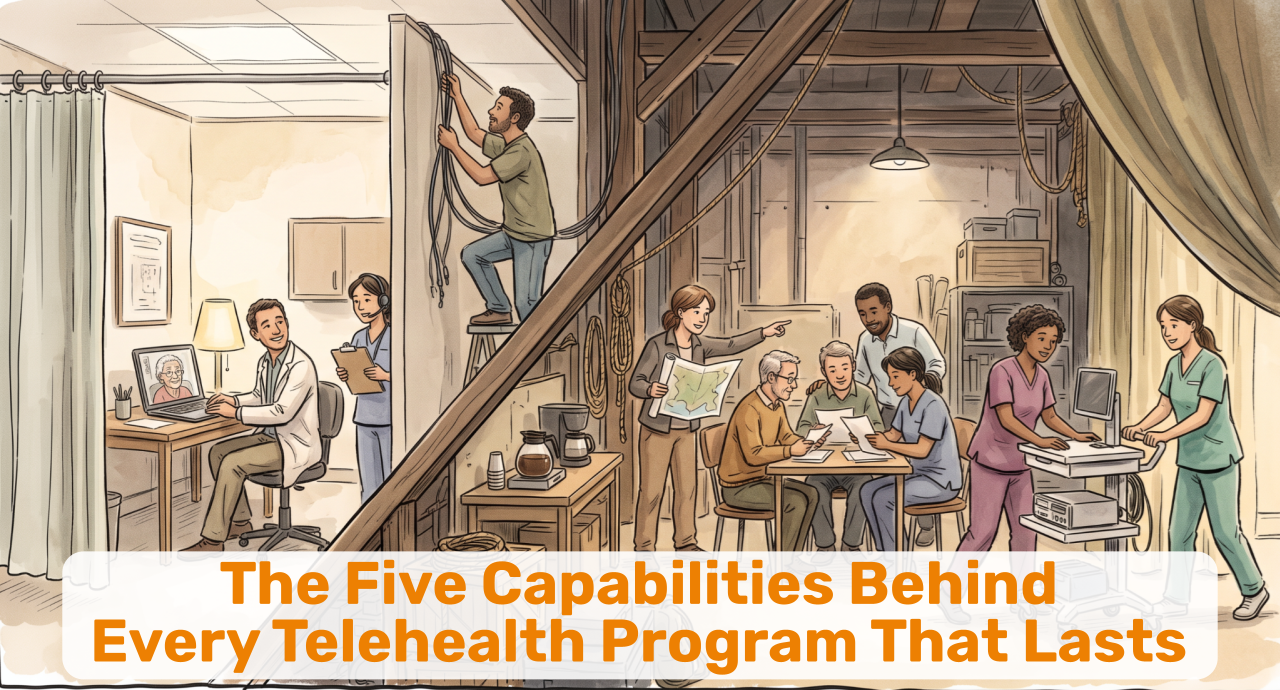
Every rural health leader knows a telehealth program that started strong and then stopped growing. The platform works. A few clinicians use it well. But new services take months to launch, patients still struggle to connect, and nobody can say who decides what comes next.
The cause is almost never the technology. It is the machinery behind it: the leadership, governance and support that turn a handful of telehealth visits into a program the organization can run, repeat and expand. As states invest Rural Health Transformation Program (RHTP) funds in telehealth, that machinery decides whether the investment keeps paying off once the grant period ends.
Our Telehealth Program Maturity Model rates a program on twelve dimensions, each across seven levels, from Level 0, Chaotic, to Level 6, Transformative. Level 4, Integrated, is base camp: the goal we set with every client, and the foundation for the levels above it.
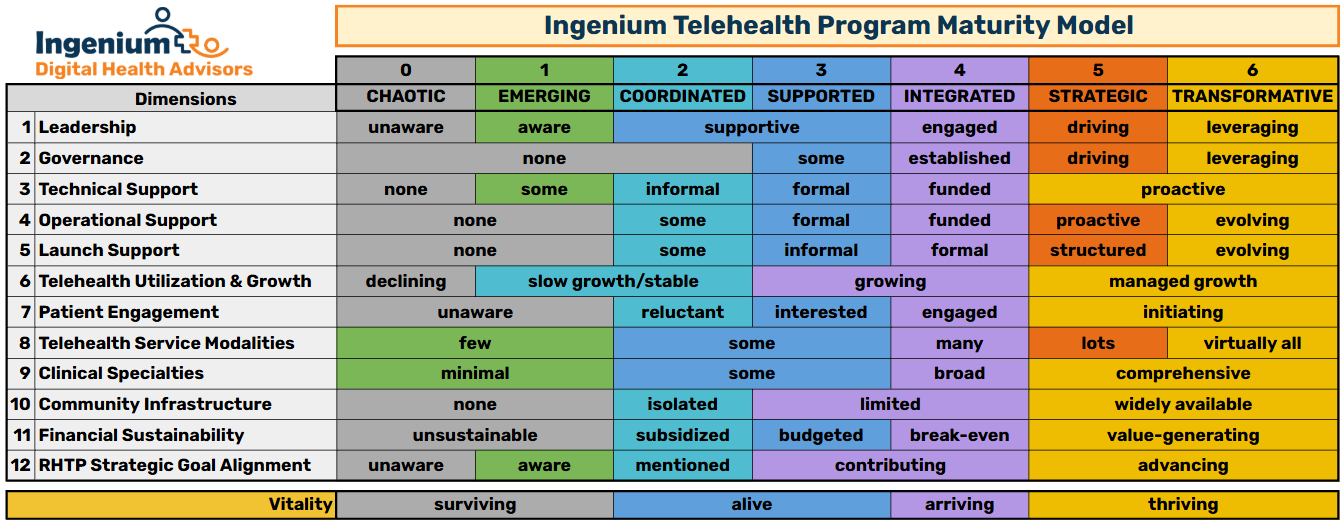
The twelve dimensions fall into three groups: Capability dimensions build the program. Reach dimensions describe what it delivers. Sustainability dimensions show whether it lasts. Reach follows capability, and sustainability follows both, so this article starts where the model starts: with the five capability dimensions.
1. Leadership: from unaware to leveraging
This dimension measures how aware, invested and active senior leaders are in driving telehealth.
At Level 0, leaders are unaware, or telehealth never comes up. At Level 1 they are aware but not involved. At Levels 2 and 3 they are supportive: they commit staff time, funding or other resources. At Level 4 they are engaged, regularly reviewing telehealth performance and removing barriers. At Level 5 they are driving telehealth as a strategic priority, and at Level 6 they are leveraging it to redesign how care is delivered.
The step that matters most is from supportive to engaged. A supportive leader approves the budget request. An engaged leader asks every quarter how the program is performing and what is in its way, and then clears the path.
We saw the difference plainly when we mapped the maturity of 13 rural organizations over five years. Where leaders engaged, programs climbed: four reached Integrated or beyond. Where leaders stayed on the sidelines, programs barely moved, no matter how capable the staff were.
2. Governance: from none to leveraging
This dimension measures who holds responsibility for telehealth decisions and oversight.
Through Level 2 there is none. Clinicians and departments decide on their own which services to offer and how. At Level 3 there is some: an informal lead or group weighs in when a decision is needed. At Level 4 governance is established, with a designated person, team or committee that approves new services and reviews performance. At Level 5 governance is driving telehealth strategy, aligning it with organizational priorities, budgets and partners. At Level 6 it is leveraging telehealth across the organization’s plans.
Governance stays absent longer than any other capability, and its absence is easy to miss. Until someone owns the decisions, no one decides which proposed service deserves investment next, who retires one that isn’t working, or what “working” means.
For a small rural organization, governance doesn’t need to be heavy. A short charter, a standing monthly meeting and a few performance measures are often enough to move from Level 3 to Level 4.
3. Technical Support: from none to proactive
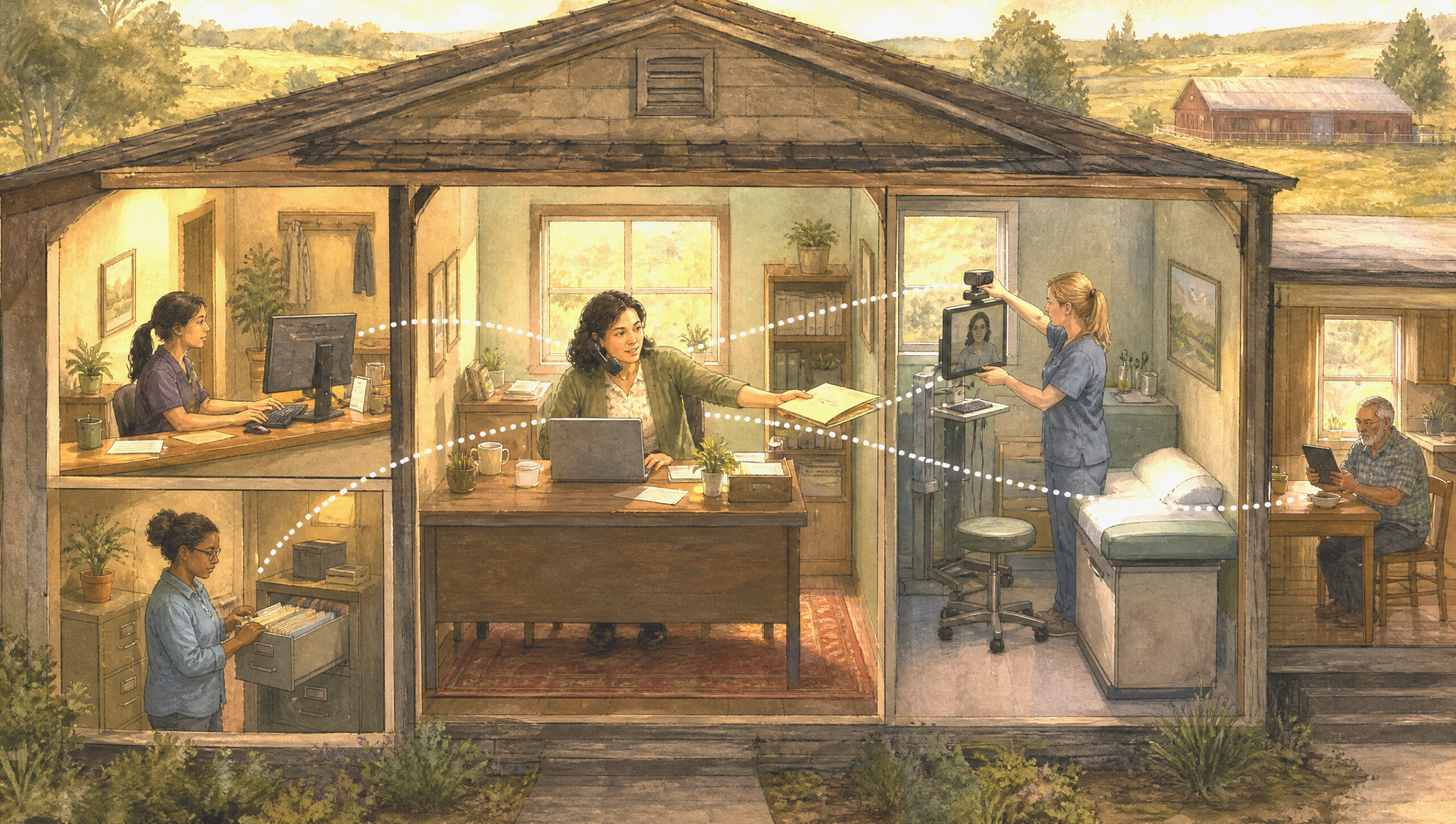
The next three dimensions cover the three kinds of support every telehealth program needs: technical, operational, and launch support. Organizations often treat them as one job, usually IT’s. At mature organizations, they are three different jobs.
Technical support is the level of IT support for telehealth. At Level 0 there is none: issues go to the general help desk, if anywhere. At Level 1 there is some, and at Level 2 it is informal, usually one IT colleague who happens to know telehealth. At Level 3 it is formal: a designated role follows a documented process. At Level 4 it is funded, with dedicated support that includes real-time help during visits. At Levels 5 and 6 it is proactive: systems are monitored so problems are caught before they affect a visit.
The move to real-time help is the one clinicians feel. A help desk ticket doesn’t help a physician whose patient is waiting on a frozen screen. Ten minutes lost per failed visit is how clinicians decide telehealth isn’t worth the trouble.
4. Operational Support: from none to evolving
This dimension measures support for day-to-day telehealth operations such as scheduling, consent, documentation and billing.
At Levels 0 and 1 there is none: each clinician or service handles these tasks alone, and nothing is written down. At Level 2 there is some, as a few staff help informally when asked. At Level 3 support is formal, with a designated telehealth coordinator and documented workflows. At Level 4 it is funded, with staff supporting standard workflows used across the organization. At Level 5 it is proactive, and at Level 6 evolving: workflows are reviewed and improved as performance data, policies and payment rules change.
Operational support is the least visible capability, so it is the easiest to underfund. Its absence shows up elsewhere: in denied claims, in a front desk that doesn’t know how to schedule a virtual visit, in a consent form no one remembers to send.
The role at the center of this dimension is the Telehealth Coordinator. A good coordinator makes sure clinicians and patients have a great telehealth experience: supporting day-to-day operations, tracking performance, growing utilization, and helping design and launch new services. At Level 3, that is often a part-time duty added to someone’s existing job. At Level 4, it is a funded role. For an organization at Level 3, a skilled coordinator is often the single best investment it can make. We describe what to look for in The 7 Critical Qualities of a Rock Star Telehealth Coordinator.
5. Launch Support: from none to evolving
This dimension measures how new telehealth services or specialties are launched.
At Levels 0 and 1 there is none: the clinician or service works it out alone. At Level 2 there is some help, but no standard process. At Level 3 support is informal, guided by a checklist or a repeatable approach. At Level 4 it is formal, with a defined process covering readiness, workflow design, training and go-live. At Level 5 the launch method is structured and improved after every launch, and at Level 6 it keeps continuously evolving.
Notice that launch support trails the other two kinds. At Level 3, technical and operational support are already formal, while launches are still guided by an informal checklist. That gap is why so many programs stall: they can support the services they have, but every new service is a fresh struggle.
A formal launch process is what lets an organization add a specialty or modality without starting over. In our own methodology, that process runs from selecting the right opportunity through validating it with a proof of concept to deploying it and managing its performance.
Why programs stall at Supported
Lay the five capability dimensions side by side, and the step from Level 3 to Level 4 has the same shape in every row. Leadership moves from supportive to engaged. Governance moves from some to established. Technical and operational support move from formal to funded. Launch support moves from informal to formal.
In each case, telehealth moves from being assigned to being owned. At Level 3, the work is real but runs on borrowed time.
Consider a composite Critical Access Hospital, typical of many we have worked with. Its clinic manager doubles as telehealth coordinator. An IT analyst spends 1-2 hours each day working on telehealth issues. The CEO supports the program and approved the platform. On paper, that is Level 3. In practice, every new service waits for the clinic manager to find a free week, and when she leaves, the program’s knowledge leaves with her.
Reaching Level 4 means dedicated, funded roles, a governance group that meets and decides, and leaders who review performance rather than just approving budgets. That is a real investment for a small organization. But it is also the point where telehealth services typically start to break even, which is why we set Level 4 as the goal.
One rule applies before any of this: if a capability dimension sits below Level 3, bring it up to Level 3 first. Funding a support team won’t help much if no one governs what it supports.
Building the engine first
RHTP funding will buy a lot of telehealth technology in rural America. The organizations that get lasting value from it will be the ones that also build the engine: engaged leaders, real governance, and funded technical, operational and launch support.
The next article in this series turns to the five “reach” dimensions, the part of telehealth that patients, boards and funders see, and shows how each one follows from the capabilities described here.
In the meantime, rate your own program on these five dimensions. Which one is still running on borrowed time? If you’d like a second opinion, or help building the case for funded support, reach out. We’re happy to talk it through.

To receive articles like these in your Inbox every week, you can subscribe to Christian’s Telehealth Tuesday Newsletter.
Christian Milaster and his team optimize Telehealth Services for health systems and physician practices. Christian is the Founder and President of Ingenium Digital Health Advisors where he and his expert consortium partner with healthcare leaders to enable the delivery of extraordinary care.
Contact Christian by phone or text at 657-464-3648, via email, or video chat.