

Years ago, the chief clinical officer at one of Ingenium’s first clients told me about a patient she had never forgotten.
Before moving into leadership, she had been a primary care physician in one of the health system’s rural clinics. Many of her patients had been with her for years. When she took on the leadership role, her practice moved with her — to a clinic in the city, 35 to 40 minutes away.
One of those long-time patients, an older woman, kept coming. At a routine follow-up, she mentioned, almost in passing, how she had managed the trip. Her grandson had given her a phone for Christmas. She had sold it to pay for the gas.
She made her appointment. The cost had already been paid by the time anyone in the room knew about it.
What stayed with both of us was the realization that if telehealth had been in place at the time, she could have seen her own physician by video for that visit — without the drive, without the gas money, and without giving up her grandson’s gift.
The Whiteboard Nobody Sees
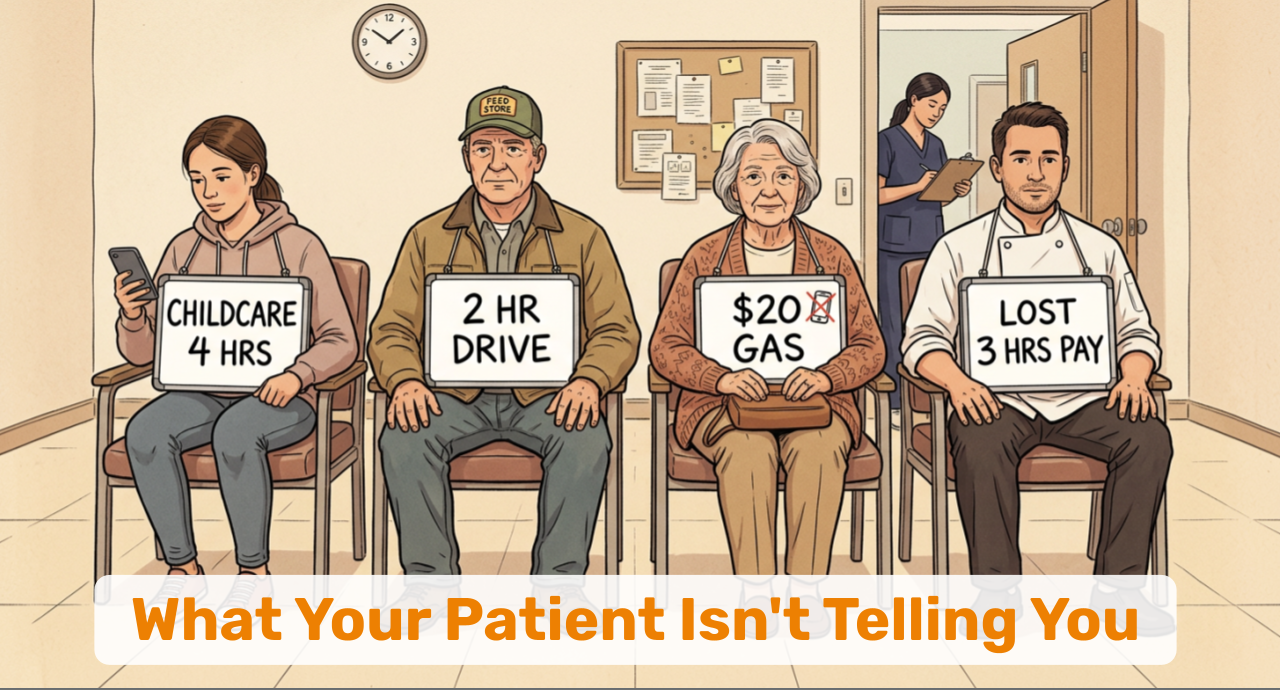
Imagine every patient arriving with a small whiteboard hanging around their neck. For the week before the appointment, they write down everything the visit is costing them: the hours on the road, the gas, the childcare, the shift they won’t get paid for, the neighbor they had to ask for a ride.
No clinic would actually do this. But picture what the clinician would see when that patient walked into the exam room.
Today, the clinician sees the 15 minutes. The whiteboard stays at home. In rural communities — where the drive is longer, public transit is rare and hourly jobs seldom come with paid time off — the whiteboard fills up fastest. And it is the one nobody in the clinic ever reads.
Why Patients Don’t Say It
The grandmother didn’t call ahead to ask whether there was another way. Most patients don’t. In our implementation work, the same reasons come up again and again:
- They don’t want to seem ungrateful. A long relationship with a trusted physician is worth a lot, and complaining about the drive can feel like complaining about the doctor.
- They don’t know there is an option. If no one has ever offered a video visit for a follow-up, it doesn’t occur to most patients to ask for one.
- They assume the clinic decides. For most patients, how they are seen is something that happens to them, not a choice they get to make.
- They are intimidated by the technology and don’t want to embarrass themselves. Many patients handle video calls with family, but to do the same with a clinicians seems daunting.
Each of these is reasonable on its own. Together, they keep the burden silent — and a burden nobody hears about never makes it into a decision.
Asking Harder Isn’t the Fix 💡
The instinctive response is to ask clinicians to probe more — to ask about transportation, to notice the patient who looks worn out, to dig a little deeper. Clinicians already care about this. But a 15-minute visit, already full of clinical work, is the wrong place to discover it. By the time the patient is in the room, the cost has been paid.
One of my favorite quotes, attributed to Dr. Paul Batalden, is that “every system is perfectly designed to get the results it gets”. In most clinics, the decision about whether a visit happens in person or by video is never actually made. It is a scheduling default. The visit type says “office visit,” the scheduler books an office visit, and the patient drives. Nobody chose the drive. The system chose it for them.
That makes this a design problem, and design problems have design answers. As I like to put it: you can’t change people’s behavior, but you can change the system so people behave differently.
Designing the Question In
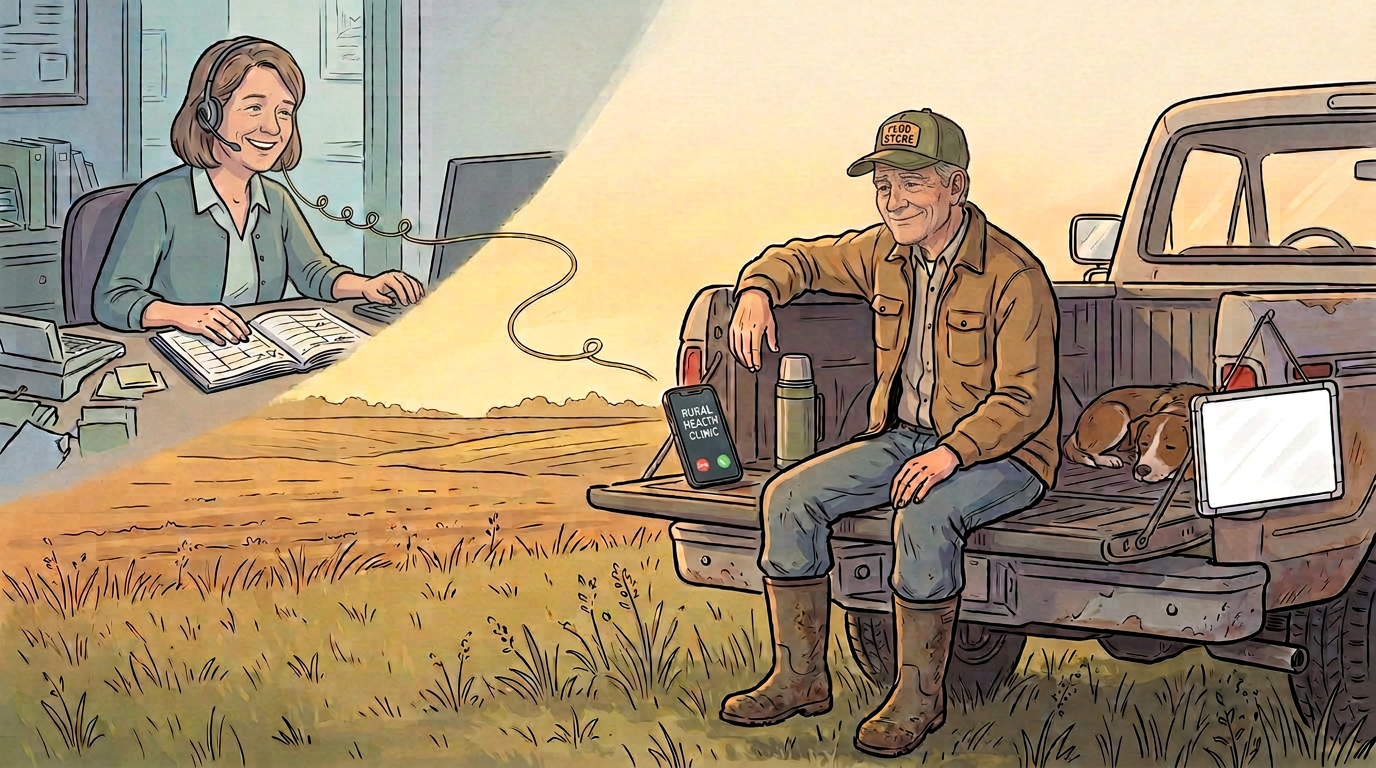
My 100% Telehealth vision is simple: if the patient wants a video visit, has the technical capability and digital literacy, and it is clinically appropriate, we should do a video visit 100% of the time.
Each of those three conditions has a natural owner — and a natural place in the workflow where it can be answered before the patient ever gets in the car.
Does the patient want it? Ask at scheduling. Offer the choice every time a video-eligible visit is booked: “Would you like to come in, or would a video visit work better for you?” One sentence gives the patient permission to say what they would never volunteer. Some will still choose to come in, and that is their call. What matters is that it becomes a choice.
Can the patient do it? Confirm it at onboarding. A Telehealth TechCheck — a short call before the first video visit to check the device, the connection, audio and video, and a private place to talk — turns “can she manage this?” from an assumption into a known answer. Digital literacy gaps surface here, where a few minutes of coaching solves them, rather than five minutes into a visit.
Is it clinically appropriate? Decide it in advance, by visit type. Clinicians shouldn’t have to make this call patient by patient at 7:45 in the morning. Sit down with them once and agree which visit types are video-eligible by default — often routine follow-ups, medication management and results reviews — and which need hands on the patient. The clinician’s judgment is then built into the schedule rather than bypassed by it, and any individual visit can still be converted when something changes.
Then close the loop at the end of every visit. When the clinician knows what the trip costs, one sentence — “For your next follow-up, let’s do it by video” — does more than any reminder or flyer. Build that question into the post-visit workflow, and it stops depending on whether anyone happens to remember.
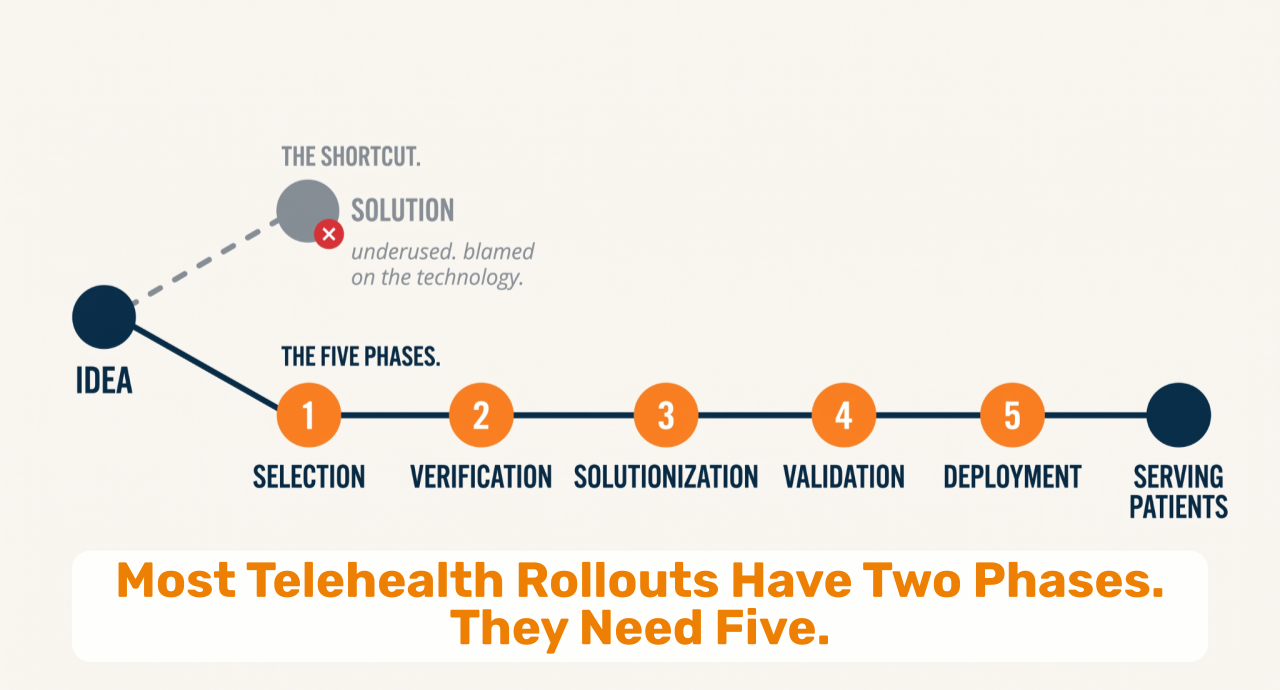
None of this requires new technology. Most clinics already have a video platform. What they’re missing is the workflow that puts it in front of the patient at the moment the decision gets made. That workflow is part of the 90% of telehealth success that has nothing to do with technology.
What Would Your Patients’ Whiteboards Say?
For rural health leaders, the stakes reach beyond any single patient. Programs like the CMS Rural Health Transformation Program are built around improving access to care in rural communities. Access is usually counted in appointments available and miles to the nearest clinic. The whiteboard is what access actually costs — for the patient who keeps showing up anyway, and for the one who quietly stops coming.
The grandmother made her appointment. Somewhere in your service area, a patient is deciding today whether the drive is worth it. When the workflow offers a video visit at the moment that decision gets made, the decision gets easier. When it doesn’t, the patient keeps paying — and you may never hear about it.
If you’d like to talk through how to build that choice into your scheduling and onboarding workflows, reach out. It is often a smaller change than leaders expect, and one of the most humane.

To receive articles like these in your Inbox every week, you can subscribe to Christian’s Telehealth Tuesday Newsletter.
Christian Milaster and his team optimize Telehealth Services for health systems and physician practices. Christian is the Founder and President of Ingenium Digital Health Advisors where he and his expert consortium partner with healthcare leaders to enable the delivery of extraordinary care.
Contact Christian by phone or text at 657-464-3648, via email, or video chat.