

Why Good People Doing Good Things Is Not Enough to Fully Leverage Telehealth’s Potential
In May 2026, the American Telemedicine Association held its 30th annual conference. I have attended about eight of them since 2013, and after each one I leave with some form of the same unsettling observation:
Telehealth is still pretty much a grassroots effort.
Albeit — and this is what makes it so hard to see — since COVID it has now become an institutionalized grassroots effort.
Job titles have been created. Budget lines established. Vendor contracts signed. Steering committees convened. Telehealth has all the costumes of a mature institutional discipline.
And yet, hospital by hospital, health system by health system, every organization is still figuring it out largely from scratch — without a shared playbook, without a standard of excellence to measure against, without a clear picture of what “done well” even looks like.
The institution arrived. The transformation didn’t.
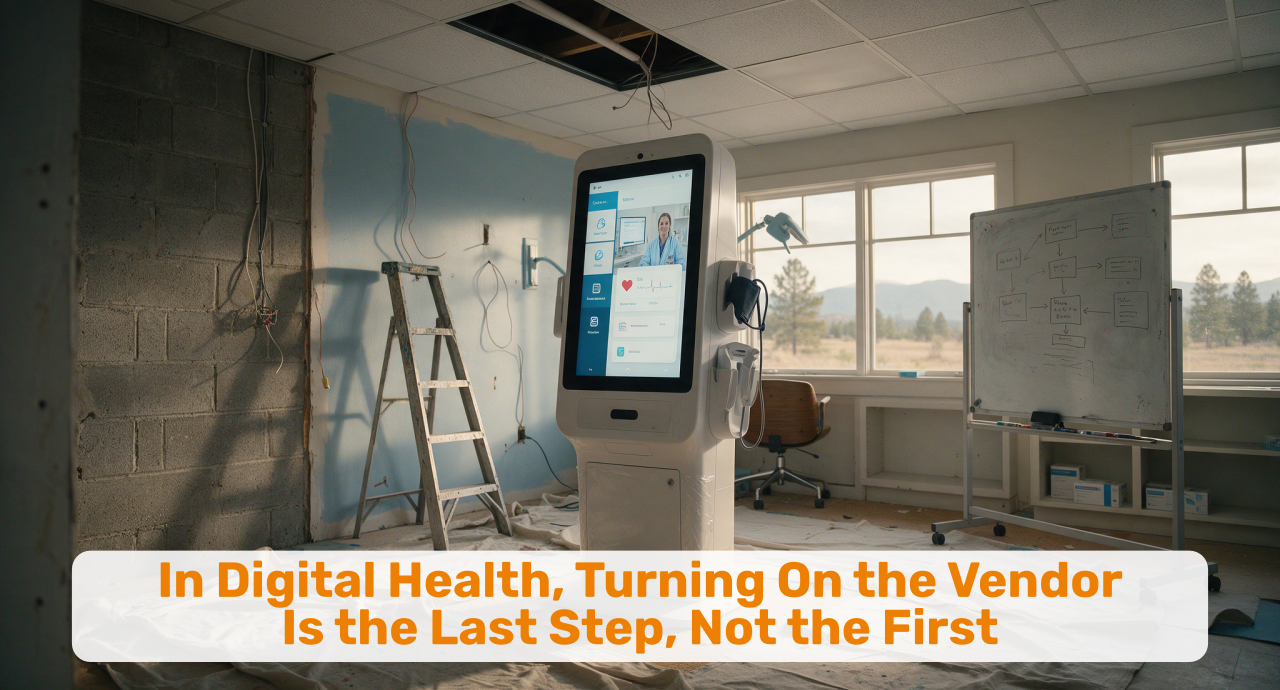
Why? Because almost every organization made the same understandable mistake. They gave telehealth an Engineer — an operator — but never hired a Navigator.
The Ship Is Running. But Where Is It Going?
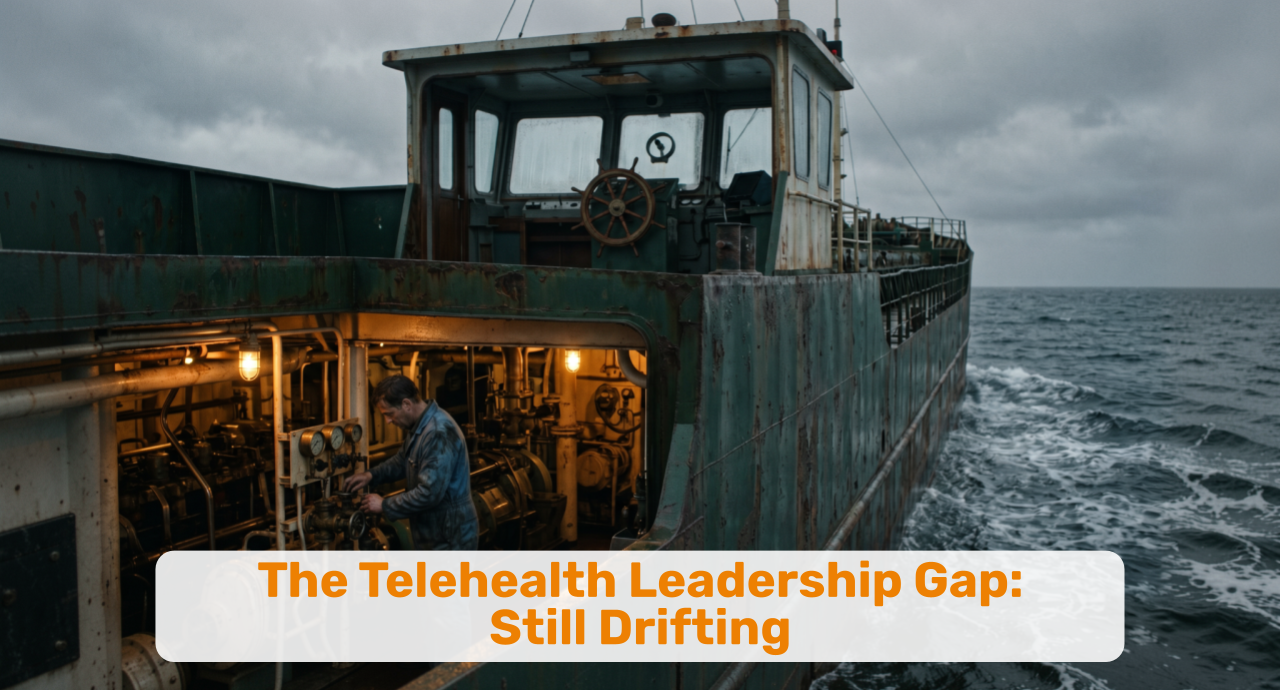
Every ship needs both.
The Engineer keeps the vessel running — managing the systems, maintaining the equipment, solving the problems that arise at sea. Without a great Engineer, the ship breaks down.
The Navigator sets the course — defining the destination, charting the route, identifying the hazards ahead, and adjusting when conditions change. Without a great Navigator, the ship drifts aimlessly.
A ship with only an Engineer doesn’t sink. It just drifts. Efficiently, reliably, and with excellent maintenance logs.
This is the precise condition of telehealth in most health systems today: drifting efficiently.
Telehealth Operations Manager — and let’s be clear, these are talented, dedicated professionals doing genuinely important work — are the Engineers. They keep the platform running. They support the clinicians using it. They troubleshoot, maintain, and optimize within existing constraints. When something breaks, they fix it. When someone needs help, they show up.
What most organizations are missing is the Navigator. The one experienced in leading growth and expansion, whose job is not to keep telehealth running, but to determine where it should go and where it should grow — and to lead the journey of getting there.
What Got Institutionalized — and What Didn’t
When COVID hit, telehealth went from niche capability to overnight mandate. Health systems delivered, heroically and imperfectly — and largely over the phone. Because what the data revealed after the dust settled was that the vast majority of that COVID-era surge was telephonic. Phone calls. Not the video visits enhanced with remote exam tools and integrated vital sign measurements that represent what telehealth can truly be.
And we blamed it on the lack of broadband. And patients’ digital illiteracy. And claimed that it simply was not good medicine.
We glimpsed the potential, delivered a workaround — and then institutionalized the workaround.
When the emergency passed, health systems made a reasonable decision: we need someone to manage this. So they created a role — telehealth director, virtual care coordinator, telehealth operations manager — and they hired or promoted someone skilled at running things.
That was the right hire. Operations support is essential. The mistake wasn’t who was hired. The mistake was the role that was never identified.
Consider how this pattern plays out in every other domain:
Every organization understands the difference between a project and operations. Projects launch things — they define scope, build something new, and hand it off. Operations sustain things — they run, maintain, and optimize what was built. You need both, in sequence.
Every organization understands the difference between a leader and a manager. Leaders set vision and direction. Managers execute within established direction. You need both, working in tandem.
Every organization understands the difference between a vision and a policy. Vision defines where you’re going and why. Policy governs how you operate once you’re there. You need both, but vision comes first.
Telehealth, in most organizations, got the operations without the project. The manager without the leader. The policy without the vision.
It got an Engineer. It never got a Navigator.
The Invisible Cost
I wrote my first article about the need for a telehealth strategic plan in January 2015. The argument was simple then, and it remains simple now: without a vision, without a roadmap, without defined objectives and the metrics to measure them, telehealth programs drift. Innovative initiatives fizzle. Clinical champions leave. And the organization ends up more or less where it started — only with more scar tissue and a slightly larger vendor contract.
What keeps this pattern in place — across 30 years, across 30 annual conferences — is that the cost of not doing telehealth well is invisible.
When a patient doesn’t get a timely specialist consult because the telestroke program was never built, that doesn’t show up on a dashboard. When a rural family drives two hours for a follow-up visit that could have happened virtually, nobody codes that as a telehealth failure. When a promising program quietly fades away after its proponent leaves, the organization moves on without ever calculating the potential that was lost.
The invisible cost is real. It shows up in access gaps, in clinician fatigue, in patient outcomes that could have been better. It just doesn’t have a line item. And without a visible cost, there is no urgency. Without urgency, there is no mandate. Without a mandate, nobody goes looking for a Navigator.
The Engineer keeps the ship moving. And because the ship is moving, everyone assumes things are fine.
The Questions Worth Asking
If you are a telehealth director or operations manager reading this: this is not about you.
You are very likely doing remarkable work within the constraints you were given. The gap this article is naming is not a performance gap. It is a structural one — and it belongs to your leadership team to address.
The questions worth bringing to that conversation:
-
Does your organization have a telehealth vision — a clear, articulated picture of what telehealth is meant to accomplish for your patients and community over the next three to five years?
-
Do you have strategic objectives with metrics — specific, measurable goals that define success, reviewed regularly by senior leadership?
-
Is there a burning platform — a compelling reason to pursue transformation now, not someday?
-
Does your telehealth Engineer have a Navigator beside them — someone whose mandate is not to maintain what exists, but to build what should?
If the answer to most of those is no, your organization doesn’t have a telehealth strategy. It has a very well-managed telehealth support function. And there is nothing wrong with that — until the moment the stakes get high enough to demand more.
That moment, for many organizations, is now.
The Platform Is Burning in Rural Health
The Rural Health Transformation Program represents a generational opportunity for rural health systems to build what their communities have needed for decades. CMS is not just offering funding — it is offering a framework, a mandate, and a deadline.
The organizations that will capture this opportunity are not the ones with the best technology. They are the ones with the clearest vision, the most disciplined implementation approach, and the leadership willing to treat telehealth as a transformation priority — not just an operational one.
Thirty years after the first ATA conference, telehealth is still a grassroots effort in most places. Institutionalized, yes. Integrated, not yet.
That is not a technology problem. It is not a reimbursement problem. It is not a clinician adoption problem.
It is a leadership problem.
And the good news about a leadership problem is this: once you know the role is missing, you can fill it. And sometimes, filling it doesn’t require a new hire — it requires the right partner to show you the way.
Christian Milaster is the Founder and CEO of Ingenium Digital Health Advisors, where since 2012 he and his team partner with rural health leaders to design, implement, and scale telehealth programs that deliver extraordinary care. If this article raised questions worth thinking through together, set up a call.

To receive articles like these in your Inbox every week, you can subscribe to Christian’s Telehealth Tuesday Newsletter.
Christian Milaster and his team optimize Telehealth Services for health systems and physician practices. Christian is the Founder and President of Ingenium Digital Health Advisors where he and his expert consortium partner with healthcare leaders to enable the delivery of extraordinary care.
Contact Christian by phone or text at 657-464-3648, via email, or video chat.