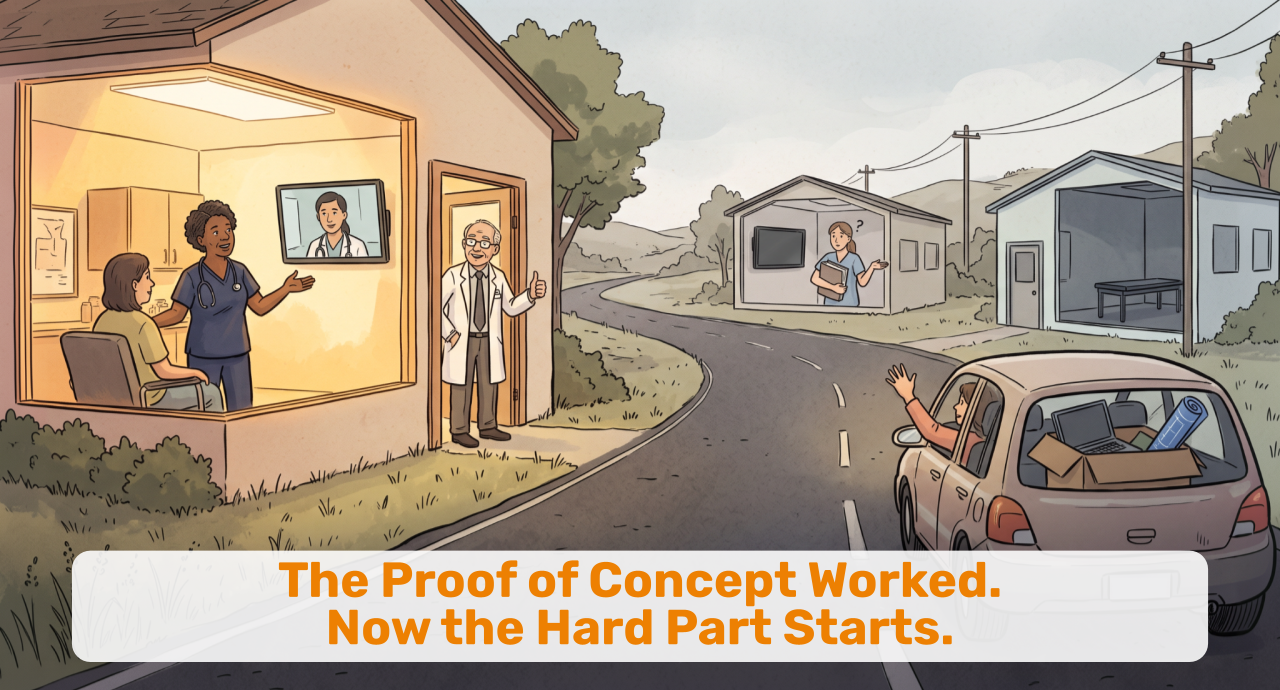


At the core of every rural health transformation is one fundamental task: creating the desire in clinicians, staff, patients, and leaders to do things differently.
As most leaders in healthcare know, that is harder than it sounds. And it is more important than most implementation plans acknowledge.
Last week, we explored the first three of Covey’s 7 Habits and how they apply to the preparation phase of change leadership — anticipating resistance before it hardens, painting a destination vivid enough to create desire, and sequencing priorities so that people and process come before technology. Those three habits happen largely in the mind of the change leader. They are the foundation.
This week, we move into the work that happens in the minds and hearts of everyone else.
Because here is the truth about desire: it is not enough to create it at the beginning. Desire must be sustained. People can do things differently for a while if they want to — but as soon as nobody is looking, as soon as an obstacle appears, as soon as the old way feels easier, they will drift back. Not out of malice. Not out of stubbornness. Simply because the path of least resistance leads to familiar ground.
Sustaining desire requires engagement — deliberate, ongoing, human engagement. Habits 4, 5, and 6 give us the tools to create it. And Habit 7 gives us the discipline to make it last.
Habit 4 — Think Win-Win
Find What Each Stakeholder Actually Wants
Covey’s fourth habit rejects the zero-sum mindset. Win-Win is not compromise — where both parties give something up. It is the genuine belief that solutions exist that are good for everyone involved, and the discipline to find them.
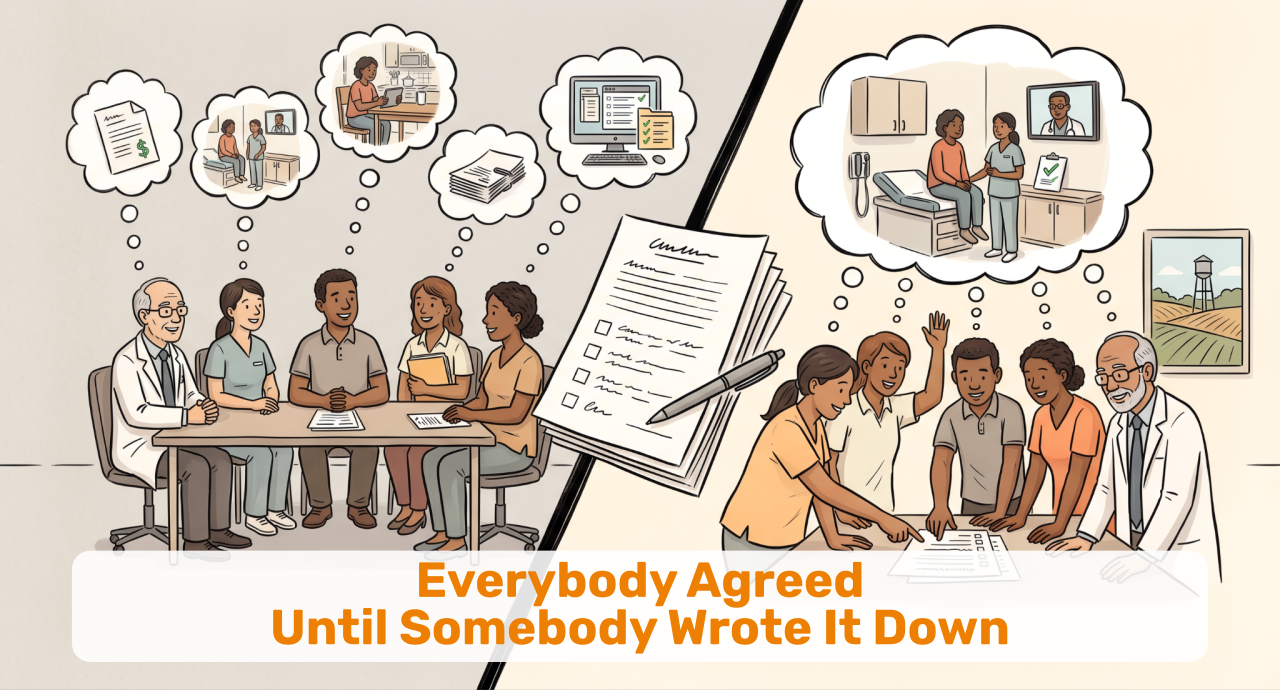
In change management, this is the WIIFM discipline: “What’s In It For Me?” Every stakeholder group — clinicians, nurses, care coordinators, front desk staff, patients, administrators — has a different answer to that question. And until you know their answer, you cannot create their Desire.
The primary care physician wants faster specialist opinions on complex patients. The care coordinator wants to stop spending hours arranging distant referrals. The patient wants to keep their job and not lose a day of wages to a two-hour drive one way. The administrator wants to demonstrate community benefit and retain clinical staff.
None of those perspectives are wrong. And they are all different. Thus a single, organization-wide message about the benefits of virtual specialty consults will reach none of them as powerfully as a targeted conversation that speaks directly to what each person actually cares about.
Think Win-Win means doing the work to find those answers — before the training session, before the kickoff meeting, before the go-live date. It means designing your engagement strategy around their priorities, their needs, their desires, not simply around the goals of the new program. This means being willing to adapt the implementation itself when stakeholder needs reveal a path to better sustainability.
This is also where desire is most fragile. A clinician who sees the change as something done to them — rather than something designed for them — will comply when required and revert back to the hold ways when possible. A clinician who sees genuine benefit for themselves and their patients will become an advocate.
Switch connection: Find the Feeling + Grow Your People — Win-Win engagement speaks directly to the emotional motivators and professional identity of each stakeholder. ADKAR connection: Desire — the most direct habit for building the genuine internal motivation to support and sustain the change.
Habit 5 — Seek First to Understand
Listen Before You Design
Covey’s fifth habit is the discipline of deep listening — seeking to understand another’s perspective fully before offering your own. It is, in Covey’s framework, the foundation of all effective interpersonal influence. And in change management, it translates into a specific and often skipped practice: studying the current state before designing the future one.
Before redesigning workflows for any new telehealth service, spend time in the existing process. Shadow the care coordinator. Sit with the front desk. Ask clinicians how they currently manage patients who need specialist input. Learn the language, the workarounds, the informal systems that keep things running. Understand what is frustrating about the current process — and what is working, however imperfectly.
This does two things. First, it builds the Knowledge foundation: you cannot script new critical moves without first understanding the existing ones. Change designed on the basis of reality is far more adoptable than change designed on the basis of mere assumptions.
Second — and this is the deeper insight — it builds Desire. When clinicians and staff see that you took the time to understand their world before redesigning it, their willingness to engage with the change increases dramatically. Being heard is not a soft outcome. It is a precondition for enrollment.
There is a practical technique embedded in this habit that we use consistently at Ingenium: current-state process mapping. Before any new service goes live, we spend time understanding the existing workflow in detail — every step, every handoff, every exception. Not to critique it, but to understand it. And then we build the new workflow on top of that understanding, preserving what works and improving what doesn’t.
Clinicians who see their current reality reflected accurately in the new design trust the new design. That trust is the foundation of sustained desire.
Switch connection: Follow the Bright Spots — understanding the current state reveals what is already working and can be scaled, rather than replaced. ADKAR connection: Knowledge + Desire — understanding precedes effective knowledge transfer, and being genuinely understood builds the trust that makes people willing to change.
Habit 6 — Synergize
Co-Create the Change, Don’t Just Announce It
Synergy is Covey’s most ambitious habit — and the one most frequently misunderstood. It is often confused with Win-Win. But the distinction matters.
Win-Win is about finding mutual benefit — solutions that work for both parties. Synergy goes further: it is about creating something together that neither party could have created alone. The outcome of true synergy exceeds what either party imagined at the outset.
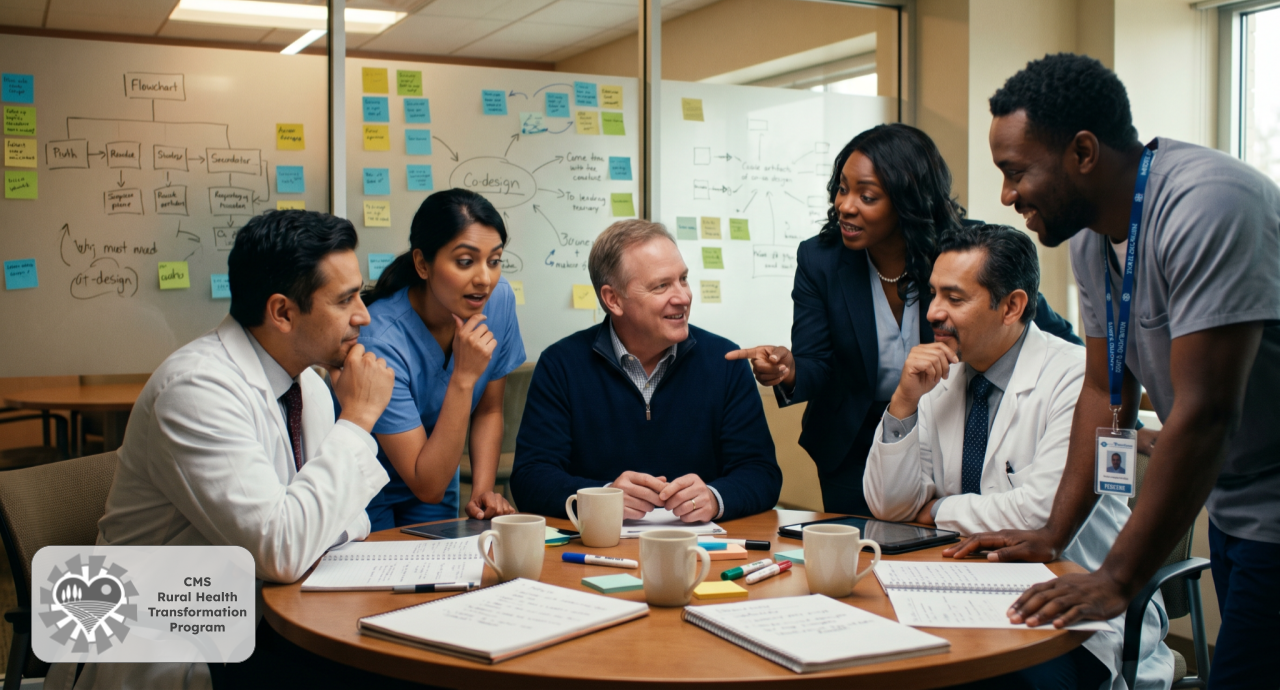
In RHTP implementation, this is the difference between designing for clinicians and designing with them. A workflow designed by an implementation team and presented to clinical staff for adoption is, at best, a Win-Win attempt. A workflow co-designed with the clinicians who will use it — where their knowledge of patient behavior, clinical nuance, and operational reality shapes the solution — is Synergy.
The result is not just a better workflow. It is a workflow that clinicians will defend, champion, and teach to their peers — because they helped build it. People do not abandon things they created. Elephants that helped construct something do not walk away from it — that’s stubbornness working in our favor.
This is also where the most creative solutions emerge. Clinicians who understand both the clinical problem and the available tools will often identify possibilities that no outside consultant would have proposed. A virtual triage protocol, a hybrid consult model, a patient preparation workflow — these innovations come from the people closest to the work, given the invitation and the space to contribute.
Co-design is not just good change management. It is good medicine. The people who will deliver care through a new telehealth service know things about their patients, their community, and their clinical reality that no implementation plan can capture. Synergy is how you access that knowledge — and turn it into a solution that works.
Switch connection: Rally the Herd — clinicians who co-designed the solution become its most powerful champions, and their enthusiasm is contagious. ADKAR connection: Ability + Desire — co-design builds both the capability to execute the change and the ownership that sustains motivation long after launch.
Habit 7 — Sharpen the Saw
Renewal Is What Makes Change Stick
Covey deliberately placed the seventh habit apart from the others. It is not a step in a sequence — it is the discipline that makes all the other steps sustainable over time. Sharpening the saw means investing continuously in the capacities that make everything else possible.
In RHTP implementation, this means refusing — firmly and consistently — to treat the launch as the finish line.
To launch is to begin. What comes after launch is where most implementations either take root or quietly wither. The initial energy fades. The champion who drove adoption gets pulled into other priorities. The staff member who struggled with the technology but never said so starts routing around it. The metrics that looked promising in month one stop being tracked in month six.
Sharpening the saw means building the organizational routines that prevent this decay. Regular performance reviews with clinicians and staff. Patient satisfaction tracking fed back to the people doing the work. Peer learning sessions where early adopters share what they’ve discovered. “Sharpening” the training as workflows evolve. Recognition and celebration of progress — not just at launch, but throughout the life of the program.
It also means leadership renewal: the ongoing investment by executives and administrators in understanding how the program is actually performing, not just how it was designed to perform. The best telehealth programs are continuously refined by the people closest to the work, supported by leaders who understand that the investment in renewal is what separates a sustainable program from a successful launch followed by a slow decline.
This is ADKAR’s Reinforcement element made into an organizational habit. And it is the answer to the challenge we opened with: desire that is created at launch but never reinforced will fade. Desire that is continuously renewed — through accountability, support, recognition, and improvement — becomes something more durable than motivation. It becomes culture.
Switch connection: Build Habits + Tweak the Environment — renewal requires building the structural routines and environmental supports that make continuous improvement the default, not the exception. ADKAR connection: Reinforcement — sharpening the saw is the organizational practice of ADKAR’s final and most neglected element, applied not once at launch but continuously throughout the life of the program.
The Complete Picture
Four articles. Three frameworks. One message.
Switch gives us the psychology of change: engage the rational mind with clear direction, motivate the emotional side with feeling and identity, and shape the environment to make the right behavior easier than the old one.
ADKAR gives us the sequence: build Awareness, create Desire, supply Knowledge, develop Ability, and reinforce the change until it holds — and use the model as a diagnostic when something stalls.
The 7 Habits give us the character and the practice: the mindset of preparation, the disciplines of engagement, and the commitment to renewal that makes everything else sustainable.
Each of these three frameworks stands on its own. Implemented well, any one of them will make your change initiative stronger. Switch gives you nine tactics for moving people through the psychology of change. ADKAR gives you five conditions for sequencing that change correctly. The 7 Habits give you seven disciplines for preparing, engaging, and sustaining the people at the center of it.
Together, they offer something even richer: 21 distinct thought patterns, approaches, and perspectives on the same fundamental challenge. Not because you need all 21 every time — but because different stakeholders, different situations, and different moments in an implementation will call for different tools. The change leader who has internalized all three frameworks has a full toolkit. And in the complex, high-stakes work of rural health transformation, a full toolkit is exactly what the job requires.
The Rural Health Transformation Program is asking rural healthcare organizations to do something genuinely difficult: to change not just their technology, but their culture, their workflows, and their relationships with the communities they serve. That is a human endeavor. It requires human tools.
You now have them. The question is whether you will use them.
Next in the series: the Project Management toolkit for change — stakeholder management, communications planning, and risk management as change disciplines.
Christian Milaster and his team at Ingenium Digital Health Advisors help rural healthcare organizations build the implementation capability to turn telehealth funding into lasting outcomes. Connect with Christian at ingeniumdigitalhealth.com.

To receive articles like these in your Inbox every week, you can subscribe to Christian’s Telehealth Tuesday Newsletter.
Christian Milaster and his team optimize Telehealth Services for health systems and physician practices. Christian is the Founder and President of Ingenium Digital Health Advisors where he and his expert consortium partner with healthcare leaders to enable the delivery of extraordinary care.
Contact Christian by phone or text at 657-464-3648, via email, or video chat.