

Inspired by Stephen Covey’s “The 7 Habits of Highly Effective People”
In 1976, a doctoral student named Stephen Covey set out to understand what made people truly effective. His method was ambitious: he read and analyzed 200 years of American success literature — self-help books, motivational writing, psychology texts, hundreds of authors spanning two centuries. What he found surprised him.
The most enduring insights weren’t new. They kept reappearing across generations, across disciplines, across cultures. Covey didn’t invent them. He recognized them — and gave them structure. Thirteen years later, he published The 7 Habits of Highly Effective People. It went on to be named the #1 Most Influential Business Book of the 20th Century, with over 65 million copies sold worldwide.
I was introduced to the 7 Habits over 20 years ago, and it has been a cornerstone of my personal and professional thinking ever since. Not because it is clever or trendy — but because those habits truly work. The habits are not techniques. They are principles. And principles, as Covey understood, are timeless.
Which is precisely why they apply so powerfully to the challenge of leading RHTP transformation.
The Hardest Part of Change Management
In our first two articles in this series, we introduced two essential frameworks. The Switch model from Chip and Dan Heath gave us the psychology of change — nine tactics for engaging the rational mind, the emotional side, and the environment to move people, not just processes. The ADKAR® model from the Prosci Institute gave us the sequence of change — five conditions that must all be present for change to be sustainable.
Of those five ADKAR conditions, one stands apart in its difficulty: Desire.
Awareness can be built through communication. Knowledge can be delivered through training. Ability can be developed through practice. Reinforcement can be structured through measurement and accountability. But Desire — the genuine, internal motivation to support and participate in the change — cannot be mandated, engineered, or trained into existence.
Desire is built through emotion, identity, and trust. Through feeling seen and heard. Through believing the change is worth it — for me, not just for the organization. The Switch framework tells us to find the feeling, grow people’s sense of identity, and make the change feel achievable rather than threatening. All of that is true. But it is also hard — harder than any other element of change management.
The 7 Habits of Highly Effective People offer something valuable here: multiple distinct approaches to cultivating Desire, each reaching a different stakeholder through a different door. As you read through the habits below, notice how many of them circle back to Desire.
That is not redundancy. That is the point. Because getting someone to want to do something takes effective communication.
Habit 1 — Be Proactive
Anticipate Resistance Before It Manifests
The first habit is about taking initiative — choosing deliberate action over reactive response. For change managers, this means one thing above all: don’t wait for resistance to emerge before you address it.
Resistance to change is not a surprise. It is predictable, it is human, and — as we explored in our ADKAR article — it is a survival instinct. Clinicians will have concerns about clinical validity. Staff will worry about added workload. Leaders will question the return on investment. These objections will arise whether you anticipate them or not. The only question is whether you address them proactively — on your terms, with evidence and empathy — or reactively, after they have hardened into opposition.
Being proactive means mapping resistance before launch. Who is likely to push back, and why? What specific concerns will each stakeholder group raise? What evidence, stories, or experiences would speak directly to those concerns? What can be designed into the rollout — before a single training session is held — to preemptively answer the questions that will otherwise derail momentum?
Switch connection: Script the Critical Moves — anticipating and scripting responses to likely objections is part of directing the Rider before confusion sets in. ADKAR connection: Awareness — building awareness proactively, before the rumor mill does it for you, shapes the narrative before resistance can define it.
Habit 2 — Begin with the End in Mind
Paint the Picture of Transformation
Covey’s second habit is about vision — knowing where you are going before you start moving. For RHTP leaders, this is not just strategic planning. It is one of the most powerful tools available for building Desire.
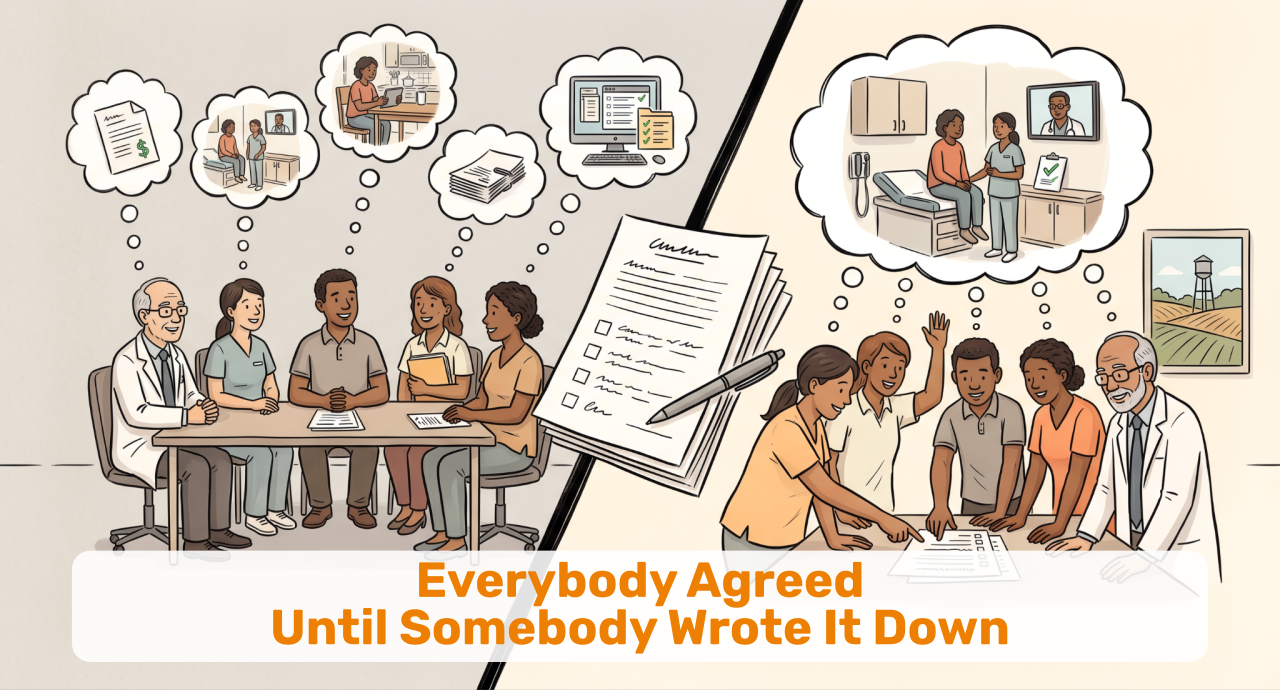
A compelling destination does two things simultaneously: it gives the rational mind (the Rider) something to navigate toward, and it gives the emotional side (the Elephant) something to want. But the Switch framework reminds us that the emotional connection is the more powerful of the two.
A vivid, human picture of transformation — not a slide full of metrics, but a story of a patient who got the care they needed, a clinician who finally had the support they’d been asking for, a community that no longer had to choose between distance and access — is what moves Elephants.
For virtual specialty consults, the end in mind is not “increased utilization of telehealth services.” It is: “Every patient in our region who needs a neurologist can see one this week — without leaving their county.” That is a picture people can feel. And feeling it is what creates the desire to build it.
Begin with the end in mind. Then communicate that end — repeatedly, visibly, and emotionally — to everyone who needs to make a choice about whether to support the change.
Switch connection: Point to the Destination + Find the Feeling — the destination must be both clear and emotionally resonant to engage both the Rider and the Elephant. ADKAR connection: Awareness + Desire — a vivid, human destination answers “why are we doing this?” and “why do I want to be part of it?” simultaneously.
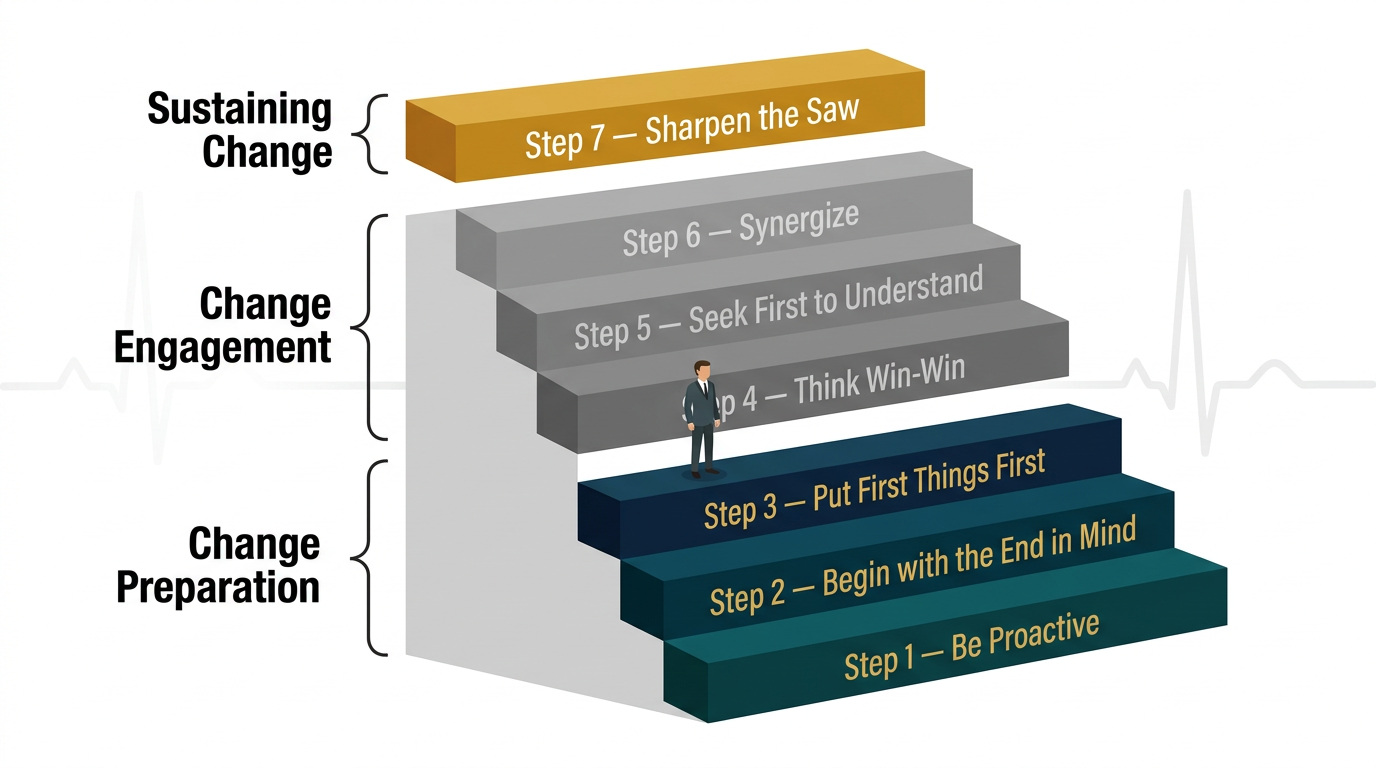
Habit 3 — Put First Things First
Sequence Your Priorities Deliberately
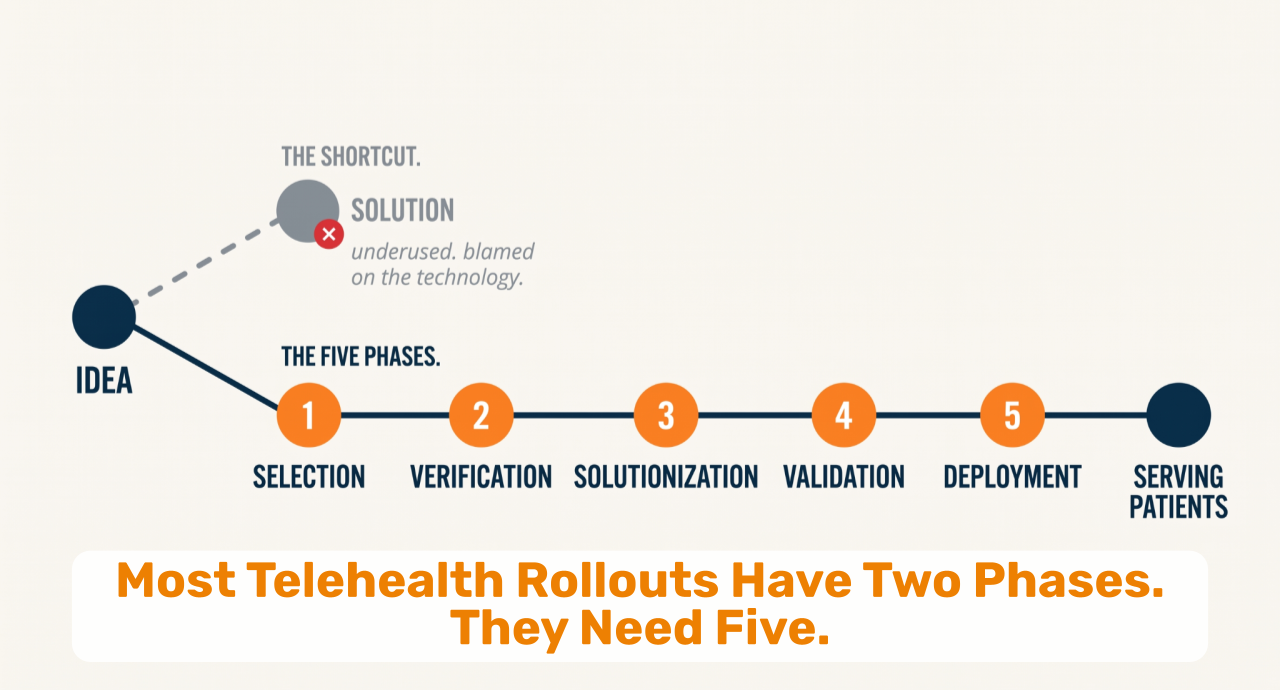
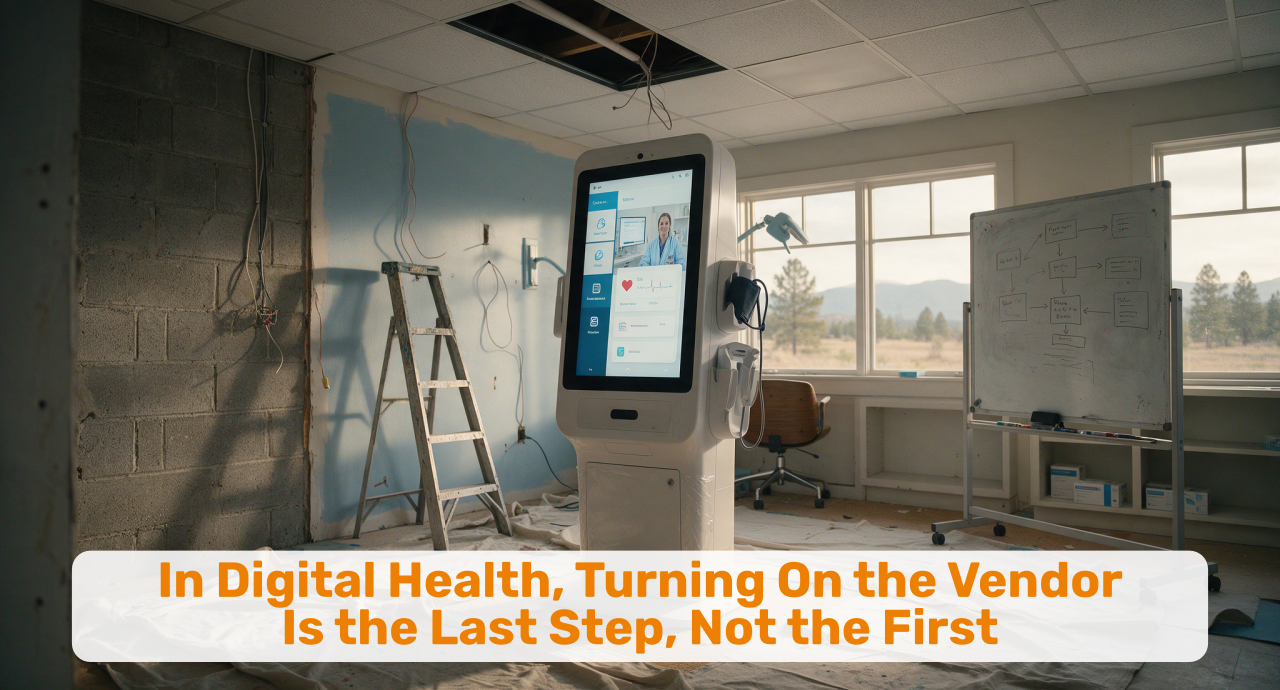
The third habit is about prioritization — doing what matters most before what seems most urgent. In RHTP implementation, the most common violation of this habit is starting with technology selection before the human and process infrastructure is in place.
Two questions must be answered before any technology decision is made: Who needs to be engaged, and in what order? And what does the current process actually look like?
On the people side: not everyone needs to be informed at the same time, in the same way, or with the same level of detail. Mapping stakeholders by influence and readiness — who are the early adopters, the fence-sitters, the potential resistors, the essential decision-makers — allows you to sequence your Awareness-building deliberately. Start with those whose buy-in is essential before the project can proceed. Build outward from there.
On the process side: before designing new workflows, the existing ones must be mapped, understood, and respected. What are staff already doing? Where are the workarounds? What are the informal processes that keep things running? New services built on top of understood processes have a dramatically higher adoption rate than those that arrive as replacements for workflows nobody bothered to learn.
Switch connection: Shape the Path — understanding and building on existing processes makes the new behavior easier, not harder. ADKAR connection: Awareness — knowing who needs to be engaged and when is the foundation of a deliberate Awareness strategy.
Preparation Is the Work
These first three habits share a common thread: they are all about preparation. About what you, as an effective manager of change, can do.
Proactively mapping resistance before it hardens. Painting a destination vivid enough to create genuine desire. Sequencing your priorities so that people and processes come before technology.
None of this is highly visible work. It happens before the kickoff meeting, before the vendor demo, before the training session. But it is the work that determines whether everything that follows will land on solid ground or shifting sand.
Next week, we turn to the interpersonal habits of Covey’s framework — the disciplines of engaging, listening, co-creating, and sustaining the people whose hands, hearts, and minds will ultimately determine whether your RHTP transformation succeeds.
Because preparing well is necessary. But it is not sufficient. Change does not happen in a plan. It happens in people.
Christian Milaster and his team at Ingenium Digital Health Advisors help rural healthcare organizations build the implementation capability, including the mastery of change management, to turn RHTP funding into lasting outcomes. Connect with Christian at ingeniumdigitalhealth.com.

To receive articles like these in your Inbox every week, you can subscribe to Christian’s Telehealth Tuesday Newsletter.
Christian Milaster and his team optimize Telehealth Services for health systems and physician practices. Christian is the Founder and President of Ingenium Digital Health Advisors where he and his expert consortium partner with healthcare leaders to enable the delivery of extraordinary care.
Contact Christian by phone or text at 657-464-3648, via email, or video chat.